
Coffee statistics get repeated long after they stop being true. A trade ranking from the 1970s, a caffeine claim that only works per ounce, and survey numbers with the date quietly dropped all turn up in articles written this year. This page collects coffee and espresso numbers traced back to a primary source.
Every figure below links to its source: the National Coffee Association (NCA) consumer surveys, nutrient data from the U.S. Department of Agriculture (USDA), the Bureau of Labor Statistics (BLS), USDA and International Coffee Organization (ICO) market reports, and peer-reviewed studies. After that come four claims about coffee that the sources don't support.
Quick take: 66% of American adults drank coffee yesterday, and 47% had an espresso drink in the past week. A pound of ground coffee cost $9.30 in August 2026, more than double the August 2020 price. A single shot of espresso has about 63 mg of caffeine, less than an 8-ounce cup of drip. And coffee isn't the world's second most traded commodity, whatever you've read.
Coffee statistics at a glance
Each row is explained further down, including who was surveyed and what period the numbers cover.
How many Americans drink coffee
The standard U.S. coffee statistics come from the National Coffee Association's National Coffee Data Trends survey, run twice a year by Dig Insights. The latest edition surveyed 1,882 adults online from June 8 to 24, 2026, all of whom had drunk something other than tap water the day before.
In that survey, 66% of American adults drank coffee in the past day, unchanged from its January 2026 survey. NCA reports coffee is still the most popular drink among American adults. 48% had specialty coffee in the past day, which NCA called a new record.
Most of that coffee is made at home. 83% of past-day coffee drinkers had coffee at home, while 38% had some away from home, the highest share since January 2020. Among people who bought coffee out in the past week, 40% ordered on an app, another record. 21% of past-day drinkers had cold coffee.
Espresso statistics
Espresso drinks keep gaining ground in NCA's coffee statistics. NCA's June 2026 survey found 47% of American adults had an espresso-based drink in the past week. Its January 2026 survey put the figure at 45%, up from 40% in 2022, with lattes alone rising from 17% to 21% over the same period.
Younger adults lead the shift. In NCA's 2026 specialty coffee report, produced with the Specialty Coffee Association, 69% of 25- to 39-year-olds had specialty coffee in the past week.
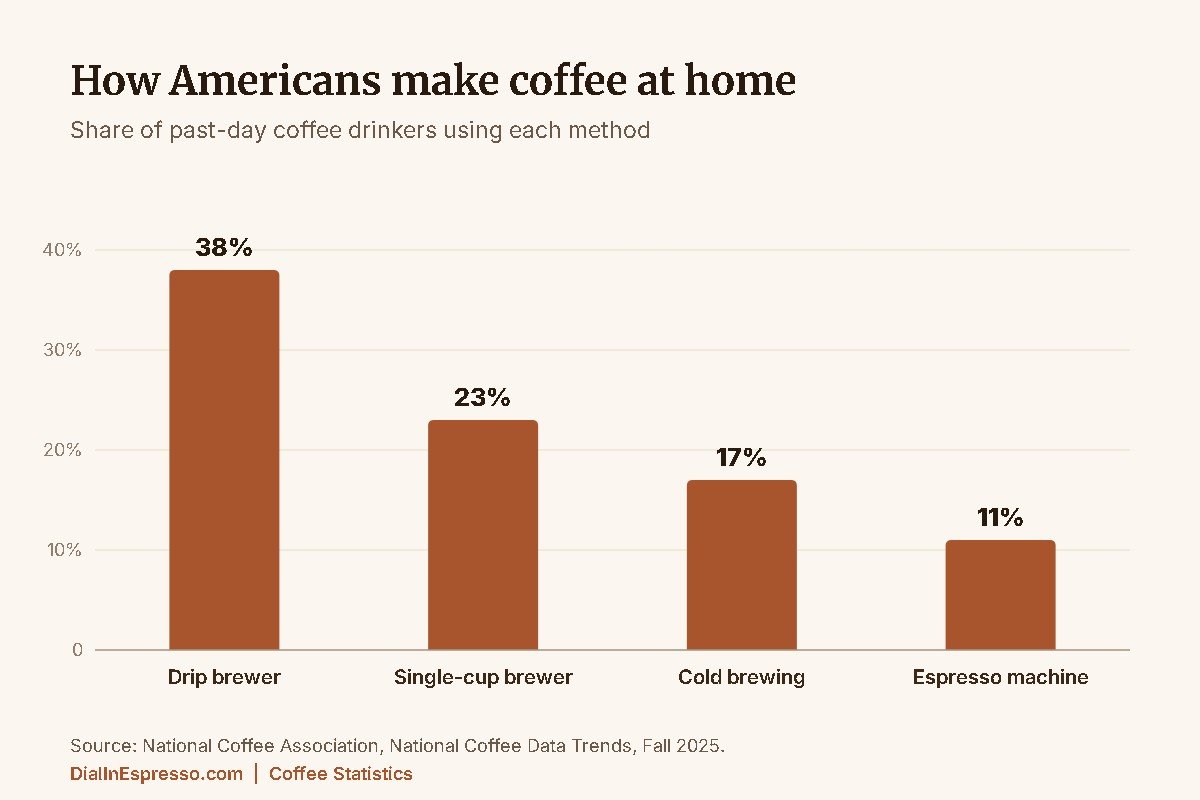
Home espresso is still a niche. In NCA's Fall 2025 survey, 11% of past-day coffee drinkers had coffee made on an espresso machine, compared with 38% for drip brewers, 23% for single-cup brewers and 17% for cold brewing. If you're thinking about joining that 11%, our espresso machine buying guide covers what to look for.
Caffeine statistics
The FDA says 400 mg of caffeine a day is an amount not generally associated with negative effects for most healthy adults. It describes that as about two to three 12-ounce cups of coffee.
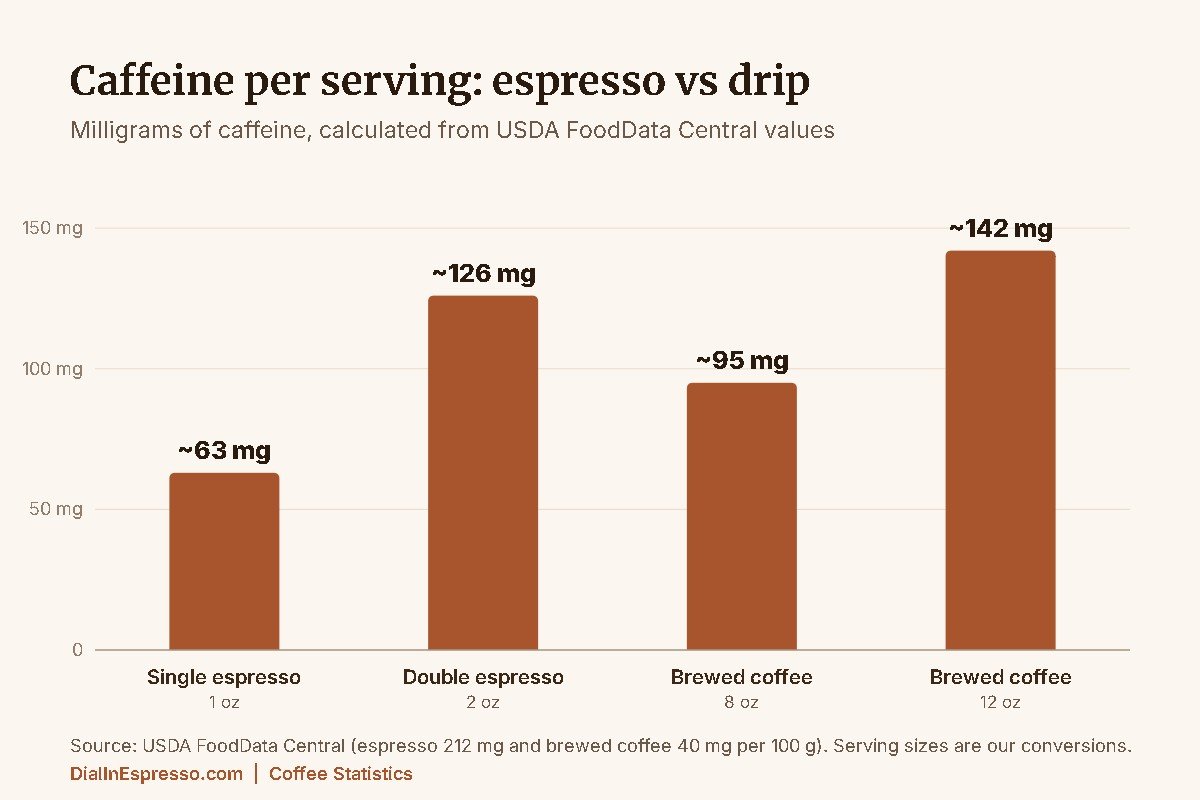
For the coffee itself, the most reliable per-serving coffee statistics come from USDA FoodData Central. Restaurant-prepared espresso has 212 mg of caffeine per 100 grams, and brewed coffee has 40 mg per 100 grams. Converted to normal servings, a single 1-ounce shot has about 63 mg, a double about 126 mg, an 8-ounce cup of drip about 95 mg, and a 12-ounce cup about 142 mg. Those serving numbers are our conversions from USDA's per-gram values.
Real shots vary a lot by bean, dose, and basket size. Our guide to how much caffeine is in a shot of espresso goes through the range.
Coffee price statistics
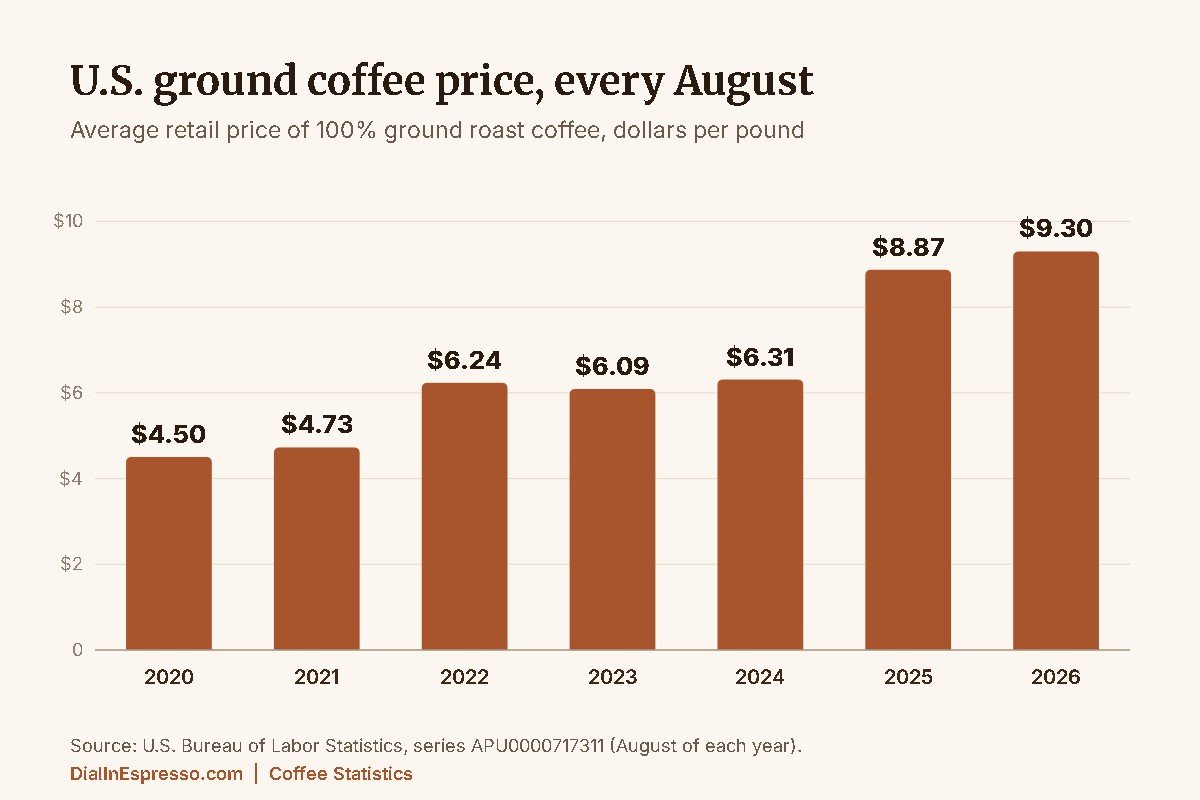
Coffee prices have changed more than any other number on this page in the last few years. The Bureau of Labor Statistics tracks the average U.S. retail price of 100% ground roast coffee every month. In August 2026, it was $9.299 a pound, up 4.8% from $8.872 a year earlier.
The longer view is starker. The same BLS series, as republished by FRED (the St. Louis Federal Reserve's economic data site), shows $4.504 a pound in August 2020, so the price has more than doubled in six years. Most of the jump came between August 2024 ($6.311) and August 2025.
That's one reason more people are pricing out home espresso. Our breakdown of what an espresso machine costs covers the full range.
World coffee production and consumption
Global coffee statistics usually come from USDA's Foreign Agricultural Service. Its July 2026 Coffee: World Markets and Trade report forecasts world production for 2026/27 at a record 189.7 million 60-kilogram bags, up 10.8 million bags from the year before. It expects global consumption to reach a record 179.7 million bags, with the largest gains in the European Union and the United States.
The International Coffee Organization measures things slightly differently. Its August 2026 market report puts world coffee consumption for 2024/25 at 182.2 million bags, up 4.3% from the year before. The two organizations use different crop years and methods, so their totals don't line up exactly.
Coffee is also big business at home. NCA's most recent economic impact study, based on 2022 data, put the total U.S. economic impact of the coffee industry at $343.2 billion.
Four coffee myths the sources don't support
These coffee statistics and claims come up constantly in articles, cafe menus, and break room debates. Here's what the primary sources say.
Myth 1: Coffee is the second most traded commodity in the world
The International Trade Centre, the joint trade agency of the United Nations and the World Trade Organization, calls this little more than a myth. It says the claim may have been true in the 1960s and 1970s, but green coffee trade doesn't make today's top five by value or volume.
Myth 2: Espresso has more caffeine than regular coffee
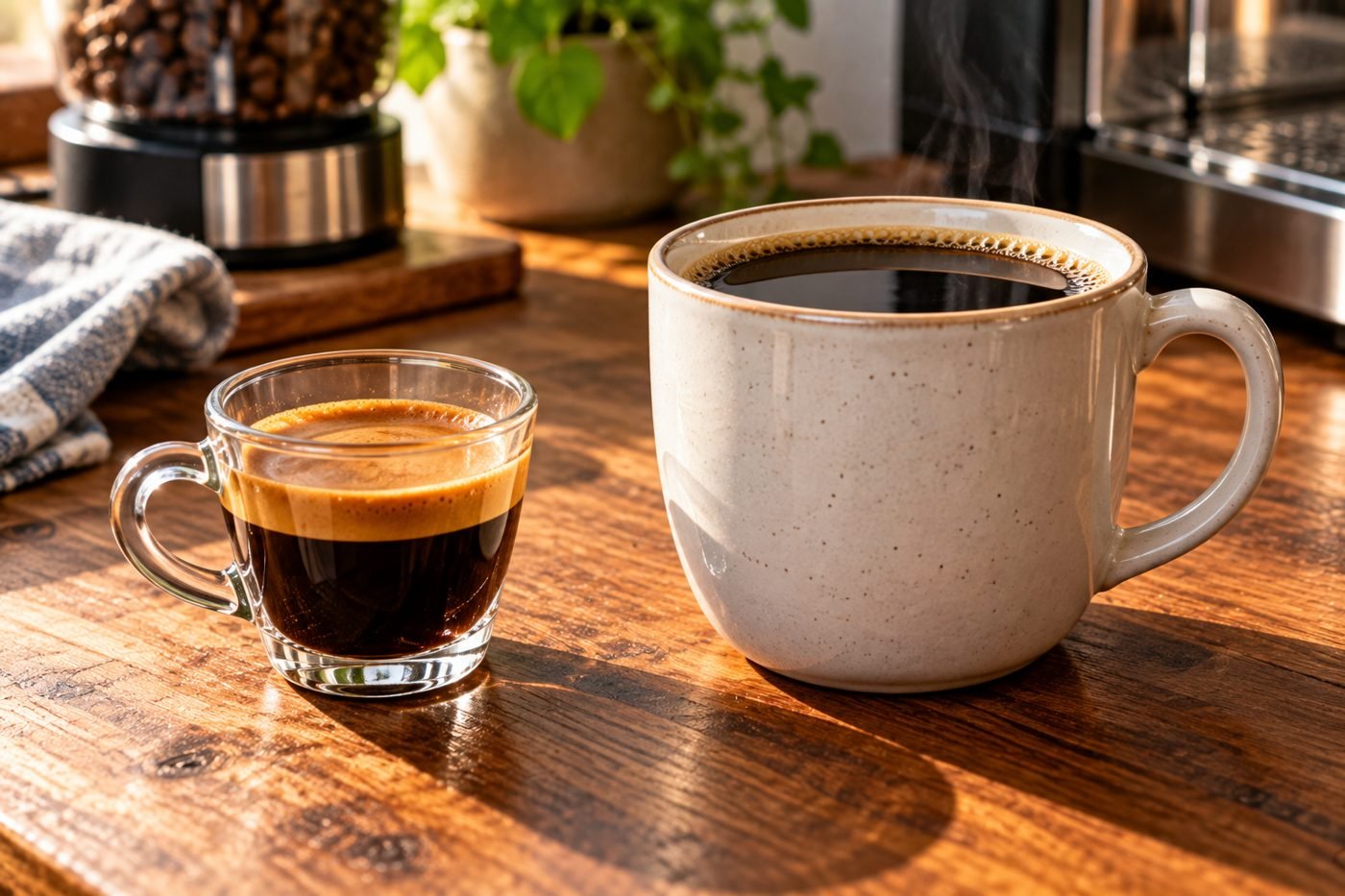
Per ounce, yes. Espresso has about five times the caffeine of brewed coffee by weight in USDA data. Per serving, no. A single shot has about 63 mg, while an 8-ounce cup of drip has about 95 mg. Only a double shot, at about 126 mg, beats a standard cup, and a 12-ounce cup of drip still beats the double.
Myth 3: Dark roast has more caffeine
Usually the opposite. A 2024 study in Scientific Reports by Lindsey and colleagues brewed coffees at five roast levels under identical conditions and found caffeine was generally lower in dark roasts than in light and medium roasts. The picture flips only when extraction yield is held constant, which isn't how most people brew.
Myth 4: Coffee dehydrates you
Not at normal amounts. In a 2014 study in PLOS ONE, Killer, Blannin and Jeukendrup had 50 men who were regular coffee drinkers drink four cups of coffee a day for three days, then water for three days. The researchers found no meaningful difference in hydration and concluded that coffee in moderation provides similar hydrating qualities to water. The study only included men.
How we checked these coffee statistics
For each figure, we went to the primary source: NCA's own survey releases, USDA FoodData Central, the BLS price series, the USDA and ICO market reports, and the published studies. We note the period each number covers and who was surveyed, and we label our own calculations. Where a number only appeared in secondary sources or paid market research, we left it out. That includes the popular claim that Americans drink 400 million cups of coffee a day, which we couldn't trace to any primary source.
Last checked: September 28, 2026. We'll update this page when NCA publishes its next survey or BLS prices move meaningfully.
Using these statistics
You're welcome to use any figure or chart on this page in an article, report or presentation. Please link to the primary source for the number and to this page as the place you found it. Suggested citation: DialInEspresso, "Coffee Statistics: 16 Verified Numbers and 4 Myths," dialinespresso.com/coffee-statistics/, September 2026.
Coffee statistics FAQ
What percentage of Americans drink coffee every day?
66% of American adults drank coffee in the past day in NCA's June 2026 survey. That was unchanged from NCA's January 2026 survey.
How many Americans drink espresso?
47% of American adults had an espresso-based drink in the past week, according to NCA's June 2026 survey, up from 40% in 2022.
How much caffeine is in espresso compared to coffee?
A single 1-ounce shot has about 63 mg and an 8-ounce cup of brewed coffee about 95 mg, based on USDA data. Espresso is stronger per ounce but usually has less caffeine per serving.
How much does a pound of coffee cost?
The average U.S. price of ground roast coffee was $9.299 a pound in August 2026, according to BLS, up from $4.504 in August 2020.
How much coffee does the world produce?
USDA forecasts a record 189.7 million 60-kilogram bags for 2026/27.
This guide is part of the Beginner's Essentials hub, which brings together our guides on getting started with espresso at home.