
Dialing In & Technique
"Dialing in" just means adjusting your variables until the shot tastes right, but the variables behind it are rarely explained. It comes down to three numbers you control directly: how much coffee goes in, how much espresso comes out, and how finely it's ground. This hub walks through each one.
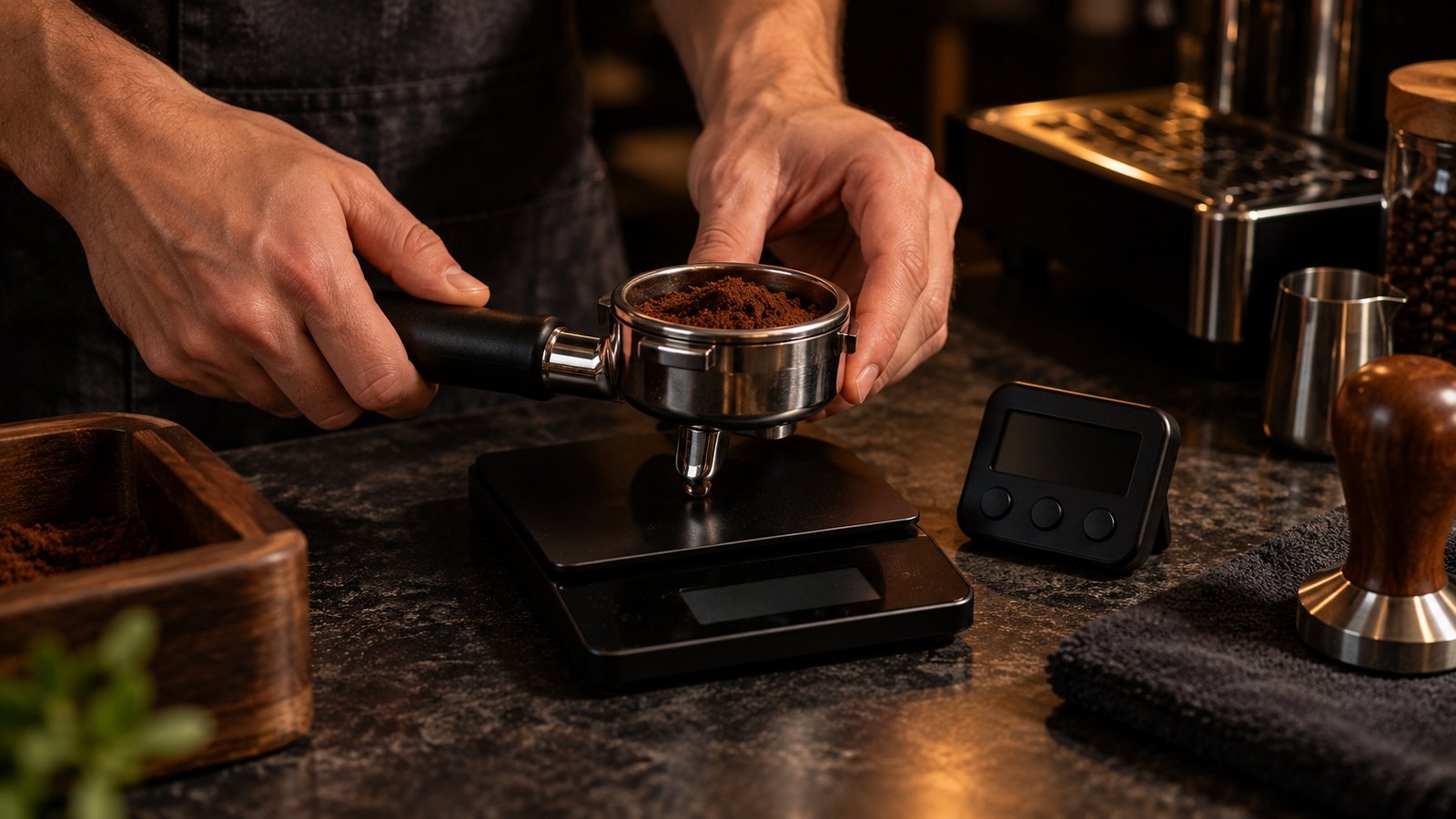
Every new bag of coffee needs a little dialing in, even on a machine you know well. Roast level, bean age and even the weather change how a coffee behaves, so the grind that worked last week may not work today. The good news is that the method stays the same. Once you learn it, a new bag usually takes three or four shots to get right.
This page covers the method from start to finish. Read it top to bottom the first time, then use the guides further down when you want to go deeper on one step.
The three numbers you control when you dial in
| Number | What it is | Common starting point | What changing it does |
|---|---|---|---|
| Dose | Dry coffee in the basket, in grams | Whatever your basket is made for, often 18 g in a double basket | Sets the size of the puck. Too little gives a wet, soupy puck. Too much presses the puck against the shower screen. |
| Yield | Espresso in the cup, weighed in grams | Twice the dose, so 36 g out from 18 g in (a 1:2 ratio) | More yield makes a lighter, longer shot. Less yield makes a thicker, more intense one. |
| Grind | How fine the coffee is ground | Fine enough that a 1:2 shot runs about 25 to 35 seconds | Finer slows the shot and pulls out more flavor. Coarser speeds it up and pulls out less. |
Shot time is the check, not a setting. You do not set the time directly. It is the result of the dose, yield and grind together, and it tells you whether those three are close. A 1:2 shot in roughly 25 to 35 seconds is the usual target. Lighter roasts can run longer and still taste good, so treat the window as a guide, not a rule.
Weigh, do not guess. A small kitchen scale that reads to 0.1 g is the single most useful tool for dialing in. Eyeballing the yield in a shot glass can be off by several grams, which is enough to change the taste.
More detail: espresso brew ratio explained and espresso extraction time.
How to dial in a new bag, step by step
- Lock in your dose. Pick the dose your basket is made for and keep it the same for the whole session. Changing dose and grind at the same time makes it hard to tell which change did what.
- Pull a first shot at 1:2. Stop the shot when the cup reaches twice your dose, for example 36 g from 18 g. Note the time.
- Adjust the grind to land in the window. If the shot ran well under 25 seconds, grind finer. If it ran well past 35 seconds, grind coarser. Move in small steps, one notch on a stepped grinder or a small turn on a stepless one.
- Taste, then fine tune the ratio. Once the time is in range, let taste decide. Sour and thin usually means pull a little more yield, such as 40 g. Harsh and bitter usually means pull a little less, such as 32 g.
- Change one thing at a time. Grind or yield, never both on the same shot. Write down each shot: dose, yield, time and one word on taste. Three or four logged shots usually tell you where the coffee wants to be.
- Stop when it tastes good. The goal is a sweet, balanced shot, not a perfect number. If the shot tastes right at 38 seconds, it is right.
If nothing you change seems to help, the coffee itself may be the problem, such as very old beans. Before you change anything else, try a fresh bag.
Puck prep affects every step above, so see espresso tamping and distribution. The full walkthrough is in how to dial in espresso.
Reading the shot: taste and time point to the fix
Taste tells you what is wrong. Time tells you why. Read them together.
| What you taste | Shot time | What it usually means | First fix |
|---|---|---|---|
| Sour, sharp, thin, hits the front of the tongue | Fast, under about 20 to 25 s | Under-extracted. Water ran through too quickly. | Grind finer |
| Sour but the time looks normal | 25 to 35 s | Ratio too short for this coffee | Pull a little more yield |
| Bitter, harsh, dry finish that lingers | Slow, past about 35 to 40 s | Over-extracted. Water spent too long in the coffee. | Grind coarser |
| Bitter but the time looks normal | 25 to 35 s | Ratio too long for this coffee | Pull a little less yield |
| Sour and bitter at once, very fast, spraying | Very fast | Water is finding a channel through the puck | Fix puck prep, not grind |
| Different every shot with the same settings | Varies | Inconsistent prep or dose | Weigh every dose and keep prep the same |
Sour and bitter are easy to mix up at first. Sour is a sharp, lemony bite near the start of the sip. Bitter shows up at the end, as a dry, harsh aftertaste. The espresso taste map walks through both with examples.
For each problem in more depth, see why is my espresso bitter, espresso channeling and inconsistent espresso shots.
When it is not your technique
Most bad shots come from dose, yield, grind or puck prep. A few signs point somewhere else:
- You cannot grind fine enough. If the shot still runs fast at your grinder's finest setting, the grinder may not be built for espresso, or the burrs may need cleaning or replacing.
- Every coffee tastes flat or stale. Beans past their best lose the gases and oils that make crema and sweetness. Check the roast date on the bag.
- The machine has slowed down or runs cooler than it used to. Scale buildup inside the boiler can affect temperature and flow. See the descaling protocol.
- Shots change through the morning on the same settings. Old grounds held inside the grinder can mix into each new dose. See espresso grinder maintenance.
To work out which side the problem is on, see technique or equipment. When a shot goes wrong, the Troubleshooting hub covers each problem in detail.
Where these numbers come from: Dialling In Basics (espressoaf.com) and Dialing In Espresso By Taste (Clive Coffee).
Start with how dialing in works
All five technique guides are live: how dialing in works, brew ratio, extraction time, tamping and distribution, and reading the taste map back to the cause.
Visit Beginner's Essentials →Guides are researched from manufacturer manuals, roaster guidance and published coffee science. No sponsorships, no paid placements.