
Equipment Care & Maintenance
Espresso machines fail early for one reason more than any other: mineral buildup and old coffee oils left to accumulate. None of the routine upkeep takes long, but it has to happen on schedule. This hub lays out what to do daily, weekly, monthly, and every few months to keep a machine running for years instead of a couple of seasons.
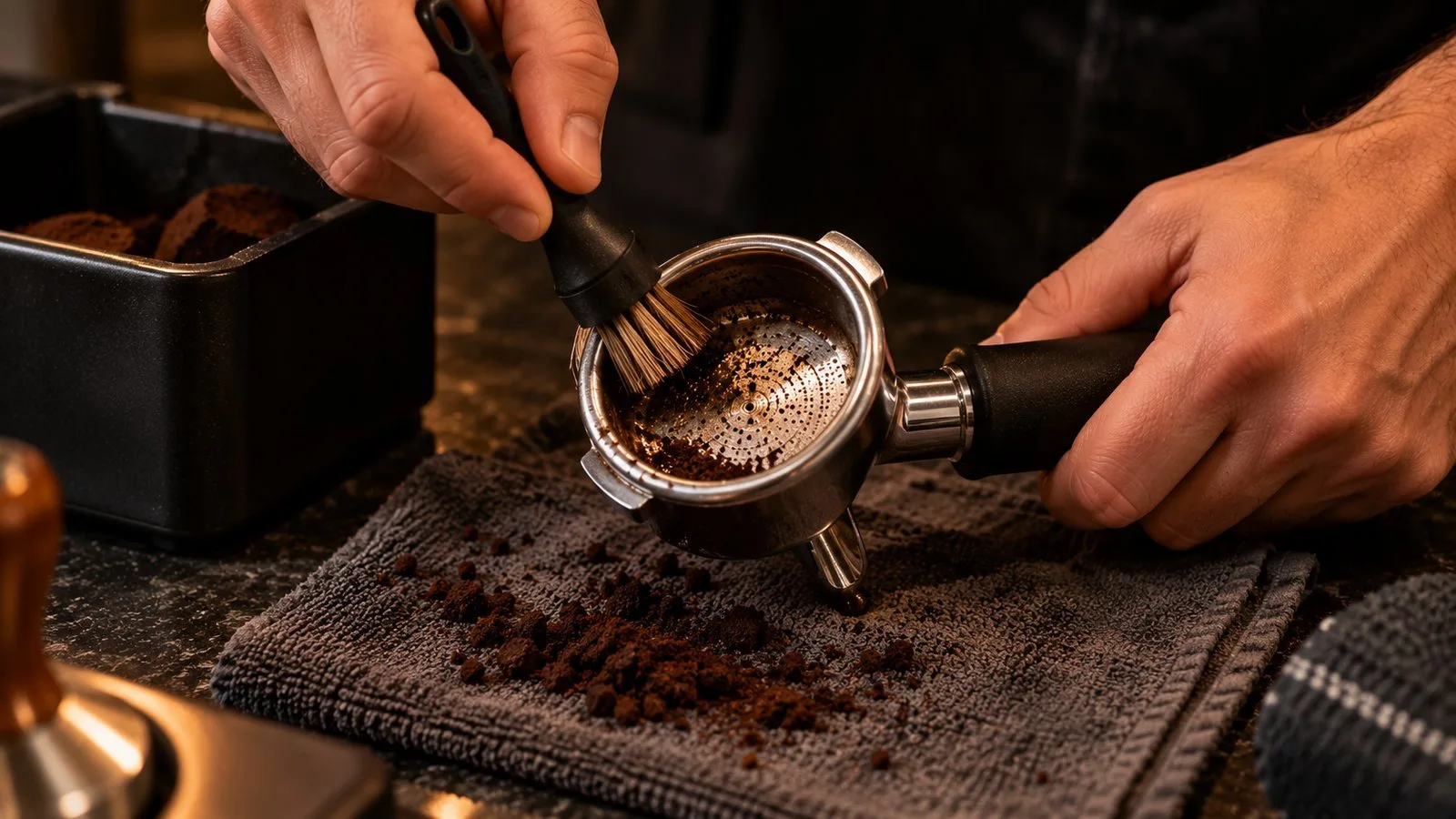
How to keep an espresso machine and grinder working
An espresso machine needs two kinds of cleaning. Coffee oils build up where the coffee touches the machine: the group head, the shower screen, the baskets and the grinder burrs. Minerals from the water build up inside, in the boiler or thermoblock and the pipes. The first is cleaned often, with water, brushes and a coffee detergent. The second is removed now and then with a descaler, on a schedule set by your water.
The two jobs use different products. Clive Coffee is clear on this: backflushing removes coffee oils, not scale, and descaling solution is not a backflush cleaner.
This guide brings together what machine makers, retailers and service guides recommend. Where their numbers differ, it says so and names who said what. Your own machine's manual comes first. If it gives a different interval, follow it.
| How often | Task | Source |
|---|---|---|
| Daily, after each session | Purge and wipe the steam wand after every milk drink. Wipe the outside of the machine. | Seattle Coffee Gear |
| Daily, after each session | Backflush with plain water (machines with a three-way valve). Clive Coffee suggests about 10 seconds on, then off, 2 or 3 times. Breville recommends a clear water backflush after each brewing session on the Barista Express. | Clive Coffee, Breville |
| Weekly | Brush out the grinder and empty the hopper. | Seattle Coffee Gear |
| Weekly to monthly | Backflush with a coffee machine detergent such as Cafiza. Seattle Coffee Gear and Anthony's Espresso say weekly for home use. Clive Coffee says every two weeks to a month, weekly if you pull four or more shots a day, and every 1 to 2 months on an E61 group. | Seattle Coffee Gear, Anthony's Espresso, Clive Coffee |
| Monthly | Soak the steam wand tip in cleaner. Run grinder cleaning tablets if you grind espresso daily. | Seattle Coffee Gear |
| Every 3 to 6 months | Take the burrs out and brush them clean. | Seattle Coffee Gear |
| As needed | Descale. De'Longhi suggests about every 200 uses on its pump machines, sooner or later depending on water hardness, or when the descale light comes on. | De'Longhi |
| As needed, about yearly | Replace the group gasket every 12 to 18 months, or sooner if the portafilter locks past center. Replace the shower screen when it is clogged, pitted or warped, roughly once a year for most home users. While the group is apart, give the shower screen and dispersion plate a quick soak in group head cleaner. | Clive Coffee |
Backflushing
Backflushing pushes water back through the group head and out through the valve into the drip tray. It clears coffee oil and fine grounds from parts you can't reach with a brush. You need a blind basket, which is a basket with no holes.
For a plain water flush on a machine with a three-way valve, Clive Coffee's routine is about 10 seconds on, then off, 2 or 3 times. For a detergent flush, Anthony's Espresso runs about a quarter teaspoon of Cafiza, 10 seconds on and 10 seconds off, 5 or 6 times, then rinses with several plain water flushes and a throwaway shot before drinking any espresso.
What not to use. Use a cleaner made for espresso machines. Dish soap, baking soda, vinegar and descaling solution are all wrong for backflushing. Seattle Coffee Gear adds that dish detergent and vinegar will make your espresso taste bad.
Check your machine. Not every machine has a three-way solenoid valve, and backflushing a machine without one can push water where it shouldn't go. If you're not sure, check your manual before you start.
For more detail, read the weekly backflushing guide.
Descaling and water hardness
Scale forms from minerals in your water, not from coffee, and it builds up inside the boiler or thermoblock and the internal plumbing where you can't see it. How often you need to descale depends on how hard your water is and how much you use the machine.
| Water | Hardness (mg/L) | What it means for descaling |
|---|---|---|
| Soft | 0 to 60 | Scale builds slowly. Descale less often. |
| Moderately hard | 61 to 120 | Scale builds at a moderate rate. |
| Hard | 121 to 180 | Scale builds faster. Descale more often. |
| Very hard | More than 180 | Descale often, and consider a filter rated to reduce hardness. |
Work out your own interval. The Espresso Descaling Calculator takes your water hardness, shots per day and whether you use a filter rated to reduce hardness, and gives a planning interval for your next descale. It is an estimate, not a rule. If your machine has a built-in descale alert that tracks water volume, follow the alert instead.
Scale can still build when you use filtered water. The descaling protocol guide explains why.
Grinder cleaning
Coffee oil and old grounds collect on the burrs and in the chute. Over time they go stale and can flavor every dose. Seattle Coffee Gear sets out a weekly brush-out, with a deeper clean on its own schedule.
- Monthly, if you grind espresso daily: run grinder cleaning tablets such as Grindz to lift oil. Then grind 20 to 30 grams of beans to clear the residue, and throw both away.
- Every 3 to 6 months: take the burrs out and brush them clean. Don't use water on steel burrs. It can cause rust.
Signs something needs attention now
These are not on a fixed schedule. Watch for them between the routine tasks above.
| What you notice | What it usually points to | What to do |
|---|---|---|
| The descale light is on | The machine has reached the period of use set by your water hardness | Descale with the maker's product |
| Coffee weeps from the edge of the group during a shot | A worn group gasket | Replace the gasket |
| The portafilter locks past the 6 o'clock position | A worn group gasket | Replace the gasket |
| Shots have started tasting flat | Gasket wear is one common cause | Check the gasket, then the shower screen |
| The shower screen looks clogged, pitted or warped | A screen past its life | Clean it, or replace it |
| Stale or rancid taste even with fresh beans | Old oil and grounds in the grinder | Clean the grinder |
| New clumping, or slower grinding | Buildup in the grinder | Brush out and clean the burrs |
Sources: Clive Coffee, Seattle Coffee Gear, Anthony's Espresso, Whole Latte Love, De'Longhi, Breville and the U.S. Geological Survey.
Daily Maintenance
You want the full routine in one place, starting with the few minutes of daily care.
Weekly Backflushing
Your machine has a three-way valve and you're ready to backflush with detergent.
Find your descaling interval
Six guides covering the full routine, from the daily five-minute habits to figuring out exactly when to descale for your own water.
Use the Descaling Calculator →Guides are researched from manufacturer manuals, roaster guidance and published coffee science. No sponsorships, no paid placements.