
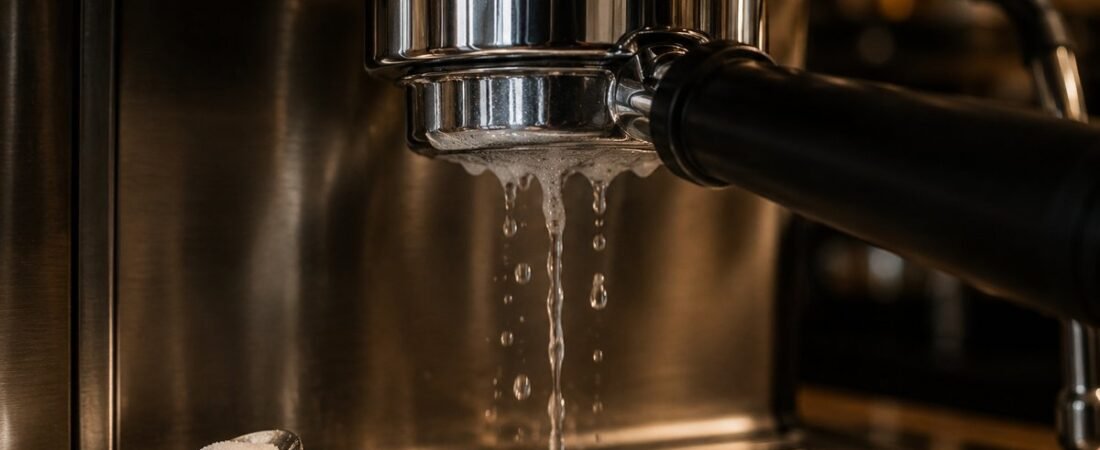
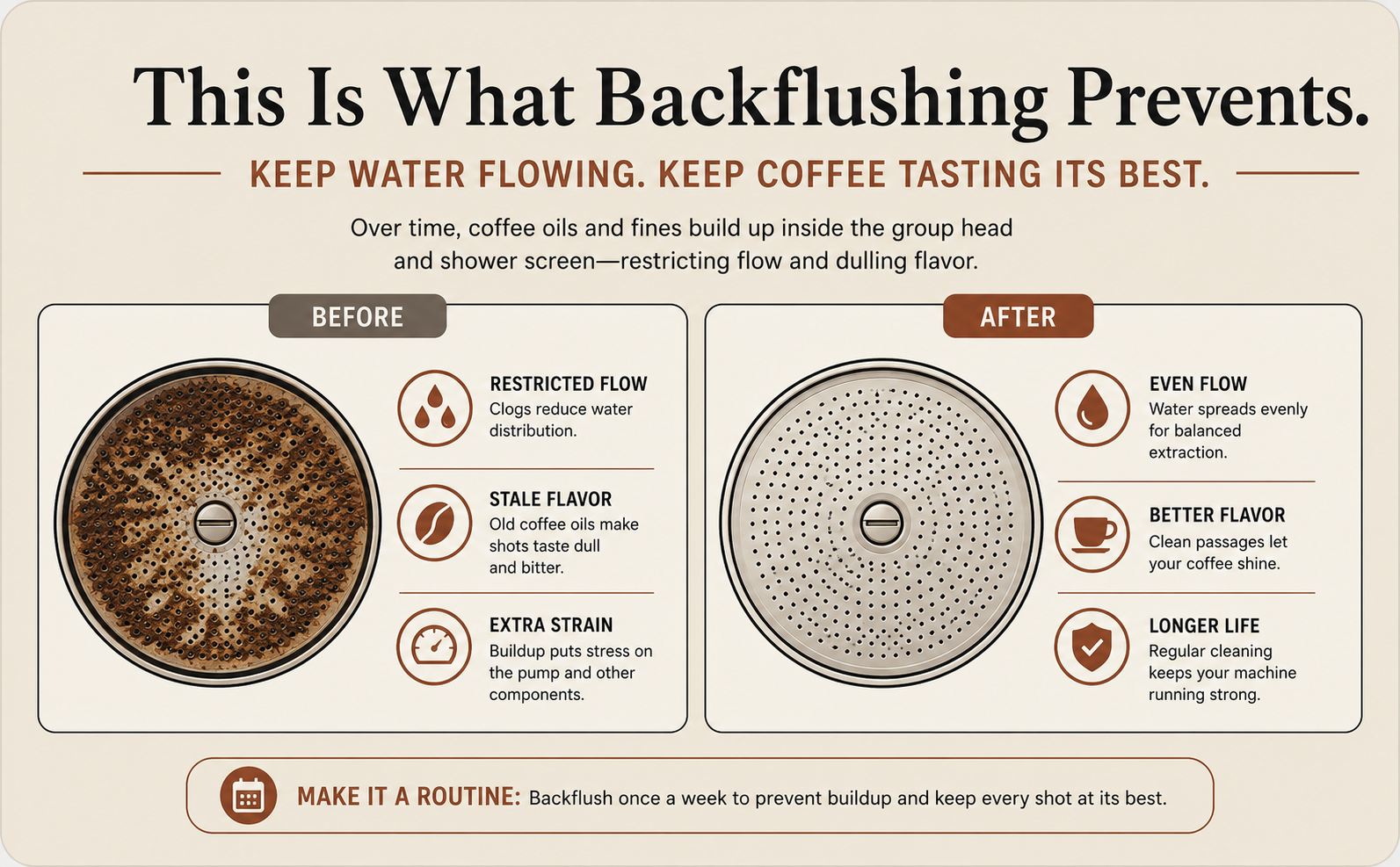
Your machine can look spotless and still be dirty in the one place you can’t see: inside the group head, behind the shower screen, in the passages the 3-way valve uses to relieve pressure after every shot. Every extraction leaves behind a thin film of coffee oil, and that oil doesn’t rinse away on its own. It oxidizes, hardens, and builds up in layers over weeks and months, quietly turning into the source of a bitter, muddy taste that no amount of dialing in will fix. The problem isn’t your grind or your beans; it’s residue from shots you pulled two months ago.
Backflushing lets you remove that residue without taking the machine apart. It’s also one of the few maintenance habits with a real safety catch: it’s only safe on machines built for it, and doing it on the wrong machine can cause damage instead of preventing it. Here’s how to tell which kind you have, and exactly how to do it right.
The First Question: Does Your Machine Have a 3-Way Solenoid Valve?
Get this detail right before anything else, because it determines whether you should backflush at all.
A 3-way solenoid valve is what makes backflushing possible. After a normal shot, this valve opens a path that releases the pressure trapped in the group head and lets a small amount of water drain back into the drip tray. You’ll typically hear a brief hiss and see a little water run out after the pump stops.
When you lock in a blind basket (a solid disk with no holes, standing in for a normal filter basket) and run the machine, that same valve reverses the flow: instead of water pushing down through coffee, it pushes back up through the group and out through the valve, carrying dissolved oils with it. That reverse path only exists because the 3-way valve is built to handle it.
Machines without a 3-way valve- many entry-level and single-boiler machines, most super-automatics, and lever machines- don’t have that release path. If you force a backflush on one of these, the water and pressure have nowhere safe to go, which can damage seals or internal components instead of cleaning anything.
If you’re not sure which kind you have, check the machine’s spec sheet or manual for “3-way solenoid valve,” or ask the manufacturer directly before you try this. Most mid-range and prosumer machines with a single group and a portafilter (as opposed to a pod or capsule system) do have one, but it’s genuinely worth confirming rather than assuming.
If your machine doesn’t have a 3-way valve, you’re not out of options. You just maintain it differently. Soak the shower screen, basket, and portafilter regularly in a cleaning solution instead, and skip backflushing entirely.
Water vs. Detergent: Two Different Jobs
Once you’ve confirmed your machine can handle it, backflushing splits into two routines that do different work.
Plain water backflushing clears loose grounds and fresh oil before they sit and oxidize. It’s quick, low-effort, and worth doing after your last shot of the day if you use the machine daily. Some home baristas do it every session; others manage it a few times a week. Either is fine; the point is catching residue while it’s still fresh and easy to move.
Detergent backflushing is the deeper clean, and it’s the one this guide is really about. Plain water can’t touch oil that’s already oxidized and baked onto the shower screen and valve. That takes an actual cleaning agent, typically a coffee-safe cleaner like Cafiza, Puly Caff, or a similar product sold specifically for espresso machines. For most home setups running one to three shots a day, once a week is the right cadence. If you’re pulling more shots than that, or running darker, oilier roasts that leave heavier residue, every other week or more frequent detergent backflushing keeps up better than stretching it to once a month.
Never substitute dish soap, all-purpose cleaner, or anything not labeled for espresso machines. The wrong chemical can leave residue or damage seals, which defeats the purpose.
The Weekly Detergent Backflush, Step by Step
- Insert the blind basket into your portafilter in place of your normal basket.
- Add cleaner. Add about a half teaspoon (roughly 2-3 grams) of an espresso-safe backflushing detergent directly into the blind basket. More isn’t better. Too much can leave its own residue or, in some machines, clog internal parts.
- Lock the portafilter into the group head, fully seated, as you would for a normal shot.
- Run the brew cycle for about 10 seconds, then stop and let the pressure release before starting the next cycle. Repeat this 5 to 8 times. You’re pulsing the machine, not holding it on continuously. The on-off cycle is what drives the detergent solution through the passages and back out.
- Remove the portafilter and rinse the blind basket thoroughly under running water to clear out the detergent.
- Repeat the same pulsing cycle with a clean, detergent-free blind basket, another 5 to 8 short cycles, to flush out any remaining cleaner residue from the group.
- Swap back to your normal basket, run a full shot, and discard it. This clears the last traces of detergent from the group before you pull anything you’ll actually drink.
- While you’re in there, it’s worth pulling the shower screen and giving it a quick rinse or brush if it’s due, since backflushing loosens debris around it but doesn’t always fully dislodge what’s stuck to the screen itself. That’s really a monthly deep-clean job, but a quick check here doesn’t hurt.
The whole process takes under five minutes once it’s a habit, which is exactly why it’s easy to let slide. Nothing about a normal shot tells you it’s overdue until the taste already shows it.
Signs You’ve Been Skipping It
A few tells show up before the taste turns obviously bad. Shots that taste flat, muddy, or faintly rancid even with fresh beans and a good grind are the most common sign. Oxidized oil has a distinct staleness that doesn’t respond to dialing in. A pressure gauge that builds more sluggishly than it used to, or a group head that looks fine on the outside but smells stale when you pull the portafilter, both point in the same direction. None of these are dramatic on their own, which is why buildup is easy to miss for months at a time.
Common Mistakes
Assuming a clean-looking machine doesn’t need it. The residue that matters is inside the group and valve, completely out of sight during normal use.
Backflushing a machine without first checking for a 3-way valve. This is the one mistake on this list that can actually cause damage rather than just leaving a job undone. Confirm your machine’s valve type before you start.
Using too much detergent, or the wrong detergent. More cleaner doesn’t mean cleaner; it means more residue to flush out afterward, and in some machines, a real risk of clogging.
Skipping the final water-only cycles. Detergent left in the group doesn’t just taste bad in your next shot. Repeated exposure without a proper rinse can affect gaskets over time.
Treating detergent backflushing as a substitute for the monthly deep clean. Backflushing cleans the group and valve; it doesn’t reach the shower screen, steam wand, or parts that need actual soaking. Both routines matter, each on its own schedule.
Weekly Backflushing: Putting It Together
If your machine has a 3-way solenoid valve, a weekly detergent backflush, bracketed by water-only cycles before and after, is one of the highest-payoff habits in espresso maintenance for the five minutes it costs. It’s the difference between coffee oil that gets carried out of the machine on a schedule and coffee oil that sits, oxidizes, and eventually shows up as a staleness no bean or grind adjustment can fix. If your machine doesn’t have that valve, skip this entirely and lean on regular soaking of the shower screen and basket instead. Forcing the issue on the wrong machine trades a maintenance win for a repair bill.
What to Check Out Next
Once weekly backflushing is a habit, the monthly deep clean guide covers the parts backflushing doesn’t reach. The shower screen soak, basket soak, and steam wand cleaning keep the rest of the machine in the same shape as the group head.
For how the 3-way solenoid valve fits into the rest of the brew path, Wikipedia’s overview of the espresso machine covers the group head and valve mechanics in more detail.