
Weekly backflushing cleans the group head (the part of the machine the portafilter locks into) and valve, but it doesn't reach everything. Coffee residue collects on the dispersion screen bolted to the underside of the group, in the tiny holes of your filter baskets, and around the portafilter spouts. A backflush cycle reaches none of these, because backflushing works by pushing water back through the group, not by scrubbing the parts that sit downstream of it. Milk does its own version of the same thing inside a steam wand. It bakes onto hot stainless steel within minutes of steaming and, left alone, slowly narrows the holes at the tip until your microfoam (smooth steamed milk with very tiny bubbles) gets worse for no reason you can see.
Dial In Espresso is a participant in the Amazon Services LLC Associates Program, an affiliate advertising program designed to provide a means for sites to earn advertising fees by advertising and linking to Amazon.com. As an Amazon Associate, we earn from qualifying purchases.
None of this shows up as a single dramatic failure. It shows up as espresso that tastes slightly duller than it should, or a steam wand that takes a little longer to build foam than it used to. A once-a-month deep clean catches both before they start affecting every shot.
Removing and Soaking the Shower Screen
The shower screen, sometimes called the dispersion screen, is the perforated plate the water passes through on its way into the puck (the pressed cake of coffee grounds in the basket). It's usually held on with one or two screws in the center of the group head. Most home machines let you remove it with a screwdriver, though the exact process varies enough by model that it's worth a quick check of your machine's manual before you do this for the first time. Some designs use different mounting methods. Between deep cleans, a puck screen can cut down on how much coffee sticks to it.
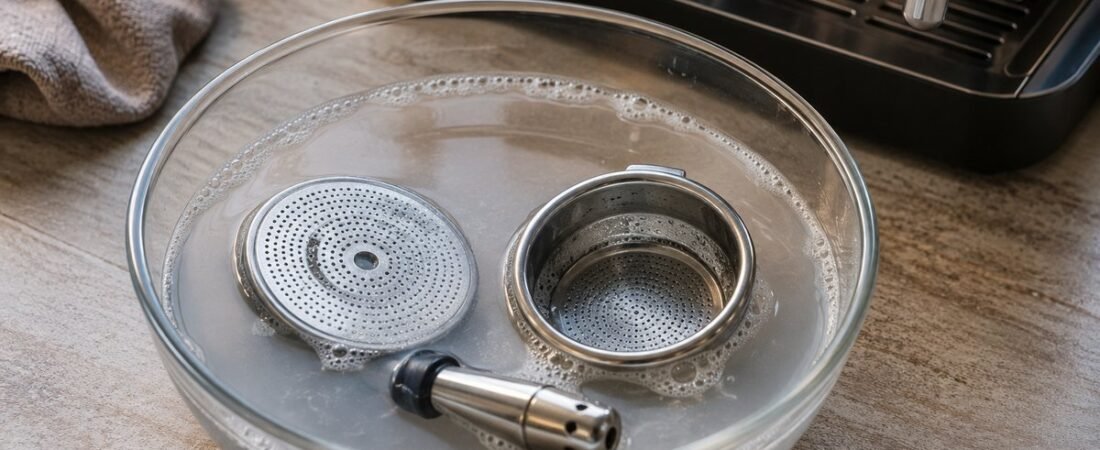
Once it's off, soak the screen in hot water mixed with an espresso-safe cleaning powder for about 30 minutes, the deep-soak time Complete Home Barista recommends for a heavily soiled screen. Cafiza and Cafetto are the two most commonly used. This loosens the baked-on oil that builds up on both sides of the screen, oil that backflushing alone never reaches because the screen sits between the group and the puck, outside the reverse-flow path. If any residue remains after soaking, scrub gently with a soft brush, rinse thoroughly, and reinstall before running the machine again.
If your shower screen isn't removable, don't force it. Instead, brush around the visible gasket and screen from below as best you can, and lean more heavily on your weekly backflushing routine to keep buildup from getting ahead of you.
Soaking the Baskets and Portafilter Spouts
Your filter baskets and the metal portafilter spouts get the same detergent soak, in the same solution, for the same window of time. Oil clogs the tiny holes in the basket over weeks of use, and a clogged basket restricts flow in ways that look exactly like a grinder problem: slow shots, uneven extraction, even though the grind is fine. A monthly soak clears that out.
One real caution here: soak only the metal components. Don't submerge a portafilter (the handle that holds the basket of coffee) with a wooden or plastic handle. Soak the metal basket and spouts separately, or fill the basket while it's seated in the portafilter and let the solution sit without fully submerging the handle. Cleaning detergent isn't kind to non-metal materials over repeated exposure, and this is an easy step to get wrong if you're moving quickly.
Deep-Cleaning the Steam Wand Tip
The steam wand needs two different levels of attention, and conflating them is where most of the trouble starts. After every milk session, wipe the wand down with a damp cloth and purge it for a second or two. That's the daily habit, and it's what keeps milk from baking on in the first place. The monthly deep clean is a different job: it's for the residue that daily wiping doesn't fully remove, especially inside the tip itself.
If your steam wand tip unscrews or detaches (many do, though some panarello-style wands need the whole assembly removed rather than just the tip), take it off and soak it for about 15 minutes in hot water with a milk-specific cleaning powder. Rinza and Cafetto's milk frother cleaner are both made for this. This dissolves protein and fat residue from inside the tip's holes that a wipe-down can never reach, since it's the internal channel, not the outer surface, that narrows over time and eventually throws off your microfoam texture.
After soaking, rinse thoroughly, reattach, and run a long purge, about 10 seconds, before steaming milk again, to clear any remaining cleaning solution out of the line.
Putting It Back Together
Before your first shot after a deep clean, run the group head with no basket in place for a few seconds to flush out any lingering detergent. Then pull and discard one shot the normal way, exactly like you would after a detergent backflush. Reinstall the shower screen securely. A loose screen can rattle or seat unevenly, which affects extraction pressure. Then give the steam wand a purge before your first milk drink to confirm the holes are clear and flowing evenly.
Signs You're Overdue
A shot that runs slower than usual despite no change in grind, dose, or beans often traces back to a clogged basket rather than a dulling grinder, so rule it out before you touch your grind settings. Steam that takes longer to build the same volume of foam it used to, or foam that comes out coarser and less silky despite consistent technique, points to a narrowing steam tip. And if a shot tastes stale in a way that a fresh backflush doesn't fix, the shower screen, sitting just outside the group's reverse-flow path, is worth checking next.
Common Mistakes
Assuming weekly backflushing covers everything. It cleans the group and valve. It does nothing for the shower screen, baskets, or steam wand, which is exactly why this is a separate monthly routine.
Soaking a portafilter with its wooden or plastic handle submerged. Detergent solution isn't built for those materials. Soak the metal parts separately.
Skipping the steam wand's internal soak because the outside looks clean. A wand can look spotless on the outside while the holes at the tip are slowly narrowing from the inside.
Forcing off a shower screen that isn't designed to be removed. Check your manual first. Not every machine's screen comes off the same way, and forcing it risks damaging the mounting.
Not flushing detergent out before the next drink. A quick water-only run through the group and a full steam wand purge afterward matter as much as the soak itself.
Monthly Deep Clean: Putting It Together
Weekly backflushing and monthly deep cleaning aren't competing routines. They cover different parts of the same machine. Backflushing keeps the group and valve clear. The monthly soak reaches the shower screen, the baskets, and the inside of the steam wand tip, all of which sit outside backflushing's reach entirely. Skip the monthly pass, and the symptoms show up anyway as slower shots, duller flavor and worse microfoam. They arrive slowly, and nothing about a normal shot points to a clogged basket or a narrowing steam tip until you've ruled out everything else.
The monthly clean works best on top of a regular weekly backflush, which keeps oils from building up between deep cleans.
To plan descaling around your water, try the espresso descaling calculator.
The Equipment Care & Maintenance hub has the rest of our guides on cleaning and descaling.
What to Read Next
Once the monthly routine is a habit, the descaling guide covers the other side of long-term machine health. It covers the mineral buildup that soap and backflushing can't touch, and how often to run it depending on your water.