
Espresso Machines
Shopping for a machine is confusing because most listings start with the brand name, not with what's inside. The heating system decides whether you can steam milk and brew at the same time, how stable the temperature stays shot to shot, and how much you'll pay. This hub starts with how machines work and comes to price after that.
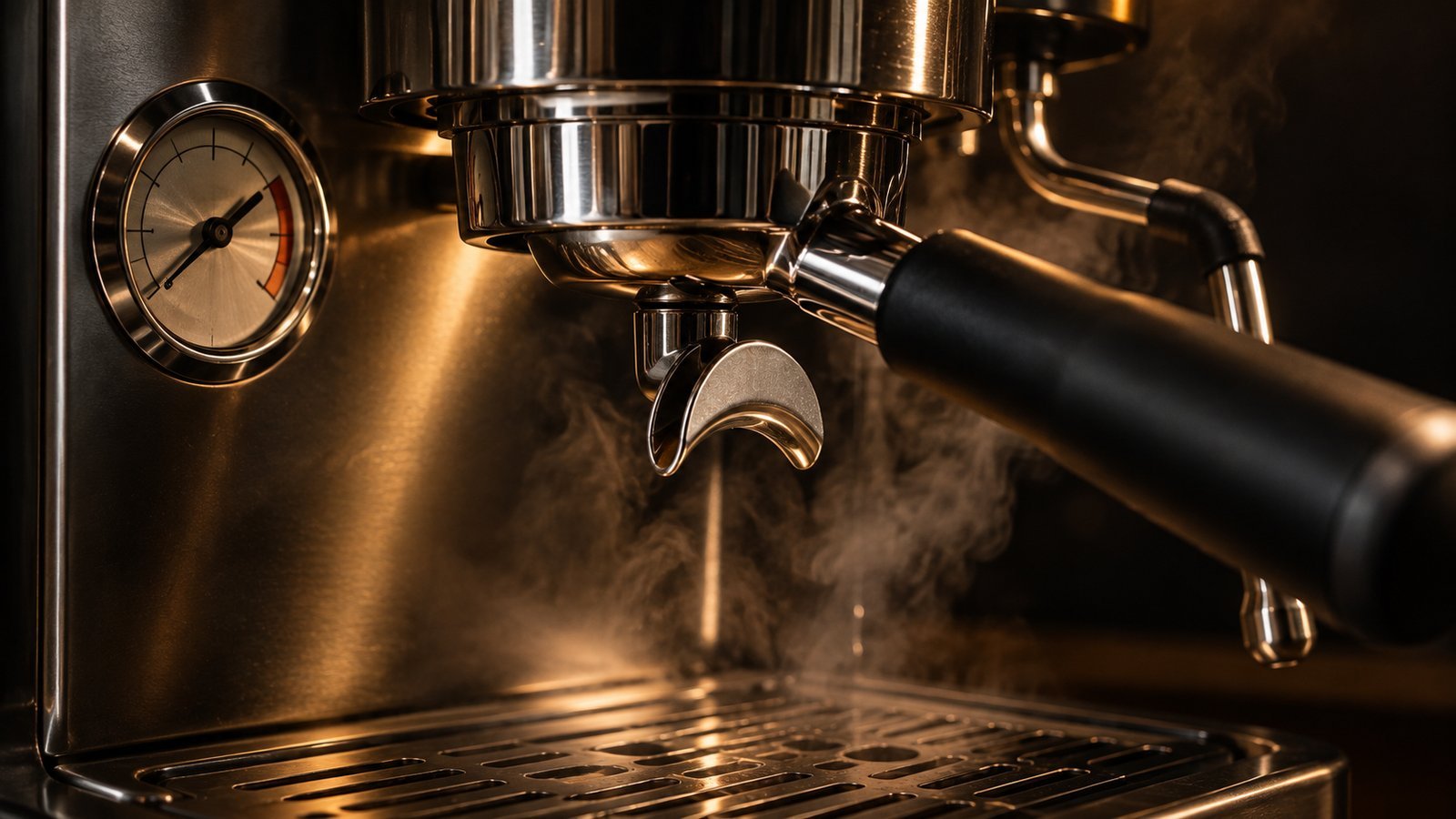
Two questions decide most of what an espresso machine can do: how much of the shot it controls for you, and how it heats water. Brand and price matter less than these two.
This page starts with the four machine types, from a hand lever to a one-button super-automatic. It then covers the four heating systems and what each means for steaming milk, what you get as the price goes up, and how long a machine should last. Every guide in the hub is listed at the bottom with a note on when to read it.
The guides in this hub draw on manufacturer specs, retailer and coffee education guides, and owner reports. The sources for this page are listed at the end. If you're new to espresso machines, start with the espresso machine buying guide.
Four machine types, from most hands-on to least
The type tells you who starts and stops the shot. On a manual machine you do everything. On a super-automatic you press one button. The table below uses CoffeeGeek's definitions.
| Type | What pushes the water | Who stops the shot | Built-in grinder | Suits someone who |
|---|---|---|---|---|
| Manual (lever) | You, by pulling a lever. There's no pump. | You | No | Wants full control and doesn't mind the effort. Pro Coffee Gear notes that several drinks in a row "can be tiring". |
| Semi-automatic | An electric pump that you turn on and off | You | No | Wants to learn espresso technique. You grind, weigh the coffee (the dose), press it into the basket (tamping) and time each shot. |
| Automatic | An electric pump | The machine, after a preset volume of water | No | Wants the same shot size every time but still grinds and tamps. |
| Super-automatic | An electric pump | The machine | Yes. It grinds, tamps, brews and drops the used coffee (the puck) into a bin. | Wants drinks at the press of a button. Pro Coffee Gear says you "can't fine-tune every detail". |
A note on names: some retailers say "fully automatic" for a super-automatic, so check whether a grinder is built in. Most guides on this site assume a semi-automatic, since that's the type where you control the grind, the dose and when the shot starts and stops.
If you're deciding between a lever and a pump machine, read manual vs semi-automatic. For the types in more depth, see espresso machine types explained.
How the machine heats water
The heating system decides two things: how steady the brew temperature is, and whether you can steam milk while a shot runs. Brewing and steaming need very different temperatures. Seattle Coffee Gear puts the gap at more than 40°F, and Kaffeemacher says a steam boiler runs at 120 to 130°C (about 250 to 265°F).
| System | How it works | Brew and steam at once? | Trade-offs |
|---|---|---|---|
| Thermoblock or ThermoJet | Water is heated as it flows through a hot metal block or coil | No | Fast warm-up. Breville's Bambino page says its ThermoJet is ready in 3 seconds. Kaffeemacher says thermoblocks are "generally not well suited for steaming milk" and the temperature can change as the water flows faster or slower. |
| Single boiler | One boiler for both brewing and steaming | No. You wait for it to heat up or cool down between the two. | Simple and affordable. Many can be fitted with a PID controller (explained below) for steadier brew temperature. |
| Heat exchanger | One steam boiler, with the brew water running through a tube inside it | Yes | Usually costs less than a dual boiler, says Seattle Coffee Gear, and brew temperature can drift during heavy use. Kaffeemacher adds that brew water left in the tube overheats while the machine sits idle, so it's important to run a little water through the group head (the part the coffee basket locks into) before brewing. |
| Dual boiler | A separate boiler for brewing and for steaming | Yes | The steadiest brew temperature, since each boiler holds its own setting. Seattle Coffee Gear says they cost more, are larger and have "double the components that could fail". Kaffeemacher adds that a larger boiler takes longer to heat up. |
A PID is a small controller that holds the water at a set temperature. Machines with any heating system can have one, including some thermoblock machines. Kaffeemacher calls it one of the upgrades that "change both the quality and the price".
For more detail on each system, read single boiler vs dual boiler.
What changes as the price goes up
More money mostly buys a better heating system and steadier temperature, not a different kind of espresso. The price ranges below come from Clive Coffee's April 2026 guide. Clive is a retailer, so treat the ranges as a rough guide, not fixed limits.
| Price range | What you usually get | The main limit |
|---|---|---|
| Under $500 | A thermoblock or a small single boiler with a basic thermostat. More plastic parts. | Temperature can swing 10 to 15°F between the start and end of a shot, and steam is weak. |
| $500 to $1,000 | Better boilers, sturdier build, and PID control on some models | Most are single boilers, so you wait between brewing and steaming. |
| $1,000 to $2,500 | PID, heat exchanger or dual boiler designs, 58mm portafilters (the size cafe machines use) and pre-infusion (a gentle soak before full pressure) | Mainly the price. Clive calls this range the "sweet spot" for most home baristas. |
| $2,500 and up | Dual boilers with separate PIDs, rotary pumps (the type cafe machines use), the option to connect to a water line, and commercial group heads | Clive says these are about "convenience, longevity" and are not needed for excellent espresso. |
Budget for the grinder too. Plan to keep at least a quarter, and ideally a third, of the total budget for the grinder. Clive Coffee argues that a $1,200 machine with a $500 grinder will beat a $2,000 machine with a $150 grinder. The Espresso Grinders hub explains how to choose one.
For named machines in each range, see espresso machines by price tier and best espresso machine under $500.
How long machines last, and when to repair or replace
A home machine can last anywhere from a few years to two decades. The heating system and the water you use make most of the difference. The estimates below are from Complete Home Barista. Pro Coffee Gear's guide gives similar figures: 7 to 15 years for semi-automatics in general, and 4 to 6 for the Breville Bambino. Neither guide says where its numbers come from, so treat them as rough ranges.
| System | Expected life | Parts that usually wear |
|---|---|---|
| Thermoblock | 3 to 7 years | Pump, thermoblock |
| Single boiler | 7 to 12 years | Gaskets, heating element |
| Heat exchanger | 10 to 15 years | Boiler parts, pump |
| Dual boiler | 10 to 20 years | Boiler seals, electronics |
Complete Home Barista calls water hardness "the single greatest factor in machine longevity". Scale builds up in pumps, heating elements and valves. The habits that help most are simple: use filtered or softened water, descale on a schedule set by your water hardness, backflush regularly (run water, and sometimes a cleaner, back through the group head), and never run the machine with an empty water tank. The descaling calculator gives a schedule for your water.
Before you replace a machine, descale it. Weak flow, slow heat-up and a noisy pump often come from scale, not a failing part. A leak is a different problem. It often means a worn gasket (the rubber seal the portafilter locks against), and Complete Home Barista suggests replacing gaskets once a year.
A rule of thumb for repair or replace, again from Complete Home Barista:
- Repair when the machine is under half its expected life, the repair costs less than 40% of a new one, and parts are available.
- Replace when it's past about 70% of its expected life, the repair costs more than half of a comparable new machine, or parts can't be found. Pro Coffee Gear uses the same 50% line.
For a machine between those two points, either choice can make sense. The lifespan and upgrade guide treats a second or third repair in a short span as a sign to replace.
Sources: CoffeeGeek, Pro Coffee Gear (machine types, lifespan), Seattle Coffee Gear, Kaffeemacher, Breville, Clive Coffee and Complete Home Barista.
Espresso Machine Buying Guide: Where to Start Before You Buy
You're new to espresso machines and want the main decisions in one place.
Single Boiler vs Dual Boiler Espresso Machine: What Beginners Should Know
You want to know whether you'll be able to steam milk while a shot runs.
Espresso Machines by Price Tier: What Changes as You Spend More
You have a budget and want to see what it buys.
Best Compact Espresso Machine: Choosing an Espresso Machine by Use Case
Counter space, household size or travel matters more than features.
Breville vs. De'Longhi Espresso Machines: How to Compare Two Machines
You've narrowed it to these two brands.
Breville Bambino vs Bambino Plus: What the Extra Money Buys
You're choosing between these two and want to know if automatic milk texturing is worth paying for.
How Long Do Espresso Machines Last? And When Should You Upgrade?
Your machine is slowing down, leaking or due for an expensive repair.
Where to start
If you're new to espresso machines, the buying guide puts the main decisions in one place.
Read the Buying Guide →Guides are researched from manufacturer manuals, roaster guidance and published coffee science. No sponsorships, no paid placements.