If you’ve read What Is Espresso?, you already know the short version. Espresso isn’t a bean. It’s a method. Fine grounds, hot water, pressure, a few seconds. That’s the basic formula.
Here’s what matters for choosing a machine: that formula works the same way whether a hand lever creates the pressure or a $3,000 pump does it. The difference isn’t in the espresso. The difference is in you. Specifically, how much control you have and how much you need to understand to get consistent results. Our guide to how an espresso machine actually works covers the mechanics behind that pressure. This article is about the different ways machines let you control it.
That’s really the entire decision tree hiding behind every espresso machine types article. Machines aren’t ranked on a single scale from good to bad. They’re spread across a spectrum from total manual control to complete automation. Where you land depends on whether you’re buying a machine because you want to learn espresso or because you want to skip learning and drink espresso.
Our site leans hard into the first camp. That’s not because the second camp is wrong. Plenty of people have neither the time nor the interest in understanding extraction dynamics. It’s just that if learning espresso is what brought you here, your machine type choice becomes strategic.
The One Tradeoff That Explains Every One of the Espresso Machine Types
Every espresso machine sits somewhere on a line between full manual control and full automation.
Move toward manual, and you control more: pressure profile, timing, everything. Move toward automatic, and you control less, but you also have to understand less. The tradeoff is direct and honest.
Neither end is better. It depends entirely on what you’re actually trying to do.
If you’re buying a machine because you want to understand how espresso works, your choice should keep you in the learning zone. You need to be still making decisions that affect the shot. If you’re buying a machine because you want good coffee without thinking about it, your choice should do the thinking for you.
The strange part is that most articles don’t actually separate these two reasons. They just tell you which machines are easiest or best value. That’s useful if convenience is your goal, but it doesn’t help if your goal is learning.
Manual (Lever) Espresso Machines
Lever machines are the oldest style still in production. They’re also the most hands-on.
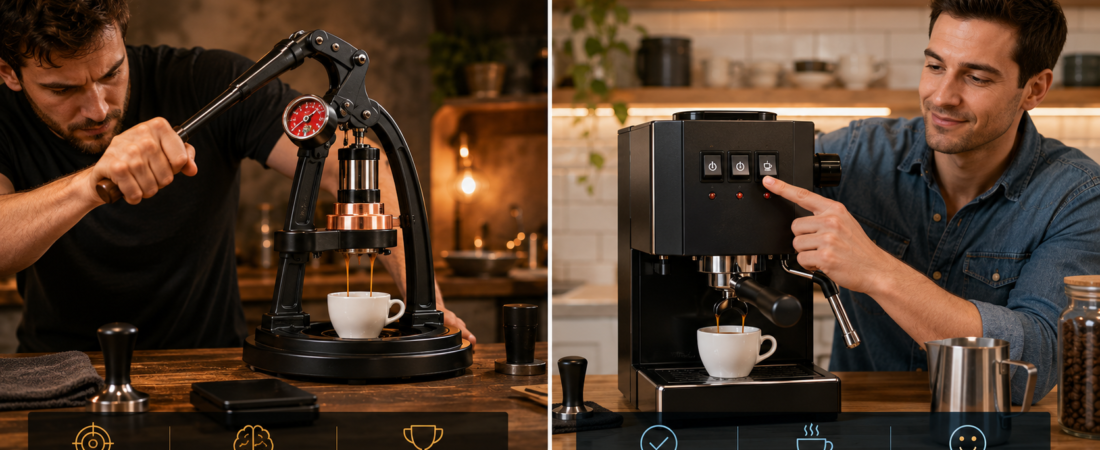
Instead of an electric pump, you manually pull a lever that builds pressure. You get total control over pressure profiling: ease into a shot, add pressure gradually, ease off at the end. You can feel the resistance change as water flows through the grounds, which gives you direct mechanical feedback about what’s actually happening in the group head.
What this means for your coffee: if you want to understand how pressure actually affects espresso extraction, a lever machine teaches you. Every shot is different because you’re making a physical decision with every shot. That’s either the appeal or the nightmare, depending on your temperament.
Rough price range: roughly $300 on the low end for basic spring-lever machines. High-end direct-lever machines with temperature stability run into the thousands.
Who it’s actually right for: honestly, not most people starting out. You grow into this machine once you already understand grind, dose, and timing. Then you can tackle the final layer of learning, which is pressure control. Start here only if you have patience and genuine curiosity about extraction mechanics. Otherwise it will frustrate you for six months before clicking.
Semi-Automatic Espresso Machines
Most home baristas actually use this category, and most of the machines this site focuses on are semi-automatics.
The basic idea: you grind, you dose, you tamp. The machine handles the rest. You press a button, water flows at consistent pressure for however long you want, and you press the button again to stop.
Because the machine delivers consistent pressure automatically, you can focus on the variables you can actually control: grind size, dose weight, distribution, tamping. You get consistent, repeatable extraction without needing to manage pressure yourself. It’s the learning sweet spot. You’re still making decisions, but you’re not fighting the machine.
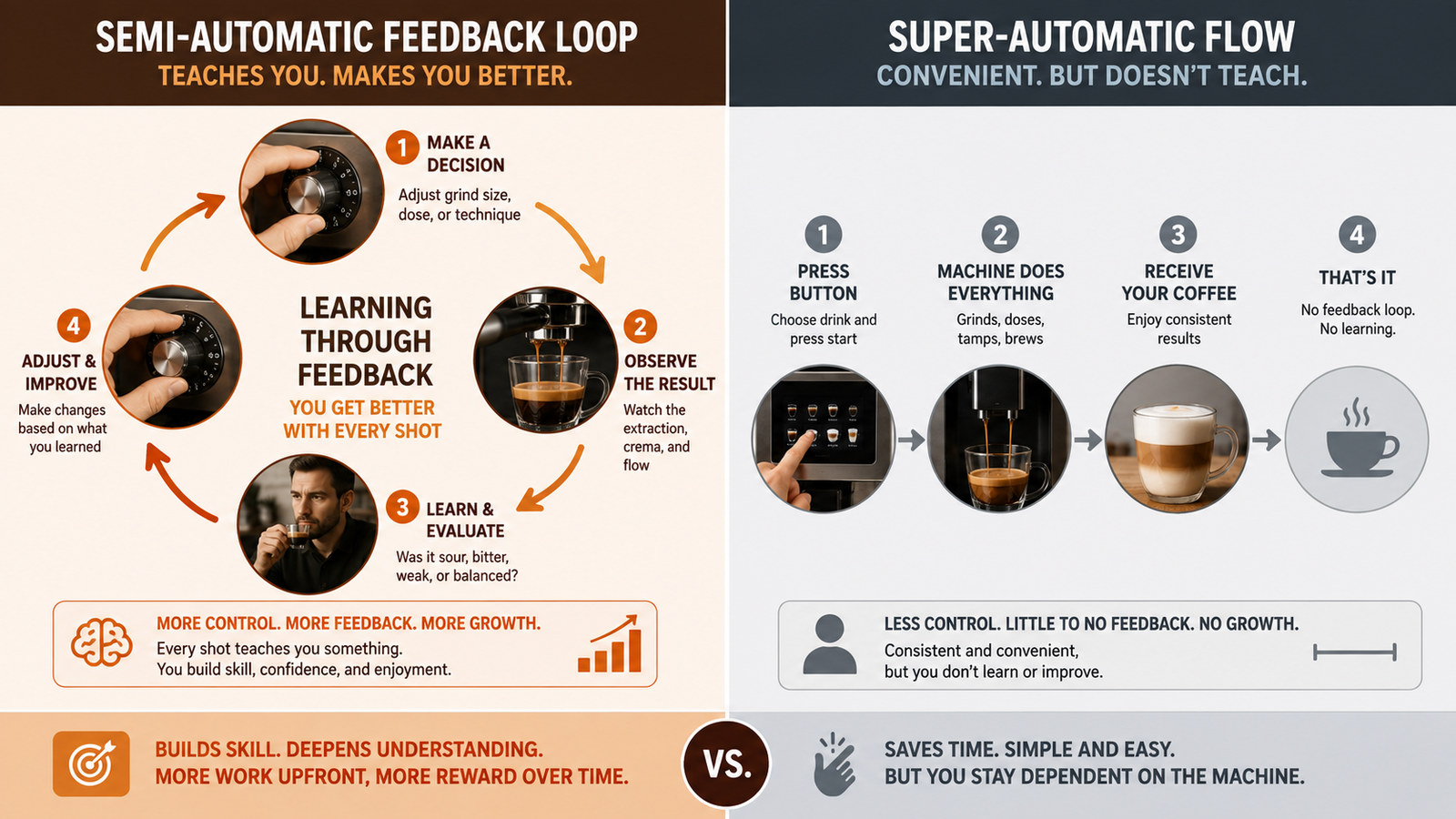
What this means for your coffee: the machine removes the one variable, pressure consistency, that’s hardest to control by hand. It keeps you responsible for the variables that actually change week to week. If your grinder’s dull or your tamp is uneven, you’ll notice because the extraction changes. Every single shot gives you direct feedback about your technique.
Rough price range: roughly $150 to $300 for basic beginner semi-automatics. Mid-range machines most people actually want to keep long-term run $400 to $900.
Why it’s the common recommendation: automatic pressure removes one barrier to consistency without removing your involvement in the shot. You’re still making enough decisions that learning actually happens.
Automatic Espresso Machines
Automatic machines are semi-automatics with one added layer of automation: programmable shot volume or timing.
You still grind, dose, and tamp. You press the button, and the machine stops automatically after hitting a pre-set volume or timer. Instead of you deciding when to stop, the machine decides.
You trade away some hands-on feedback for slightly more consistency shot to shot. That’s the actual tradeoff: slightly more consistency in exchange for slightly less hands-on feedback about when a shot is actually done.
What this means for your coffee: you get marginally more consistent results, but you also lose some ability to feel the machine respond to your grind choices. The automation is helpful. The learning cost is mild.
Rough price range: similar to semi-automatic, generally $300 to $800, since the added electronics are a relatively small cost.
Super-Automatic (Bean-to-Cup) Machines
Super-automatics do everything: grind, dose, tamp, brew, and often froth milk, all from one button.
Load beans in the hopper, hit a button, and espresso comes out. No decisions to make, no variables to adjust. The machine is designed to make the decision-making impossible.
What this means for your coffee: you get the most consistent, hands-off espresso you can make at home. That’s genuinely valuable if consistency matters more than learning. But you also get zero room to influence how the extraction happens. If something’s wrong with the shot, you can’t fix it. You can only clean the machine and hope it works better next time.
Rough price range: $500 on the low end. High-end models with built-in milk systems run into the multiple thousands.
The maintenance side nobody mentions enough: super-automatics have far more internal moving parts: grinders, brew units, milk systems, all packed into one unit. More moving parts means more to maintain and more to break. A semi-automatic with a separate grinder means that if the grinder fails, you replace the grinder. If the super-automatic’s internal grinder fails, you potentially replace the entire machine or pay for expensive repair.
Capsule and Pod Machines
Pod machines aren’t really a step on the manual-to-automatic spectrum. They’re a different category entirely.
With capsule systems, you buy pre-portioned, sealed pods of coffee and the machine punctures and brews them. They’re legitimately convenient, and fine if consistent-but-uninspired espresso on demand is genuinely all you want. They’re not great for learning because there’s nothing to adjust or understand.
Maintenance and Cleaning: The Difference Nobody Mentions
Maintenance deserves its own callout because it rarely gets the attention it should in machine-type comparisons.
Manual and semi-automatic machines: frequent but simple. You rinse the portafilter after every shot, backflush the group head periodically with a cleaning tablet, and descale the boiler every few months. Daily cleaning takes maybe ten minutes, and it’s simple because the parts are visible and accessible.
Super-automatics: guided but more complex. The machine prompts you through cleaning cycles with tablets, removable brew group rinsing, scheduled descaling, and milk system cleaning after each use. The brew group and milk path have more moving parts, and those integrated systems are generally more expensive to service than simpler semi-automatic internals. If a cleaning cycle gets skipped, residue builds up in components you can’t easily reach.
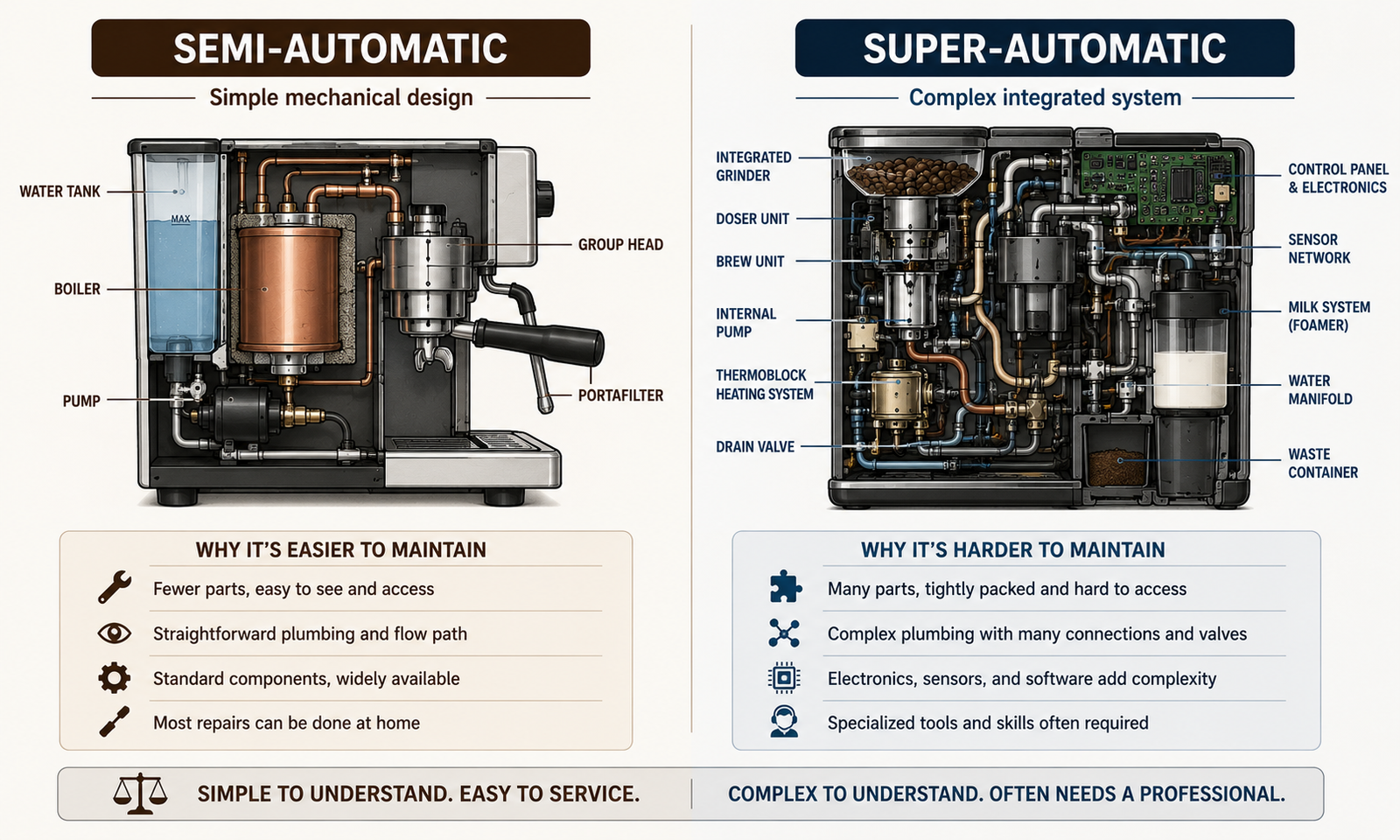
Neither is objectively more work. It’s a different kind of work. Manual cleaning is more frequent but straightforward. Automated cleaning systems are less frequent but have more failure points. Pick whichever matches your personality and patience level.
So Which One Should You Actually Start With?
If you’re reading this site because you want to actually understand espresso, start with a semi-automatic.
It’s the machine that actually lets you learn. You control enough variables that your decisions matter. The machine doesn’t make so many decisions for you that learning becomes impossible. You’re in the friction zone: enough challenge that growth happens, not so much that it’s purely frustrating.
A manual lever machine is worth considering once you already understand grind, dose, and timing and you want the final layer, which is pressure control. That’s the second machine or the third. Not the first.
A super-automatic makes sense if, honestly, you’ve read this far and realized you don’t actually want to learn espresso. And that’s valid. They’re genuinely good at what they do. Just be honest with yourself about whether the learning part matters to you or not.
Where to Go From Here
Once you’ve got a sense of which category fits you, the next thing that actually determines your shot quality isn’t the machine type at all. It’s why your grinder matters more than your machine, and understanding the espresso extraction fundamentals that actually let you fix problems when they happen. Those guides are coming soon on this site.
Once you’re comfortable with the different espresso machine types, the machine itself stops being the bottleneck. Understanding espresso machine types is step one; the grinder and your technique take it from there.
For the pressure and extraction fundamentals every one of these espresso machine types is built to deliver, Wikipedia’s overview of the espresso machine covers the shared mechanics behind the manual, semi-automatic, and automatic designs.