
If you already know that espresso needs pressure, you might be wondering what’s actually happening inside the machine to create it. That’s the real question behind how an espresso machine works: not just “pressure,” but where the pressure comes from, how the water gets hot enough, and why all of it has to happen in under a minute.
At the simplest level, an espresso machine does three jobs at once. It heats water to a precise temperature, pressurizes that water to roughly 9 bar, and forces it through a compacted puck of finely ground coffee for about 25 to 30 seconds. Every part inside the machine exists to support one of those three jobs. Once you can name the part and its job, the whole machine stops feeling like a mystery box and starts looking like a fairly simple system doing three things well.
How Does an Espresso Machine Work? The Short Version
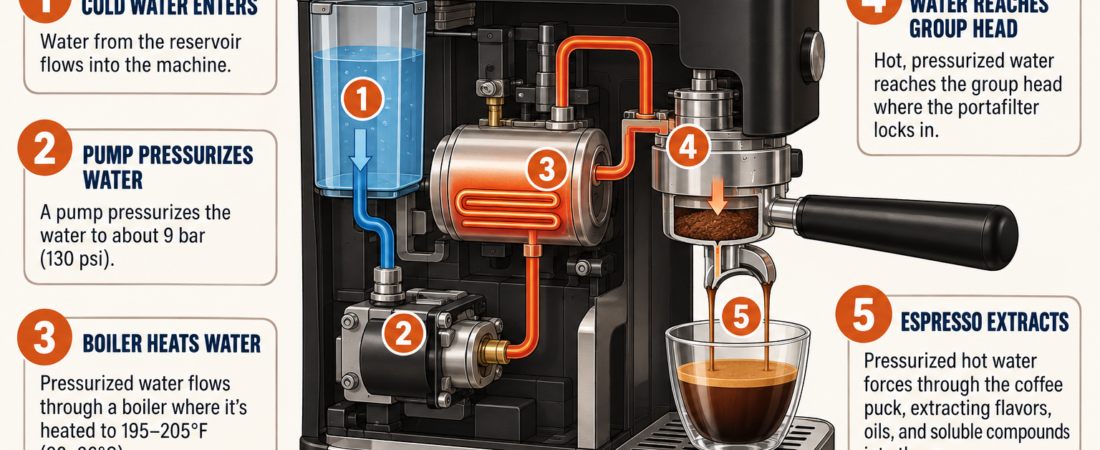
Here’s the basic sequence, start to finish. Cold water enters the machine from a reservoir or a direct waterline. A pump pressurizes the water and pushes it through a heating element or boiler, where it’s heated to about 195 to 205°F. The hot, pressurized water then travels to the group head, the part of the machine where the portafilter locks in, and gets forced through the packed coffee grounds inside.
That’s genuinely the whole process. The complexity people associate with espresso machines comes from how each step is engineered, not from the number of steps itself. A basic espresso machine combines a heating system and a pressure system into one continuous path, then routes that path directly through the coffee. Nothing about it is exotic. It’s closer to a small, purpose-built plumbing system than anything else.
The Parts of an Espresso Machine, and What Each One Does
Understanding the parts of an espresso machine is really the fastest way to understand how the whole thing works, since each part maps directly onto one job in the process above.
The pump is what generates pressure. Most home machines use a vibratory pump, which is compact and affordable, while higher-end and commercial machines often use a rotary pump, which runs quieter and holds pressure more consistently over long sessions. Either way, the pump’s job is the same: push water hard enough to hit around 9 bar by the time it reaches the coffee.
The boiler or heating element brings water up to brewing temperature and holds it there. Some machines use a single boiler that handles both brewing and steaming, which keeps the machine compact but means you sometimes wait between tasks. Others use a dual boiler setup, with one boiler dedicated to brewing and a second to steaming milk, so both can happen at the same stable temperature without one interfering with the other.
The group head is where the portafilter attaches, and where hot, pressurized water actually meets the coffee. It’s essentially the delivery point for everything the pump and boiler have already done.
The portafilter and basket hold the ground coffee itself. The basket determines how much coffee you can dose, and the fit between the basket and the group head directly affects how evenly water distributes across the puck.
The steam wand pulls steam from the boiler for texturing milk. It isn’t part of the brewing process, but it draws from the same heating system, which is part of why boiler design matters so much on machines meant for milk drinks.
Between them, these five parts cover the entire mechanism. A machine can add extra features on top- PID temperature controllers, pressure gauges, pre-infusion modes- but everything still routes through a pump, a heating system, a group head, and a portafilter.
Why Pressure Has to Be Built, Not Just Applied
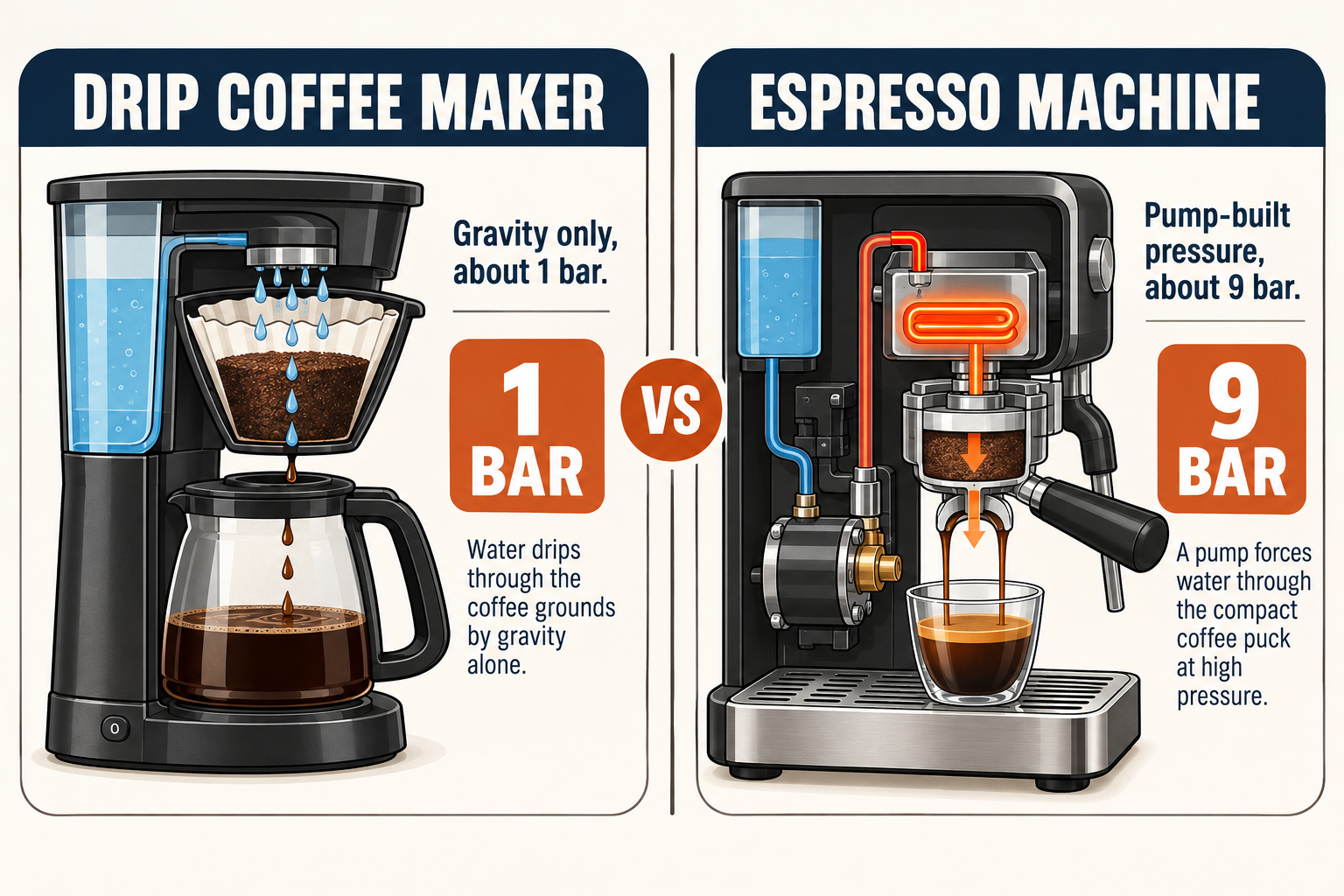
It’s worth being specific about what “9 bar” actually means, since it’s easy to gloss over. One bar is roughly normal atmospheric pressure at sea level. Nine bar is about nine times that, which is a meaningful amount of force being pushed through a small puck of coffee packed into a filter basket only a couple of inches wide.
Generating that pressure reliably is why espresso machines look the way they do internally. A drip coffee maker only needs gravity, so it can get away with a simple heating element and a basket sitting under it. An espresso machine needs a pump strong enough to overcome the resistance of tightly packed, finely ground coffee, which is a much harder engineering problem. If you want the fuller explanation of why pressure, specifically, is what separates espresso from every other brewing method, that’s covered in more depth in our guide to what espresso actually is.
Do You Use Regular Coffee in an Espresso Machine?
Yes, technically. Any coffee bean can go into an espresso machine, and there’s no separate category of bean that’s required. What matters is the grind size and how you dose and pack it, not the bag it came from.
That said, “regular coffee” ground the way you’d grind it for a drip machine won’t work well in an espresso machine. Drip coffee uses a coarser grind because water only needs to pass through it once, slowly, under gravity. Espresso needs a much finer, more consistent grind so that 9 bar of pressure meets enough resistance to extract properly in 25 to 30 seconds instead of rushing through in five. Run a drip grind through an espresso machine and you’ll typically get a thin, fast, sour shot, not because the beans were wrong, but because the grind size wasn’t suited to the amount of pressure being applied.
What Is the 30 Second Rule for Espresso?
The 30-second rule refers to the general target extraction window for a shot: somewhere between 25 and 30 seconds from the moment the pump starts to the moment you stop the shot, for a standard double shot brewed at a normal ratio.
It’s a useful benchmark, not a strict law. A shot that runs noticeably faster than that, say under 20 seconds, usually means the grind is too coarse, the dose is too low, or the puck isn’t packed evenly, and the water is finding an easy path through instead of being forced to work for it. A shot that runs much longer than 30 seconds, on the other hand, often points to a grind that’s too fine or too much resistance, which tends to pull out bitter, over-extracted flavors. The 25 to 30 second window exists because it’s roughly how long it takes pressurized water to extract a balanced amount of flavor from correctly ground, correctly dosed coffee, not because there’s anything magic about the number 30 itself.
Is One Shot of Espresso Equal to One Cup of Coffee?
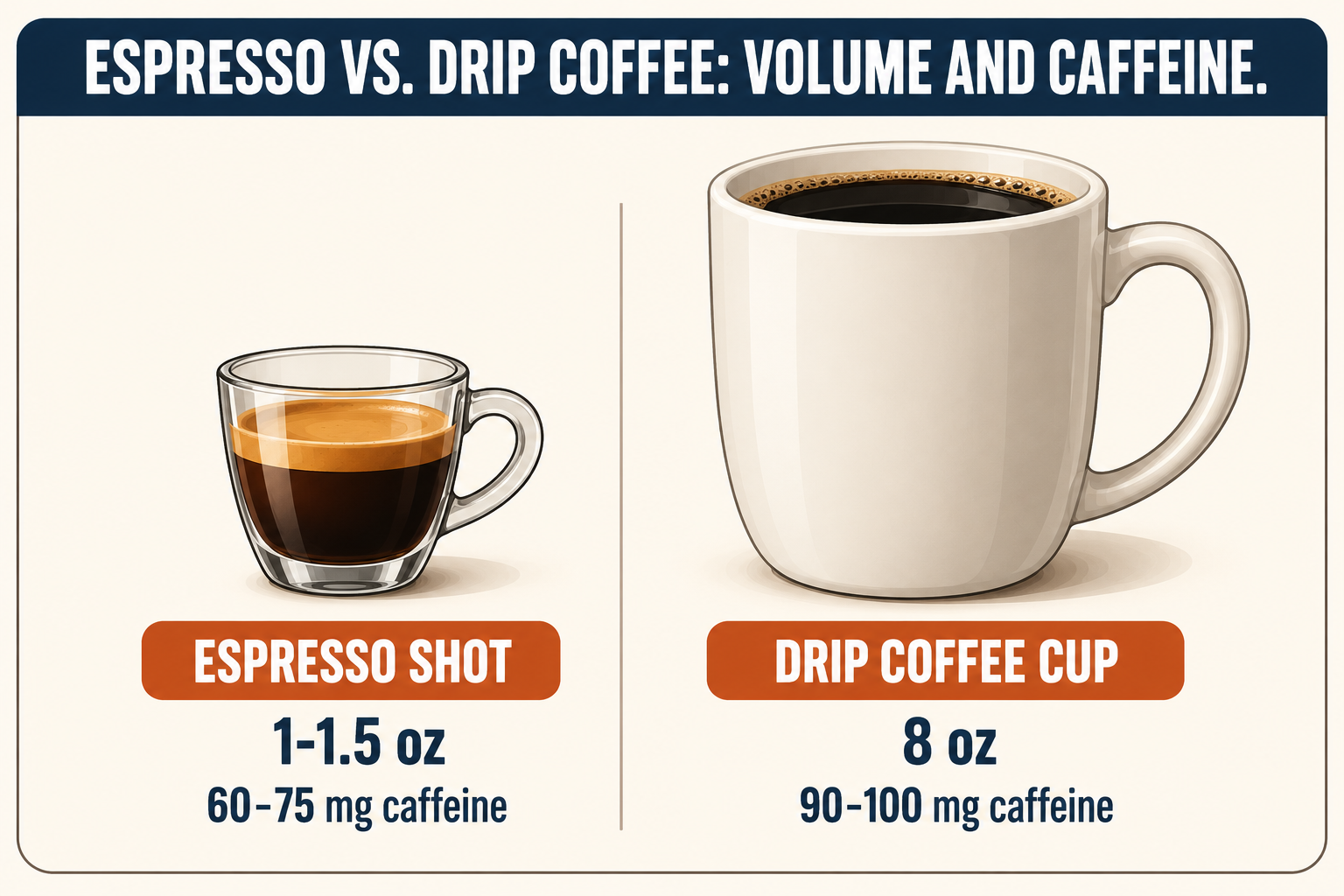
Not in volume, and not really in caffeine either. A single shot of espresso is about 1 to 1.5 ounces, compared to a standard 8-ounce cup of drip coffee, so by volume they’re nowhere close.
Caffeine tells a similar story. A single shot generally lands somewhere around 60 to 75 milligrams, while an 8-ounce cup of drip coffee is often closer to 90 to 100 milligrams. Espresso tastes and feels more intense because it’s concentrated into a much smaller volume, not because it packs more total caffeine than a full cup. If you’re drinking a double shot as part of a latte or cappuccino, you’re getting closer to the caffeine range of a regular cup of coffee, just delivered in a very different form.
Why This Actually Matters When You’re Shopping for a Machine
Once you understand how an espresso machine works mechanically, shopping for one becomes much more straightforward. You’re no longer comparing machines on looks or price alone. You’re checking whether a machine can hold stable pressure through an entire shot, whether the boiler setup matches how you actually plan to use it, and whether the portafilter and basket are a solid match for the grind and dose you’ll be using.
This is also where the differences between manual, semi-automatic, and fully automatic machines start to make sense, since those categories are really just different ways of controlling the same underlying pump, boiler, and group head system. Our guide to espresso machine types breaks down exactly how those categories differ and which one tends to suit which kind of home setup. Understanding how does an espresso machine work at the component level makes every one of those comparisons easier to evaluate.
Mechanically, none of this is complicated once you break it into parts. A pump builds pressure, a boiler builds heat, and the group head brings both together with the coffee in less than half a minute. Everything else on the machine, the gauges, the steam wand, the extra modes, exists to give you more control over that same basic process.
That’s the short version of how an espresso machine works mechanically. Pressure, heat, and timing work together through the group head.