
Cappuccino vs latte is one of the most common mix-ups at the coffee counter, and the difference isn’t roast, flavor, or how the beans were grown. Order a cappuccino at one shop and a latte at another, and you might get two drinks that taste almost the same.
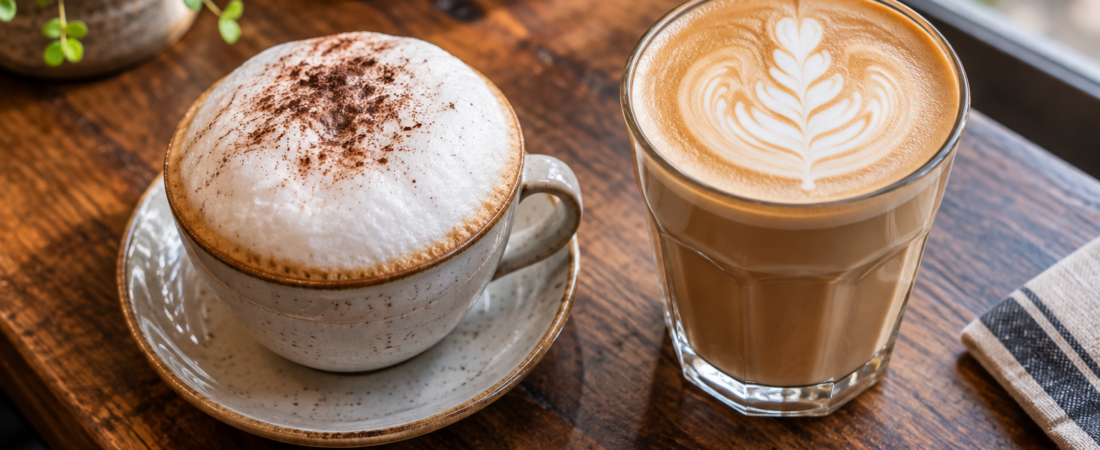
Order both at a shop that actually knows what it’s doing, though, and the difference is obvious before you even taste it: one has a thick cap of foam sitting half an inch above the rim, the other is smooth all the way to the top with maybe a thin skin of microfoam and a leaf drawn into it. The espresso underneath both drinks is identical. What changes is the milk, and specifically how much of it and how it’s steamed.
This covers what actually separates a cappuccino from a latte, where the confusion about caffeine and size comes from, how flat whites and macchiatos fit into the same family, and which one makes more sense for how you actually drink coffee.
Cappuccino vs Latte: What Actually Separates Them
Both drinks start the same way: one or two shots of espresso pulled into a cup. Nothing about the coffee itself changes between the two. The difference is entirely in what happens to the milk after that.
A cappuccino uses less milk, and roughly a third of what’s left in the cup is foam rather than liquid milk. The classic ratio taught in barista training, close to the Specialty Coffee Association’s brewing and drink standards, is close to equal thirds: espresso, steamed milk, and foam. That’s why a traditional cappuccino tops out around 5 to 6 ounces. There isn’t room for more without drowning the foam.
A latte uses much more steamed milk relative to the espresso, somewhere around four to six times as much milk as coffee, with only a thin layer of foam on top rather than a thick cap. That’s what lets a latte scale up to 10, 12, or even 16 ounces at most coffee shops without turning into a bowl of foam. The extra volume is just milk.

The foam is the real signal
If you’re trying to tell the two apart by looking, skip the cup size and look at the foam instead. Cup sizes vary wildly by shop and country. Foam texture doesn’t.
Cappuccino foam is thick and holds its shape. Baristas sometimes call this “dry” foam: dense, airy, closer to soft-serve than to liquid, usually a half inch to a full inch deep. You can rest a spoon on top of a well-made cappuccino’s foam for a second before it sinks.
Latte foam, often called microfoam, is barely foam at all in the traditional sense. It’s velvety and pourable, closer to lightly whipped cream than to the thick cap on a cappuccino, and it’s what makes latte art possible. You can’t draw a heart or a rosetta into cappuccino-style foam. It’s too stiff and too shallow to move that way when you pour.
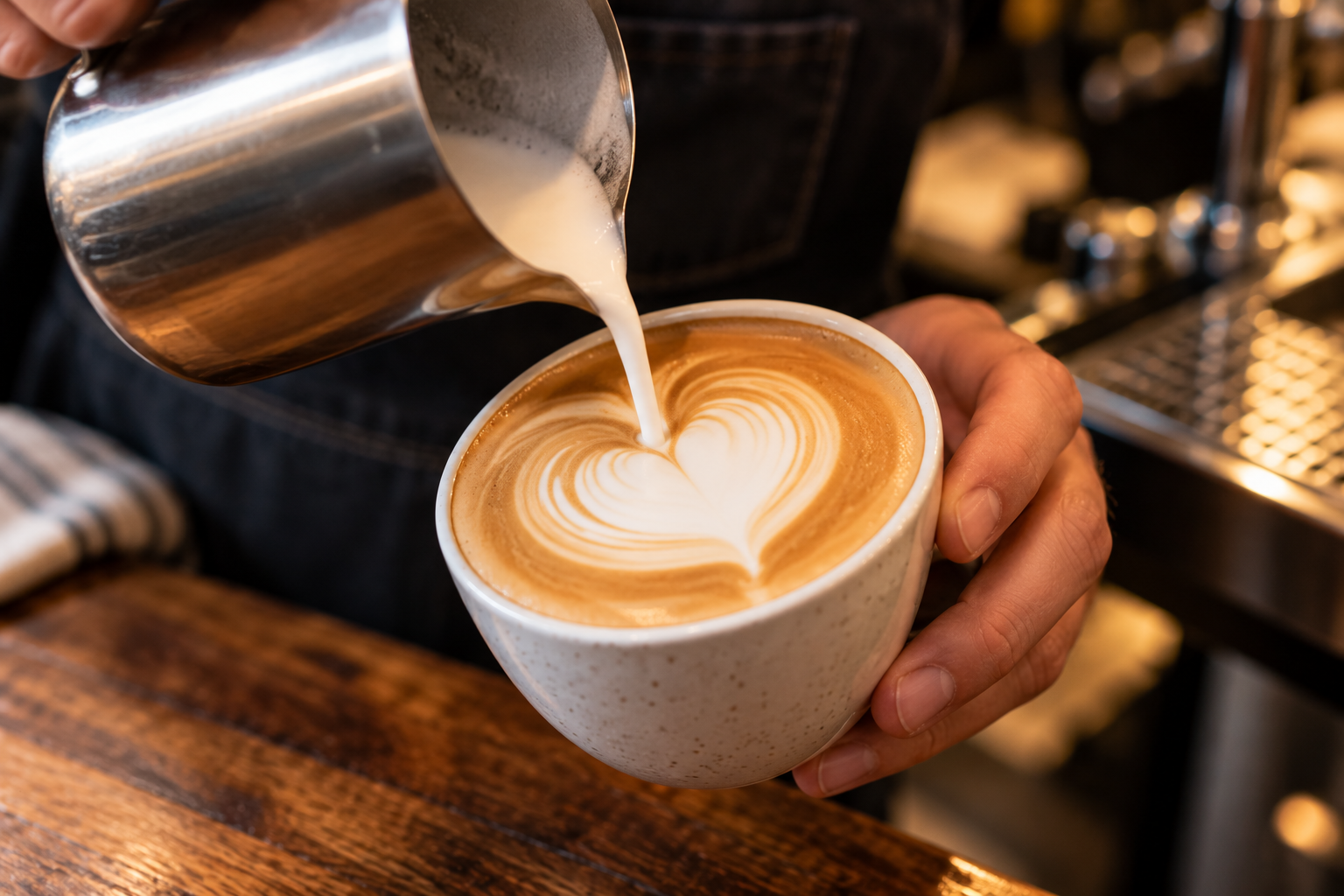
A “wet” cappuccino, with a bit less foam and a bit more steamed milk than the traditional version, sits somewhere between the two. If you’ve ever ordered a cappuccino and been surprised that it drinks more like a small latte, that’s usually what happened.
Size and ratio, side by side
| Detail | Cappuccino | Latte |
|---|---|---|
| Espresso | 1 to 2 shots | 1 to 2 shots |
| Steamed milk | Roughly equal to the espresso | 4 to 6 times the espresso |
| Foam | Thick, half inch to a full inch | Thin microfoam layer, about a quarter inch |
| Typical total size | 5 to 6 ounces (traditional) | 10 to 12 ounces, often larger |
| Texture | Dense, holds a spoon briefly | Velvety, pourable, supports latte art |
Coffee shops in the US routinely serve cappuccinos larger than the traditional 5 to 6 ounces, sometimes closer to 8 or 12 ounces with proportionally more milk added. That version still keeps the thick foam cap that defines a cappuccino. It’s just a bigger one. The traditional Italian ratio is the reference point for the cappuccino vs latte comparison, not a rule every cup follows.
Where cappuccino and latte actually came from
The cappuccino’s name comes from the Capuchin friars, whose brown robes and hoods were close in color to the drink once milk was added to coffee. The espresso-machine version most people know today took shape in Italy in the mid-20th century, once machines could reliably produce both a shot and steamed, foamed milk from the same setup.
Latte has a longer, less tidy history. Mixing coffee with milk dates back centuries in parts of Europe, and the term “caffè e latte,” meaning coffee and milk, appears in Italian by the 1800s. The shortened “latte” as its own drink name, and the version with a thin layer of steamed milk and room for latte art, is largely a US invention from the specialty coffee boom that started in Seattle in the 1980s. Most espresso drinks trace back to Italy. The latte as it’s ordered today is really an American reinvention of an old Italian phrase.
Cappuccino, latte, flat white, and macchiato: where they fit
These four drinks all start from the same one or two shots of espresso, and they’re really just different points on the same scale of how much milk gets added and how it’s textured, with cappuccino vs latte marking the two most common ends of that scale.
A macchiato sits closest to straight espresso: just a small spoonful of foam “stains” the top of the shot, with barely any milk at all. A flat white sits between a cappuccino and a latte, using microfoam like a latte but in a smaller cup with a higher espresso-to-milk ratio, so it tastes stronger than a latte despite the similar texture. A cappuccino has the thickest foam of the group. A latte has the most milk and the least foam.
If you order by size and expect the flavor to scale predictably, that’s where people usually get surprised. A flat white can taste stronger than a latte twice its size, because the ratio of coffee to milk matters more than how many ounces are in the cup.
Caffeine difference? There isn’t one
A cappuccino and a latte made with the same number of espresso shots have essentially the same caffeine content. Caffeine comes from the espresso, not the milk, so adding more steamed milk to make a latte doesn’t dilute the caffeine any more than adding water to a drink dilutes the alcohol in it. A single shot generally runs somewhere in the 60 to 100 milligram range; a double shot roughly doubles that. If a latte feels like it hits differently, it’s more likely the extra volume filling you up than a difference in the coffee itself.
Common mistakes people make with each
Assuming a bigger size means more coffee. This is the most common cappuccino vs latte mix-up: a 16-ounce latte usually has the same one or two shots as a 6-ounce cappuccino. The extra ounces are milk.
Expecting cappuccino foam from a latte order, or the reverse. If you like a thick foam cap, ordering a large latte won’t get you there. Ask for a cappuccino, sized up if you want more volume, rather than a latte with extra foam on the side.
Steam milk the same way at home for both. A latte needs milk stretched gently into microfoam with almost no visible bubbles. A cappuccino needs air introduced more aggressively early in the steaming process to build that thicker foam. Using latte technique for a cappuccino, or vice versa, is the most common reason a home version doesn’t match what a cafe produces.
Cappuccino vs Latte: Which One Should You Actually Order or Make
In the cappuccino vs latte decision, if you want a strong, mostly coffee-forward drink with a distinct texture change between the foam and the liquid underneath, a cappuccino is the better order. It drinks more like a coffee with a milk topping than a milk drink with coffee in it.
If you want something smoother and more filling, with the espresso mellowed out by a larger volume of milk, a latte is the better choice, and it scales up more comfortably if you want a bigger drink to sip over a longer stretch of time.
Neither is objectively better. They’re built for different moments: a cappuccino for a shorter, more concentrated coffee break, a latte for something you can hold onto longer.
What to check out next
If you’re still working out the basics of what espresso actually is before worrying about milk drinks, What Is Espresso? covers that from the ground up. For the mechanics behind how a machine pulls a shot and steams milk in the first place, see How Does an Espresso Machine Work? If you want to understand how shot length changes flavor before milk enters the picture, Espresso Brew Ratio Explained breaks down ristretto, normale, and lungo shots.
Frequently asked questions
Is a cappuccino stronger than a latte?
In the cappuccino vs latte comparison, a cappuccino can taste stronger because there’s less milk to soften the espresso flavor, even though the actual caffeine and coffee amount is usually the same. The thick foam also changes the mouthfeel, making the coffee taste more concentrated on the first sip.
Can I make a good cappuccino or latte without a fancy machine?
Yes, though the foam quality depends heavily on your steam wand or frother. A basic milk frother or steam wand can build enough foam for a decent cappuccino, but the fine, pourable microfoam a latte needs takes more practice to get consistently right.
Why does my homemade cappuccino turn out more like a latte?
This is usually a steaming technique issue, not a ratio issue. If you stretch the milk gently, as you would for a latte, you’ll end up with thin microfoam even if you use a cappuccino-sized cup. To get real cappuccino foam, introduce more air earlier in the steaming process.
What’s the difference between a wet and dry cappuccino?
A dry cappuccino has more foam and less liquid steamed milk, closer to the traditional Italian version. A wet cappuccino has more steamed milk and a thinner foam layer, putting it closer to a small latte. Neither is wrong; it’s just a matter of preference, and most shops will make either if you ask.
The bottom line
Cappuccino vs latte really comes down to one thing: both start with the exact same shot of espresso. What makes them taste and feel different comes down to how much milk you add and how you steam it. Equal parts espresso, milk, and thick foam get you a cappuccino. Mostly milk with a thin layer of microfoam gets you a latte. Once you know what to look for in the cappuccino vs. latte comparison, the difference is obvious in the cup, no matter the size.
Related comparisons: see how a macchiato compares to a latte or how an americano differs from a latte, or how a cortado compares to a latte, or how a flat white compares to a cappuccino, or how a mocha compares to a latte.