
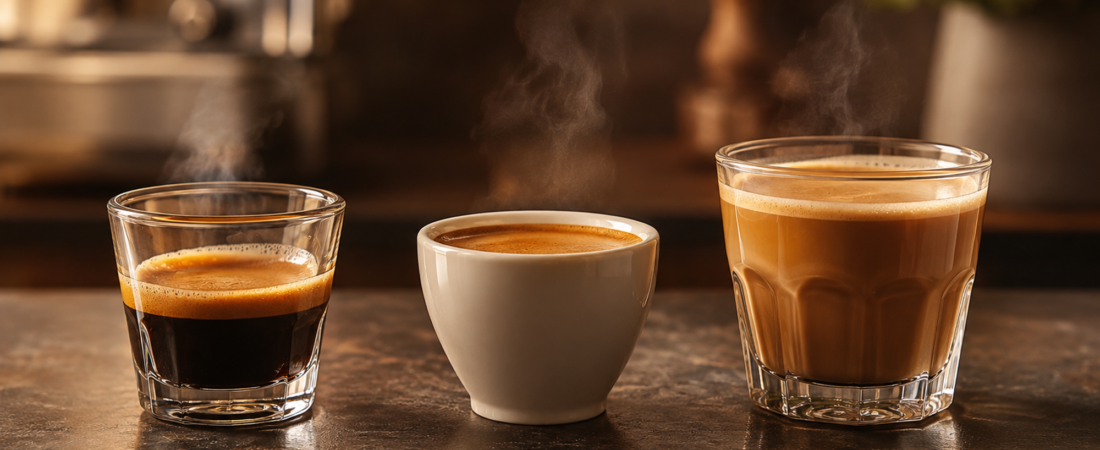
Espresso brew ratio sounds like a spec-sheet number, but it’s the fastest lever for changing a shot’s taste without touching the grinder. Dose in, espresso out, both measured in grams. That’s the whole idea. Most of the confusion around ristretto, normale, and lungo isn’t really about exotic technique; it’s just different points on the same ratio scale, and knowing where you are on it explains a lot about why a shot tastes the way it does.
This guide covers what dose and yield actually mean, the three standard ratio bands and what each one tastes like, why 1:2 became the default starting point, and, the part that trips people up most, why ratio and grind size fix two completely different problems.
What Dose and Yield Actually Mean
A brew ratio is written as dose: yield. Dose is the weight of dry ground coffee in the portafilter before you brew. Yield is the weight of liquid espresso in the cup after you stop the shot. Both are measured in grams. Not milliliters, and not by eyeballing the cup. Crema makes volume unreliable, since a syrupy ristretto and a thin lungo can look like similar volumes while weighing very differently.
You never measure water directly, because some stays trapped in the used puck and some evaporates as steam during the shot. Weighing dose in and yield out sidesteps that problem entirely and gives you a number you can actually repeat shot to shot.
An 18g dose brewed to a 36g yield is written as a 1:2 ratio. That single number is doing a lot of work: it tells you roughly how strong the shot will be, roughly how it will feel in the mouth, and roughly how long it needs to run.
The Three Standard Ratio Bands
Ristretto, 1:1 to 1:1.5. An 18g dose stopped at 18 to 27g out. Syrupy, intense, and sweet, with a thick, almost heavy body but less aromatic complexity than a longer shot. Ristretto shots are technically under-extracted by the numbers, which is exactly what gives them that concentrated character. They’re popular in Italian espresso culture and with darker roasts that turn bitter quickly if pushed further.
Normale, 1:2. An 18g dose stopped at 36g out. This is the modern specialty-coffee default: balanced sweetness, acidity, and bitterness, full flavor without heaviness. It’s the ratio most third-wave roasters dial their beans around and the one worth starting from for any new bag of coffee.
Lungo, 1:2.5 to 1:3. An 18g dose stopped at 45 to 54g out. Brighter and more aromatic, with more nuance in the cup, but at the cost of body. It trades some of that syrupy weight for clarity. Lungo ratios work especially well with very light roasts that are difficult to fully extract at a standard 1:2.
None of these is “correct” in an absolute sense. They’re different trade-offs between intensity and complexity, and which one tastes best depends on the bean, the roast level, and personal preference.
Why 1:2 Is the Default Starting Point
1:2 isn’t the default because it’s the “safest” number. It’s the default because it consistently lands most well-roasted, medium-bodied coffees in the 18 to 22% extraction window, which is where sweetness, acidity, and bitterness tend to balance out. Shorter ratios often stay under-extracted by design; longer ratios push toward over-extraction unless the grind compensates. 1:2 gives you the widest margin for error while you’re still learning to read a shot.
Start any new bag of coffee at 1:2 (18g in, 36g out), landing around 25 to 30 seconds. Before deciding it needs to move shorter or longer. That’s also the ratio target used in How to Dial In Espresso, so if the two guides point to the same numbers, that’s intentional. This one goes deeper into why that specific ratio, and what to do once you understand it.
Ratio vs. Grind: What Each One Actually Fixes
This is the part that causes the most confusion, so it’s worth being direct: ratio controls strength; grind controls extraction balance. They are not interchangeable fixes.
A sour, sharp shot means under-extraction; the fix is a finer grind, which slows the flow and pulls more flavor out of the same puck in the same time. A bitter, harsh, astringent shot means over-extraction; the fix is a coarser grind, which speeds the flow and pulls less out. Changing the ratio doesn’t fix either of these problems on its own; stopping a sour shot earlier just gives you a smaller, still-sour shot, and letting a bitter shot run longer just gives you a larger, still-bitter one.
Ratio helps when you prefer a shot that’s already tasting balanced. If a 1:2 shot tastes correct no sourness, no bitterness but simply too intense or too weak for your taste, that’s when adjusting yield up or down a few grams at the same dose makes sense. Diagnose taste problems with grind first. Adjust ratio second, once the shot is already balanced and you’re just tuning intensity.
How to Adjust Ratio Once a Shot Is Balanced
Once a shot tastes clean, not sour, not bitter, but you want it stronger or lighter, move the yield in 3 to 5g steps at the same dose and re-taste. Pulling yield down toward 1:1.5 concentrates the shot and thickens the body. Pushing yield up toward 1:2.5 or 1:3 lightens it and brings out more aromatic detail at the cost of some of that syrupy weight.
Keep dose fixed while you do this. Ratio math falls apart if dose is drifting shot to shot; 18g one time and 19g the next makes every ratio comparison meaningless, since you’re no longer changing one variable at a time.
Ratio and Roast Level
Roast level shifts where a bean actually wants to sit on the ratio scale. Darker roasts extract faster and turn bitter quickly, so they often taste best pulled shorter, 1:1.5 to 1:2, before that bitterness has a chance to develop. Light roasts are denser and extract more slowly, so they often need to run longer, 1:2.5 to 1:3, just to pull enough flavor out of the puck in the first place. A single fixed ratio applied to every bag in the cupboard is a common reason a “perfect” dial-in on one coffee tastes off on the next.
Common Mistakes
Measuring by volume instead of weight is the most common one. Crema density varies enough that two very different-strength shots can look like the same amount of liquid in the cup. Weigh dose and yield every time, at least until reading a shot by taste alone becomes second nature.
Using shot time as the primary control instead of weight is the second. Time is a consequence of ratio and grind, not a target in itself. Two shots can hit the same 28-second mark and taste completely different if the yield weights don’t match. Stop the shot by weight on the scale, and treat time as a sanity check, not the goal.
The third is reaching for a ratio change to fix a taste problem that’s actually a grind problem. If a shot is sour or bitter, that’s an extraction issue. Fix it with grind size, not by stopping the shot earlier or later.
Espresso Brew Ratio: Putting It Together
Brew ratio is dose in, yield out, both weighed in grams: 1:1 to 1:1.5 for ristretto, 1:2 for the balanced specialty default, and 1:2.5 to 1:3 for lungo. Start any new coffee at 1:2, then adjust based on roast level and taste. Most importantly: grind size fixes sour or bitter extraction problems, and ratio only tunes strength once a shot tastes balanced. Mixing up which tool fixes which problem is the single biggest source of dialing-in frustration, and now it doesn’t have to be.
What to Check Out Next
For the full picture of how ratio fits alongside dose, grind, and timing, start with How to Dial In Espresso. And if shots are coming out sour, bitter, or inconsistent regardless of ratio, Espresso Troubleshooting walks through reading the shot back to the variable that’s actually causing it.
For where the term ristretto comes from and how it’s used outside a specialty coffee shop, Wikipedia’s overview of ristretto covers its origins in Italian espresso tradition.
And once you’ve got the ratio dialed in, Cappuccino vs Latte covers how that same espresso base changes completely once milk enters the picture, and why the milk-to-espresso ratio is what actually separates the two drinks.