
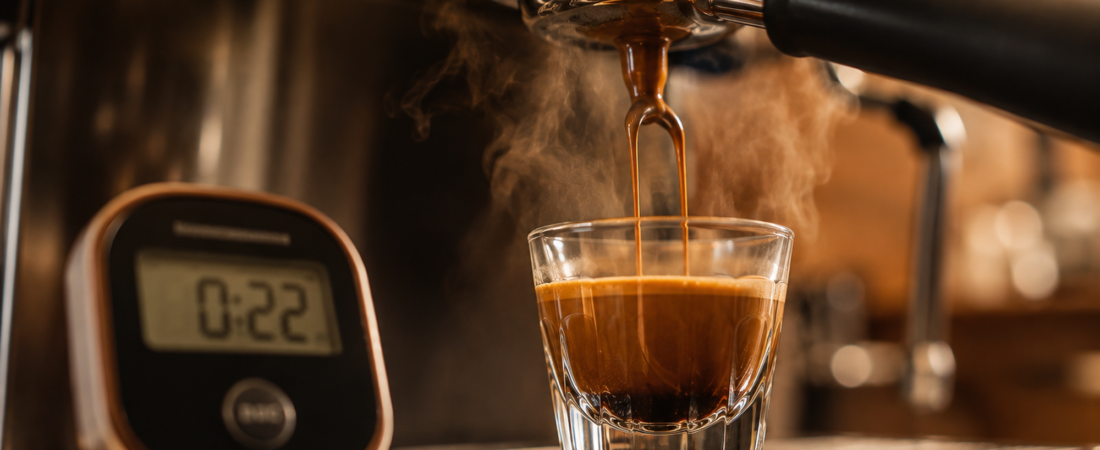
Espresso extraction time gets treated like a rulebook: “25 to 30 seconds or you did it wrong,” but the stopwatch is only useful as a diagnostic, not a target to chase for its own sake. Shot time comes after everything else is decided: grind size, dose, tamp, and distribution set the stage, and the clock just reports the result. Two shots can both land at 28 seconds and taste completely different, and two shots that taste identical can finish four seconds apart. The number matters, but only in relation to the ratio and the taste.
This guide covers what extraction time actually measures, why 25 to 30 seconds became the reference window, what a shot running fast or slow tells you, and how to use time as a check on your other variables instead of a variable to adjust directly.
What Extraction Time Actually Measures
Extraction time is the number of seconds between when water first touches the puck and when you stop the shot. Usually measured from the first drops in the cup, not from when the pump switches on. It’s a proxy for how much resistance the puck offers at 9 bars of pressure. A finer grind packs more tightly and resists longer, so water takes more time to push through the same volume. A coarser grind resists less, so the same volume clears faster. Dose and tamp firmness shift resistance the same way. More coffee or a harder tamp both slow the shot down; less coffee or a looser pack speeds it up.
Time alone doesn’t tell you whether extraction was good. It tells you how much resistance the water met. That’s why pairing time with brew ratio (dose in, yield out) gives a much clearer picture than either number alone. An 18g dose that yields 36g in 28 seconds is behaving exactly as expected. The same dose and yield finishing in 15 seconds means the water found an easy path through the puck. Usually channeling, not a genuinely “fast” extraction.
Why 25 to 30 Seconds Became the Reference Window
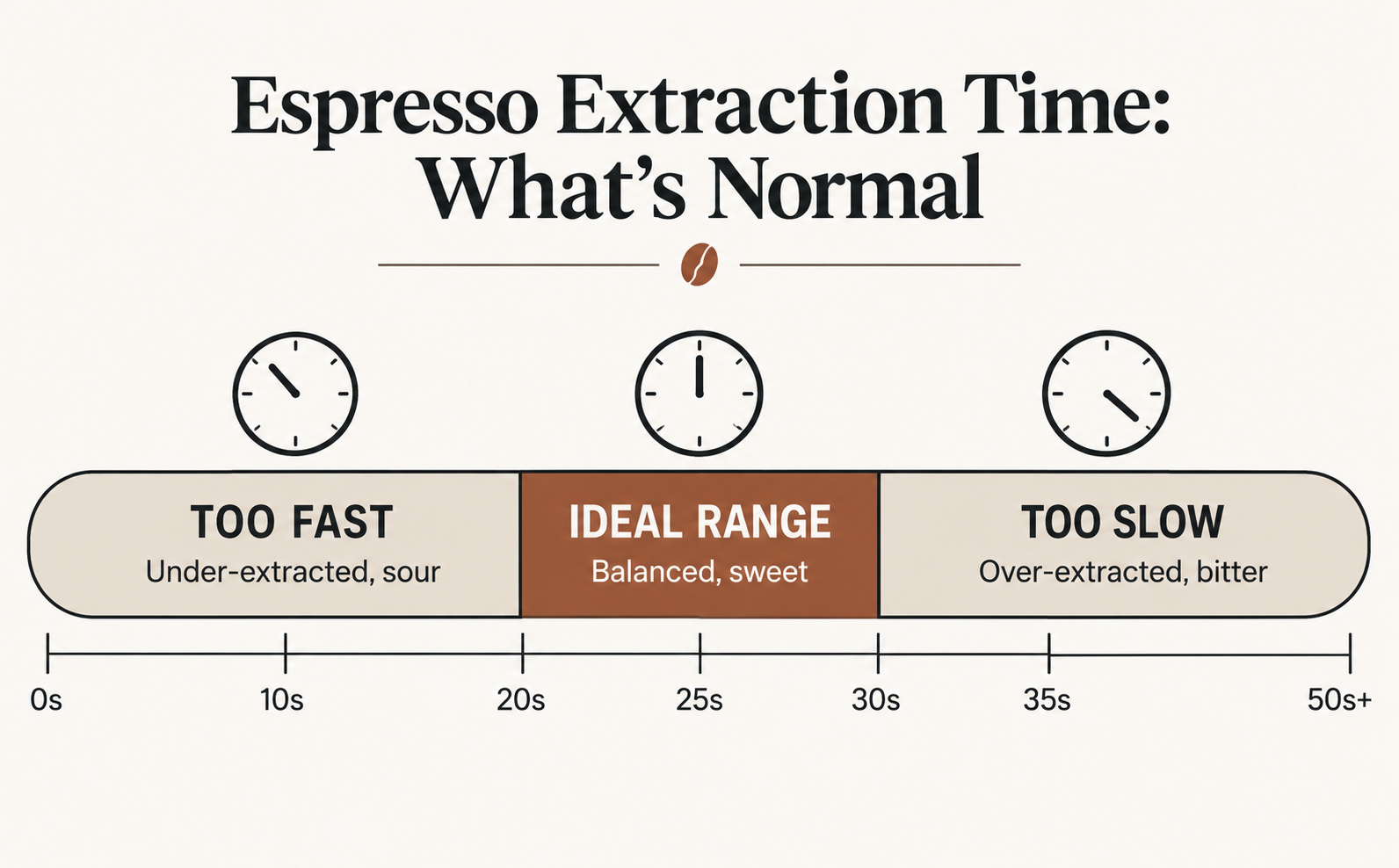
The 25 to 30 second range comes from Italian espresso tradition, built around specific machines, grinders, and roast profiles common decades ago. It stuck around because it’s a reasonable midpoint: fast enough to avoid over-extracting into bitterness, slow enough to avoid under-extracting into sourness, for a fairly wide range of beans and equipment. It is a starting point, not a physical law. Plenty of excellent shots today run 22 seconds or 35 seconds by design, especially with lighter roasts or specific bean origins that taste better outside the traditional window.
Treat the window as where to start testing, not where every shot has to land. If a shot inside 25 to 30 seconds tastes sour or bitter, the time isn’t the problem to fix. The grind, dose, or ratio is.
Time Is a Symptom, Not a Cause
This is the part that trips people up most: you can’t fix a shot by directly targeting its time. If a shot runs in 18 seconds, the instinct is to “make it slower”, but there’s no dial for slower. What you actually adjust is grind size, finer, which increases resistance and, as a side effect, increases time. The same logic runs in reverse for a shot that’s dragging past 40 seconds: you grind coarser to reduce resistance, and the time comes down as a result of that change, not because you told the clock to move.
This is also why watching the clock without watching the cup leads people astray. A shot that hits 27 seconds but tastes flat and watery, or hits 27 seconds but tastes sharp and sour, is not “correct” just because the stopwatch matched the textbook window. Time is a checkpoint to confirm your grind and dose are in a reasonable range. Taste is what tells you whether the shot worked. See the dialing in guide for how grind, dose, and yield work together as a system.
Reading a Fast or Slow Shot
A shot finishing well under 20 seconds is usually under-extracted. The water moved through too easily, water contact time was too short, and the shot will likely taste sour, thin, or salty. The fix is almost always to grind finer (increasing resistance) and to check that the dose is actually correct rather than light. A very fast shot with visible streaking or spurting from the portafilter spout strongly suggests channeling: water found a low-resistance path through the puck rather than extracting evenly, usually from uneven distribution or a cracked, under-tamped puck rather than grind size alone.
A shot dragging past 35 to 40 seconds is usually over-extracted. The water stays in contact with the grounds too long, pulling out compounds that taste bitter, dry, or harsh. The fix is to grind coarser to reduce resistance. A shot that’s both slow and under-yielding (not enough liquid in the cup even after 40+ seconds) often points to a dose that’s too high for the basket, packing the puck too densely for water to move through in a reasonable time.
Common Mistakes
The most common mistake is treating 25 to 30 seconds as a pass/fail test instead of a diagnostic range, and adjusting grind until the clock matches even when the shot tastes wrong. A close second is starting the timer from the wrong point. Timing from when the pump switches on instead of from first drip adds several seconds of pre-infusion time that isn’t part of the actual extraction, making every shot look slower than it is and leading to unnecessary grind changes. Comparing shot times across different beans, roast levels, or machines is another trap; a 22-second shot on a light roast and a 30-second shot on a dark roast can both be correctly dialed in for that specific coffee.
Espresso Extraction Time: Putting It Together
Use time as a checkpoint, not a target. Start a new bean around 25 to 30 seconds for an 18g in, 36g out shot, taste it, and adjust grind size based on what you taste. Sour and thin means grind finer; bitter and harsh means grind coarser. Let the time move wherever it moves as a result of that grind change. Once the shot tastes balanced, whatever time it lands on is the right time for that coffee, on that machine, that day.
What to Check Out Next
For how extraction time fits alongside grind, dose, and yield as one system, start with How to Dial In Espresso. For the ratio side of the equation, see Espresso Brew Ratio Explained. And if a shot’s time looks right but the taste still isn’t, Espresso Troubleshooting walks through reading the cup back to the actual cause.
For the underlying mechanics of how water under pressure moves through the coffee bed on that clock, Wikipedia’s overview of espresso covers the extraction variables in more technical detail.