
Espresso tamping and distribution get talked about backward. Tamping gets more attention than it deserves, and distribution gets less than it deserves. For years, “tamp harder” or “tamp more evenly” was the standard advice for fixing an inconsistent shot, but a hard, level tamp on top of an unevenly distributed puck still lets water carve an easy path straight through the loose spots. Distribution, how evenly the grounds are spread and settled in the basket before you tamp, is what actually determines whether water meets consistent resistance across the whole puck. Tamping just locks in whatever distribution you already have.
This guide covers what tamping is actually for, why distribution matters more than tamp pressure, what WDT (Weiss Distribution Technique) is and why it became standard practice, and how to tell channeling from a genuinely bad shot.
What Tamping Is Actually For
Tamping compresses the ground coffee into a flat, firm puck so water can’t simply push the grounds out of the way instead of extracting through them. A level tamp matters more than a hard one. An angled tamp creates a puck that’s thinner on one side, and water always finds the path of least resistance, extracting faster through the thin side and unevenly across the shot. Beyond level and reasonably firm, extra tamp pressure has diminishing returns; going from a light tamp to a firm one matters, but going from firm to “as hard as you can” mostly just tires out your wrist.
The tamp also can’t fix what happened before it. If the grounds were unevenly distributed in the basket, clumped on one side, or with a dense layer on top and air pockets underneath, tamping just compresses that unevenness into a firmer, harder-to-see version of the same problem.
Why Distribution Matters More
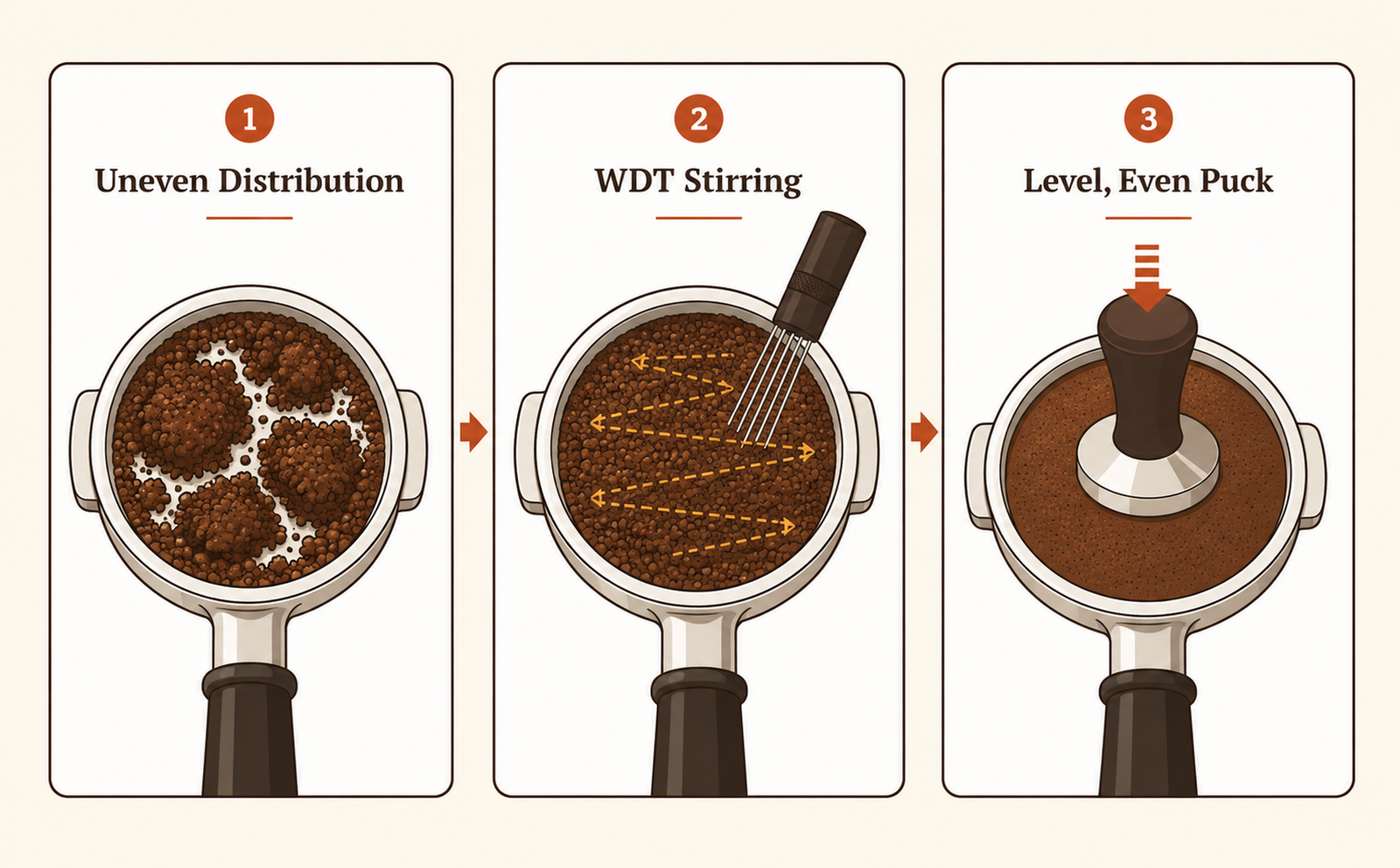
Distribution comes before tamping: it breaks up clumps and spreads the ground coffee evenly across the basket so every part of the puck has roughly the same density. Grinders, even good ones, don’t drop coffee into the basket in a perfectly even layer. Static builds up clumps, some grounds pile in the center, and finer particles tend to settle differently than coarser ones. An uneven distribution means some areas of the puck are denser than others, and since water always takes the path of least resistance, it will extract faster through the loose areas and barely touch the dense ones. Even if the top surface looks level after tamping.
This unevenness causes channeling: water burrows a narrow path through a weak spot in the puck instead of flowing evenly through the whole thing. A channeled shot often pours unevenly (streaking, spurting, or one side of the double spout running faster), finishes faster than expected for the extraction time you’re used to, and tastes both sour and bitter at once. Sour from the coffee the channel bypassed, bitter from the small area it over-extracted on its way through.
WDT: Why It Became Standard Practice
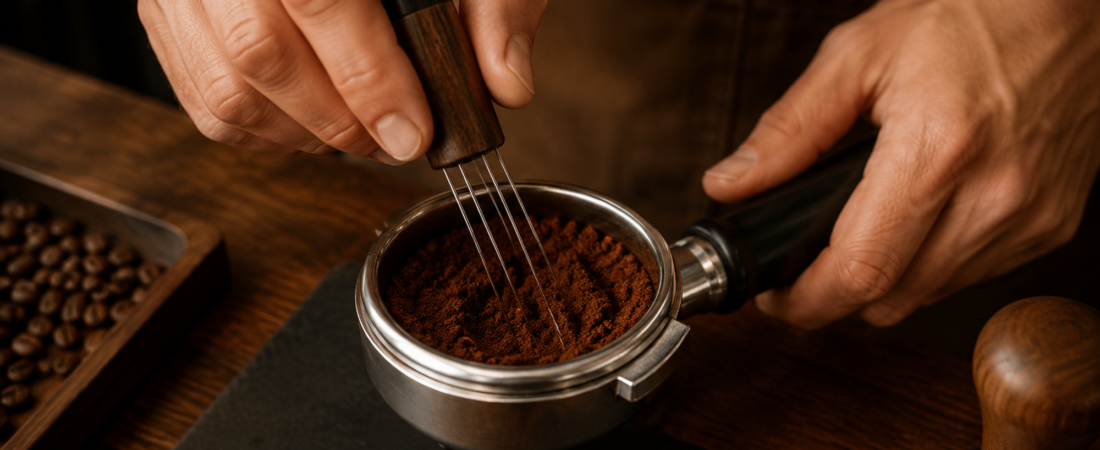
WDT stands for Weiss Distribution Technique, named after the home barista who popularized it. The method is simple: before tamping, stir the loose grounds in the basket with a set of thin needles (a WDT tool, or even a bent paperclip or sewing needle in a handle) in a circular or zigzag motion, breaking up clumps and evening out the density from the bottom of the basket up. It takes maybe 10 to 15 seconds and requires no special skill. Just stir consistently and gently until the grounds look uniform.
WDT has become nearly universal in specialty home espresso because it directly targets the cause of channeling, clumping, and uneven density, rather than trying to compensate with tamp technique after the fact. Baristas who add a WDT step consistently report fewer streaky, fast, sour-and-bitter shots, and more shots that finish in the expected time and ratio for that dose. It’s one of the few near-zero-cost technique changes that reliably improves shot consistency.
How to Tamp After Distributing
Once the grounds are evenly distributed, tamping is mostly about being level and consistent. Tamp straight down, check that the tamper base is parallel to the rim of the basket (not tilted), and use enough pressure to compress the puck firmly. There’s no need to lean on it with your full body weight. A light polish tamp (a second, very light tamp after a small twist) can help settle any loose grounds on the surface, but it’s a minor refinement, not a fix for a bad distribution.
Common Mistakes
The most common mistake is skipping distribution entirely and trying to fix channeling with a harder or more careful tamp. Tamping can’t undo uneven density that’s already baked into the puck. A close second is tamping at an angle without realizing it; a small wobble in wrist position creates a puck that’s thicker on one side, which reads as inconsistent shots even when everything else (grind, dose, ratio) is dialed in correctly. Using a WDT tool too aggressively, stirring so hard it pushes grounds up and over the basket rim, can also make distribution worse, not better; the motion should be light enough to break up clumps without ejecting coffee.
Espresso Tamping and Distribution: Putting It Together
Distribute first, tamp second. Break up clumps with a WDT tool or similar method until the grounds look and feel even across the basket, then tamp level and firm. Not necessarily hard. If shots are streaking, pouring unevenly, or finishing fast and tasting both sour and bitter, look at distribution before assuming it’s a grind or dose problem. Getting this step right is one of the cheapest, most reliable ways to make every other variable- grind size, ratio, extraction time- actually behave the way it’s supposed to.
What to Check Out Next
For how distribution fits alongside grind, dose, and yield, start with How to Dial In Espresso. For reading shot time as a symptom of resistance, see Espresso Extraction Time. And if a shot is coming out streaky, sour, or bitter despite your grind being right, Espresso Troubleshooting walks through channeling and other causes in more depth.
For how the portafilter basket holds the puck this whole process is built around, Wikipedia’s overview of the espresso machine covers the group head and basket geometry in more detail.