
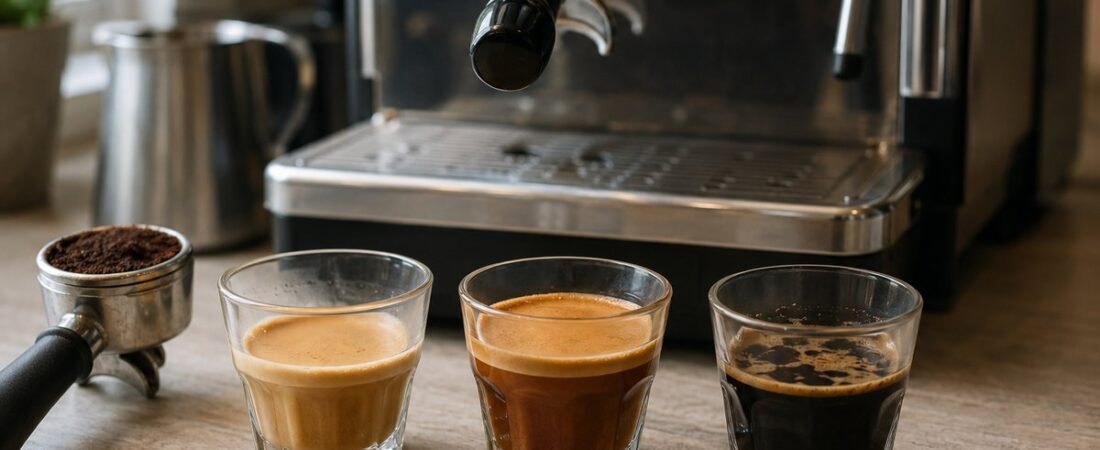
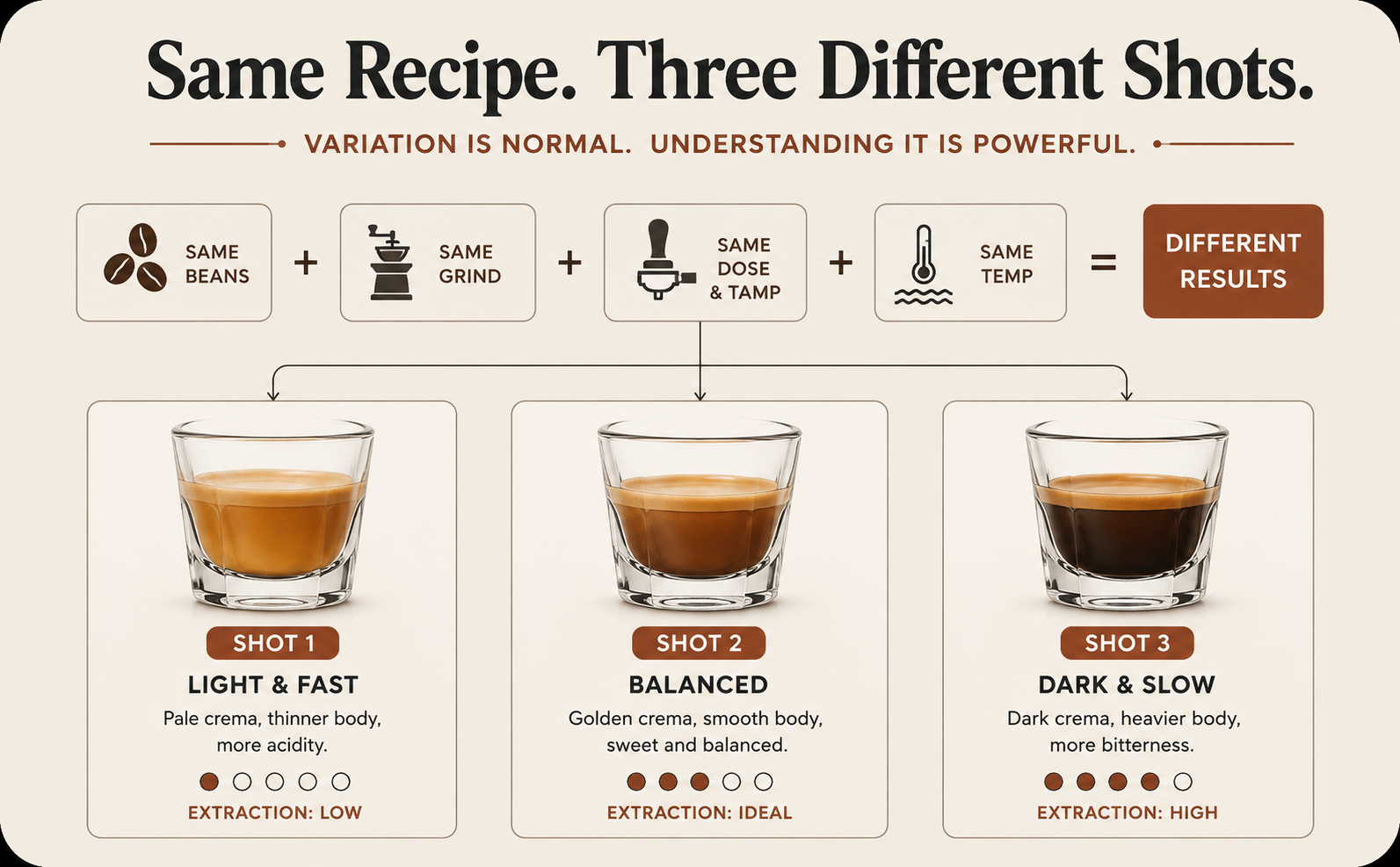
You pull a great shot. Same beans, same grind setting, same everything, and the next one tastes completely different. Sour one pull, bitter the next, fine the one after that. Nothing about your routine changed, but the shot did.
This is one of the most frustrating problems in home espresso, because it isn’t a single mistake you can fix once. It’s usually several small variables drifting independently, each one nudging the shot in a different direction, so the result never repeats. The fix isn’t a new technique. It’s finding which variable is actually moving.
What Inconsistent Espresso Shots Actually Look Like
Inconsistency shows up differently than a single bad shot. A shot that’s always sour points to one clear cause: your grind is too coarse, every time. Inconsistency is different. One shot sour, the next balanced, the one after bitter, with no change in what you think you’re doing.
The giveaway is the pattern, not any single shot. If your shot times swing by more than a couple of seconds from run to run, your yield varies by several grams when you’re aiming for the same target, or the taste genuinely surprises you in either direction, that’s inconsistency. It means something upstream of the shot itself isn’t repeating.
Why It Happens
Espresso has almost no margin for error. A shot is a few seconds of extraction through a few grams of coffee, and small input variations produce outsized differences in the cup. Every step between grinding and brewing is a chance for something to drift without you noticing.
The variables that most often move without you clocking it:
Grind size drift. Burr grinders, especially lower-cost conical burrs, can produce slightly different particle distributions shot to shot even at a fixed setting, particularly as beans age and their oil content changes, or as the burrs pick up static and clump unevenly.
Dose variation. Eyeballing a scoop, or trusting a grinder’s built-in doser, means the actual weight going into the portafilter moves by a gram or more between shots, enough on its own to shift a 1:2 ratio noticeably.
Distribution inconsistency. How evenly the grounds settle in the basket before tamping changes shot to shot unless you’re deliberately distributing (WDT or similar) every time. An uneven puck channels differently each pull, even from the same dose and grind.
Tamp pressure and level. A tamp that’s slightly off-level, or pressed with different force shot to shot, changes how water moves through the puck.
Bean freshness curve. Beans continue degassing for one to three weeks after roasting, and that CO2 changes how water flows through the puck during that window. A bag that tasted right on day 5 can pull differently by day 15, even if nothing else in your routine changes.
Temperature stability. Single-boiler machines, in particular, can vary a few degrees between shots depending on how long it’s been since the last pull and how long the machine’s been idle, which shifts extraction even with an identical grind and dose.
Water changes. If you’re not using the same water (filtered, bottled, or consistent tap), mineral content differences alone can shift extraction and taste.
The Most Common Causes, Ranked
Most inconsistency traces back to one of these, roughly in order of how often it’s the actual culprit:
- Inconsistent dosing: not weighing every shot, or weighing but not double-checking that the scale is zeroed and stable.
- Grinder burr wear or grind-setting creep: especially on grinders with a friction-fit or unmarked stepless collar that can shift slightly between uses.
- Distribution skipped on some shots but not others: doing WDT when you remember, skipping it when you’re in a hurry.
- Bean age moving through the degassing window: same beans, different day, genuinely different shot.
- Machine not fully up to temperature: pulling a shot right after turning the machine on, or right after a long idle period, before the group head has stabilized.
Fixes, in the Order to Try Them
Start by weighing everything, every time. Dose and yield, on a scale, no exceptions. This alone removes one of the biggest sources of shot-to-shot variation, and it costs nothing.
Standardize your distribution step. Pick one method (WDT tool, tap-and-swirl, whatever you’ve settled on) and do it identically on every shot, not just the ones where you remember or have time.
Check that your grinder’s setting hasn’t drifted. If it’s a stepless grinder, mark your working setting with tape or a paint pen so you can visually confirm it hasn’t shifted between uses. If it’s a cheap conical burr grinder, know that some shot-to-shot variation is close to unavoidable. A burr upgrade is the real fix, not more careful technique.
Let the machine reach full temperature before pulling. Give a single-boiler machine a few extra minutes past its “ready” light, or pull and discard a blank shot first, to stabilize group temperature before the shot that counts.
Track your bean’s age. Note the roast date and don’t be surprised if the same bag tastes different at day 4 versus day 12. That’s the beans, not your technique, and it’s a reason to taste and adjust rather than assume something’s broken.
Keep a simple shot log. Grind setting, dose, yield, time, and taste, for even just a week. Patterns that feel random in the moment are often obvious once they’re written down. You may find, for example, that every inconsistent shot happens right after the machine’s been idle for over an hour.
Common Mistakes
Changing more than one variable between shots. If a shot tastes off and you adjust grind, dose, and tamp pressure all before the next pull, you’ll never know which change fixed (or caused) the difference. Change one thing, taste, then decide.
Blaming the machine before ruling out technique. Most inconsistency on home equipment comes from dosing or distribution habits, not a defective machine.
Assuming a scale reading is stable when it isn’t. Cheap scales can drift, especially with a warm portafilter sitting on them. Zero it fresh for every shot rather than trusting a reading from a few minutes ago.
Chasing an exact recipe instead of a consistent process. The goal isn’t hitting 18.5g in and 37g out to the tenth of a gram every single time. It’s having a repeatable process so that when a shot does taste different, you have one clear variable to check instead of five possible ones.
Inconsistent Shots: Putting It Together
Inconsistency almost never has one dramatic cause. It’s usually two or three small habits that aren’t quite locked in yet: dosing by eye instead of by scale, skipping distribution when you’re rushed, not tracking where your beans are in their degassing window. None of these show up as an obvious mistake in the moment. They show up as “why did today’s shot taste different from yesterday’s?”
The fix is the same in every case: remove variables one at a time until the only thing changing between shots is the thing you’re deliberately testing. Weigh everything, distribute every time, mark your grind setting, and give the machine time to stabilize. Once those are locked in, the shots that still vary are telling you something real, usually about the beans, instead of just noise from an unstandardized process.
What to Check Out Next
If your shots are consistently sour or consistently bitter rather than swinging both directions, that’s a different, more specific diagnosis. See Bitter or Sluggish Espresso Shots. If you suspect the swings are actually channeling hiding inside otherwise-similar shots, read Channeling: What It Looks Like, Why It Happens, and How to Stop It. And once every variable here is locked down, and shots are still unpredictable, that’s the signal to check whether it’s technique or equipment.
Standardizing and isolating one variable at a time is really the whole method for tracking down inconsistent espresso shots. For the underlying extraction variables this same process is built around, Wikipedia’s overview of espresso is a useful technical reference.