
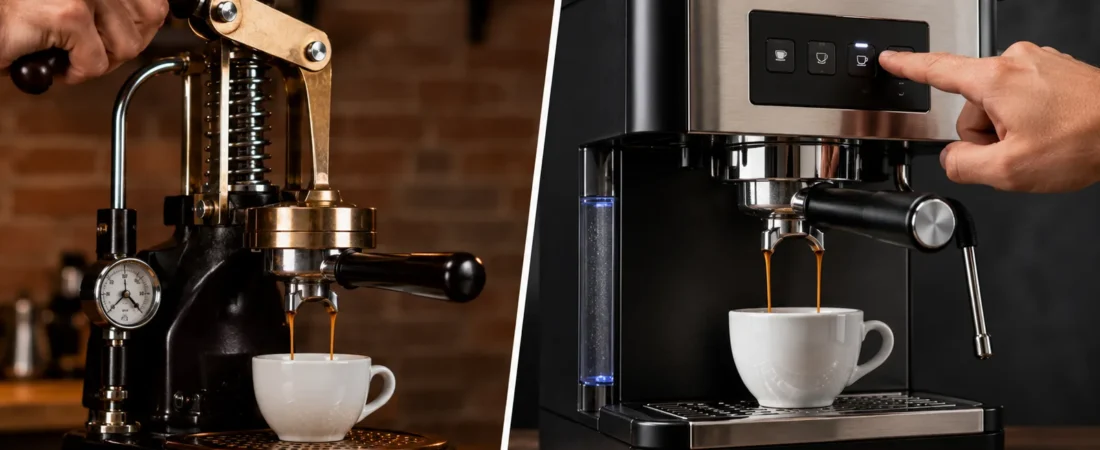
Most espresso machines a beginner considers fall into one of two learning experiences, regardless of brand or price. A manual machine puts you in direct control of pressure. A semi-automatic machine hands that job to an electric pump and lets you focus on everything else. The manual vs semi-automatic espresso machine question isn't about which one makes better coffee. Both can, in the right hands. It's about which skills you want to build.
We already covered the full lineup of espresso machine types and how the machine works under the hood. This article focuses on the one decision that confuses more beginners than any other: manual lever machines versus semi-automatic pump machines, and what each one teaches you.
What a Manual vs Semi-Automatic Espresso Machine Means
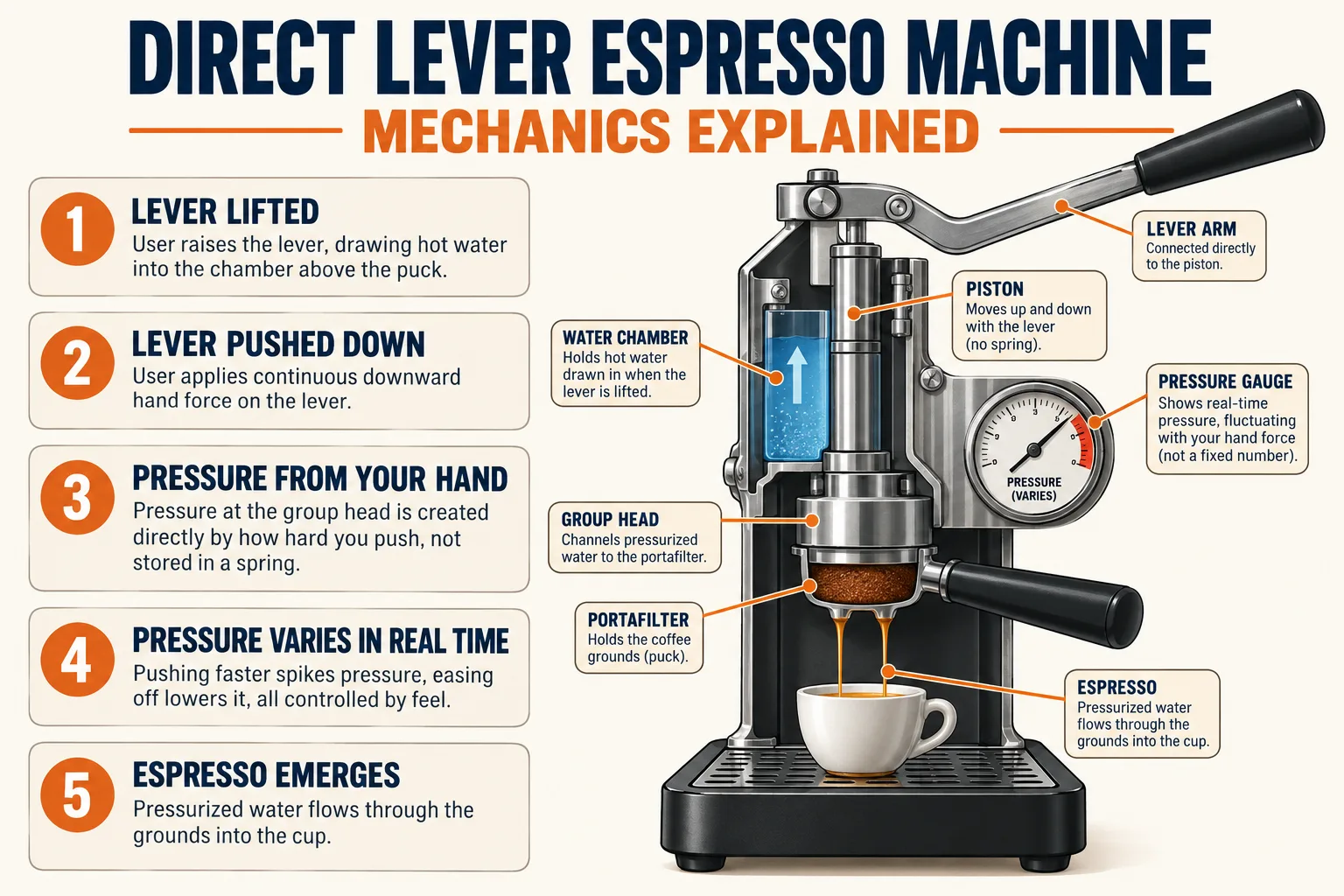
A manual espresso machine, usually called a lever machine, builds pressure through a spring or a direct hand pump. You pull the lever down, a spring compresses, and that stored energy forces hot water through the coffee puck (the pressed cake of coffee grounds in the basket). The pressure curve rises and falls based on how you move the lever. Push it fast, get a spike. Ease it down, get something closer to a smooth curve. No electronic pump does this work for you.
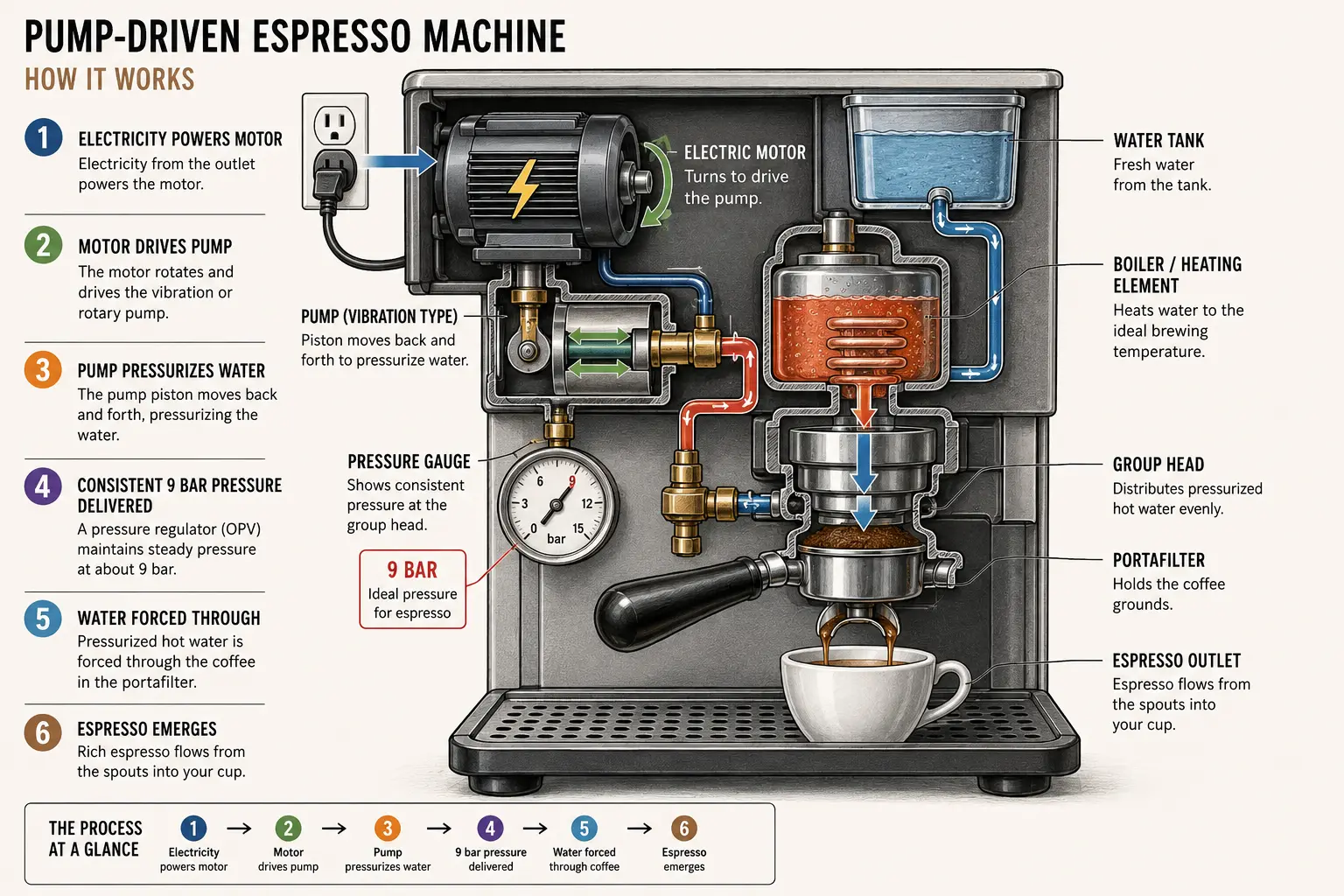
A semi-automatic machine uses an electric vibration or rotary pump instead. Flip a switch, and the pump pressurizes water to roughly 9 bar of pressure and holds it there for the length of the shot. The machine handles pressure consistency automatically. You still control dose, grind size, tamp pressure, and shot timing, which is why it's called semi-automatic rather than fully automatic. But the one variable that intimidates most beginners, getting the pressure right, is already handled before you even start pulling the shot.
How Each One Teaches You Differently
The real difference shows up here, and it's the part most buying guides skip.
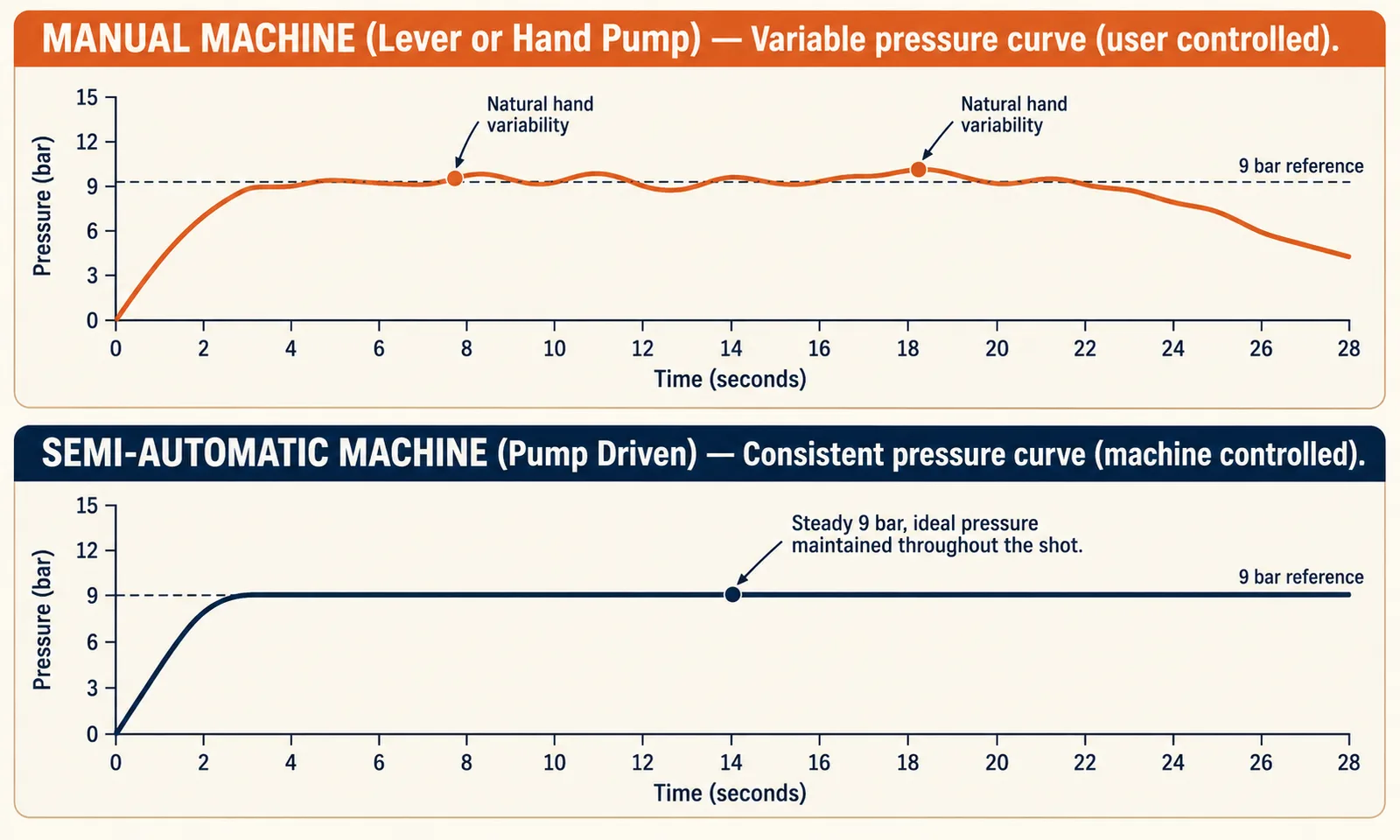
On a manual machine, the pressure gauge (if it has one) becomes your feedback loop. Pull too fast early in the shot and you'll see the needle spike past 12 bar. Ease off too much, and it drops below 6. Somewhere in the middle, usually around 9 bar held for several seconds, is the sweet spot that produces balanced extraction. You learn to feel that sweet spot through repetition. Every shot gives you immediate, physical feedback about what your hand just did.
A semi-automatic machine removes that feedback loop entirely. The pump delivers a steady 9 bar whether your technique is good or not. That's not a flaw. It's a deliberate simplification. With pressure locked in, you can isolate the other variables that determine shot quality: how fine you grind, how much coffee you dose, how evenly you tamp. Beginners often find this faster to learn from, because they're not trying to master four things simultaneously.
Neither approach is wrong. A manual machine teaches you what pressure feels like, which is knowledge you can't get any other way. A semi-automatic machine teaches you everything else first, and lets pressure become a later lesson if you ever move to a lever machine down the road.
The Learning Curve, Week by Week
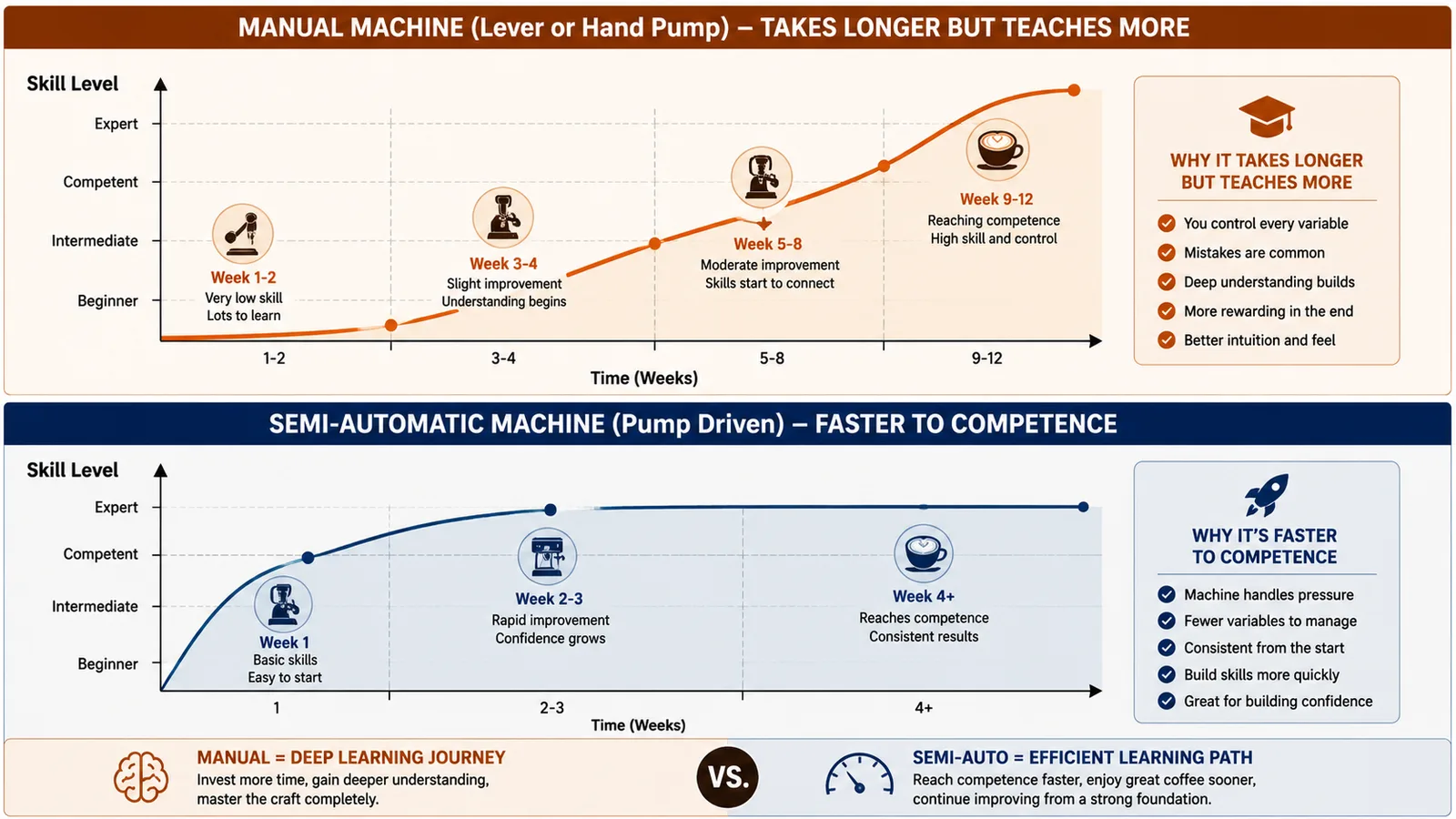
Manual machines take longer to feel comfortable with, and that's by design. In the first week or two, expect inconsistent shots. You're still learning how much lever pressure translates into how much water pressure, and that relationship isn't intuitive the first time you try it. By weeks three or four, most people start recognizing the difference between a rushed pull and a controlled one just by watching the flow. Real competence, where you can pull a consistent shot on demand, tends to arrive somewhere around week nine to twelve of regular practice.
Semi-automatic machines compress that timeline considerably. Basic shots are drinkable within the first week, since the machine is already doing the hardest part. Confidence usually builds fast over weeks two and three as dialing in grind and dose becomes the main focus instead of pressure control. Most people reach a consistent, repeatable result by week four, sometimes sooner.
Neither timeline measures how good the espresso is. It measures how many variables you're managing while you learn.
Maintenance and Day-to-Day Reality for a Manual Espresso Machine
Manual machines are mechanically simpler in some ways. Fewer electronic components means fewer things that can fail electronically, though the lever mechanism, spring, and seals still need occasional attention. Worn seals usually show up first as leaks or a sluggish lever after a few years of regular use. Many lever machines also require more manual involvement in temperature management, since some models don't have automated thermostats as precise as electric machines. You may need to watch a temperature gauge and time your shots around it rather than trusting the machine to hold steady on its own.
Semi-automatic machines bring more electronics into the picture (pumps, boilers, sometimes PID controllers for temperature stability), which means more potential points of failure, but also more day-to-day consistency without you having to think about it. A pump can wear out, or a boiler element can fail, and either repair usually costs more than fixing a spring or a seal on a manual machine. Descaling requirements are similar across both types and depend more on your water hardness than on the machine category. Either one benefits from filtered or soft water and a regular descaling schedule, typically every one to three months depending on how hard your tap water runs.
Cost Differences Worth Knowing
Entry-level semi-automatic machines are generally more affordable and more widely available than entry-level manual lever machines. Manual machines, especially well-built spring lever models, tend to cost more for comparable build quality, partly because they're a smaller, more specialized market. If budget is the primary constraint, semi-automatic options usually offer more choices under $300.
Common Mistakes Beginners Make With Each
On a manual machine, the most common early mistake is pulling the lever too aggressively at the start of the shot. That pressure spike over-extracts the coffee closest to the shower screen (the metal screen that spreads water over the coffee) before the rest of the puck has even started brewing. That shows up as a sharp, bitter edge in the cup. The fix isn't complicated, just slower and more deliberate: ease into the pull instead of pulling it down hard.
On a semi-automatic machine, the mistake usually isn't pressure, since the pump handles that. It's assuming the machine is doing more of the work than it is. Beginners will grind too coarse, dose too little, or skip tamping evenly, and then blame the machine when the shot comes out watery or sour. Since pressure is no longer the variable to troubleshoot, grind size becomes the first thing to check when a shot goes wrong.
Which One Should You Start With
If you're drawn to the mechanical, hands-on side of espresso and you don't mind a slower learning curve in exchange for a deeper understanding of pressure and extraction, a manual machine rewards that patience. You'll end up understanding espresso at a level that semi-automatic users often never reach, because you had to feel it to get it right.
If you want to start pulling good shots sooner and would rather focus your early learning on grind, dose, and tamp instead of pressure, a semi-automatic machine gets you there faster. It's also the more forgiving choice if espresso is a new hobby you're still deciding whether to commit to. You can always move to a manual machine later once you already understand the fundamentals.
Neither choice locks you in forever. Plenty of home baristas start semi-automatic and move to manual once they want more control. Fewer go the other direction, mostly because by the time you've mastered a manual machine, you already have the skills a semi-automatic machine would have taught you anyway.
For more on getting started with espresso at home, see the Beginner's Essentials hub.
What to Read Next
Once you know which direction fits you, our starter kit guide breaks down specific machine and grinder pairings in both categories, all under $500. And if you want the full picture of every machine type beyond just these two, the complete machine types breakdown covers super-automatic and capsule machines as well.
The Final Take
A manual machine and a semi-automatic machine can both make excellent espresso. The real difference is what you're signing up to learn, and how fast you want to learn it. Manual machines teach you pressure control through direct feedback, but it takes longer before your shots are consistent. Semi-automatic machines hand you consistent pressure from day one, so you can spend your early weeks mastering everything else. Pick the one that matches how you want to spend your first few months with espresso, not just which one sounds more impressive on a counter.
A manual espresso machine rewards patience: it's harder to learn, but it teaches pressure control no semi-automatic machine ever will. If you want to understand espresso rather than just make it, a manual espresso machine is worth the longer learning period.