
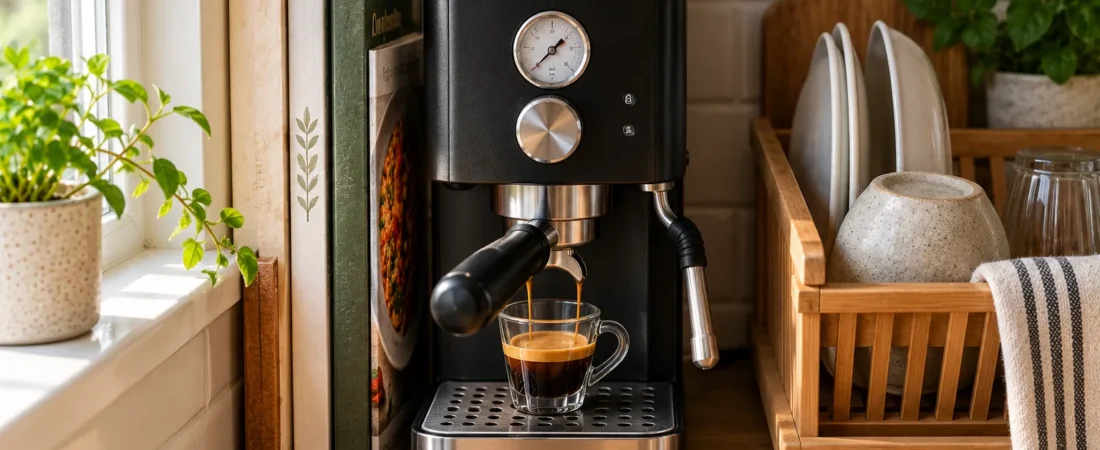
Most espresso machine buying guides sort their picks by price, and stop there. That works fine until you try to use one of those "winners" in real life and find out the large dual boiler (separate boilers for brewing and steaming) doesn't fit next to your sink, or the machine built for a family of five is more than you need for the one cup you make before your 9 am call. The best compact espresso machine for your situation depends less on your budget tier and more on where the machine lives and how often you use it. This guide sorts machines by use case instead, so you can match the machine to your routine.
If you want the full mechanical rundown on why boiler configuration changes everything about a machine's size and speed, our guide to espresso machine types is the place to start. This article assumes you've got the basics down and want to know which type fits your kitchen, your desk, or your suitcase.
Best Compact Espresso Machine for a Small Kitchen
If you're searching for the best compact espresso machine, you probably have a narrow strip of counter between the toaster and the sink, not a dedicated espresso station. That's the most common real-world constraint, and it rules out a lot of machines before you even get to taste or price.
Width matters most here, more than depth or height, because counters are usually tight side-to-side, not front-to-back. Many compact espresso machines are under 6 inches wide, which is narrow enough to slot into a gap that would never fit a full-size dual boiler unit. When you're shopping, measure your counter before you add anything to your cart. A spec sheet number means nothing until you've confirmed it against the actual space.
Beyond width, simplicity is your friend in a small kitchen. A single-boiler machine is inherently more compact than a heat exchanger (one boiler that also heats the brew water as it passes through) or dual-boiler design, because it doesn't need the extra plumbing and second thermal chamber that make those machines bigger and heavier. You'll wait a bit longer between pulling a shot and steaming milk on a single boiler. The machine needs to shift temperature between the two tasks, but for most small-kitchen households making one or two drinks at a time, that tradeoff is easy to live with. Our single boiler vs. dual boiler comparison walks through exactly what you gain and lose with each setup.
A few other things to prioritize when space is tight: a removable water reservoir that doesn't require pulling the machine away from the wall to refill, a portafilter (the handle that holds the basket of coffee) that doesn't need three extra inches of clearance to swing free, and a drip tray you can empty without unplugging anything. None of these show up on a spec sheet as "compact," but they all affect how livable the machine is in a small footprint.
It's also worth thinking about height, not just width. Many small kitchens have upper cabinets that sit low over the counter, and a taller machine with a fixed steam wand can bump right into them, especially if you need to lift a milk pitcher under the wand. Measure the vertical clearance the same way you measure width, and check whether the portafilter has enough room to be inserted and removed at an angle without hitting the cabinet above it. A machine that's narrow enough to fit but too tall to use comfortably isn't compact in any way that matters.
One more small-kitchen consideration: cord length and outlet placement. Compact machines are often pushed into corners or against a backsplash where the nearest outlet isn't directly behind them, and a short cord can force awkward workarounds. It's a minor detail, but it's exactly the kind of thing that turns "this fits" into "this fits, but I have to unplug the toaster every morning to make room."
Best Setup for a Home Office or Single-Person Household
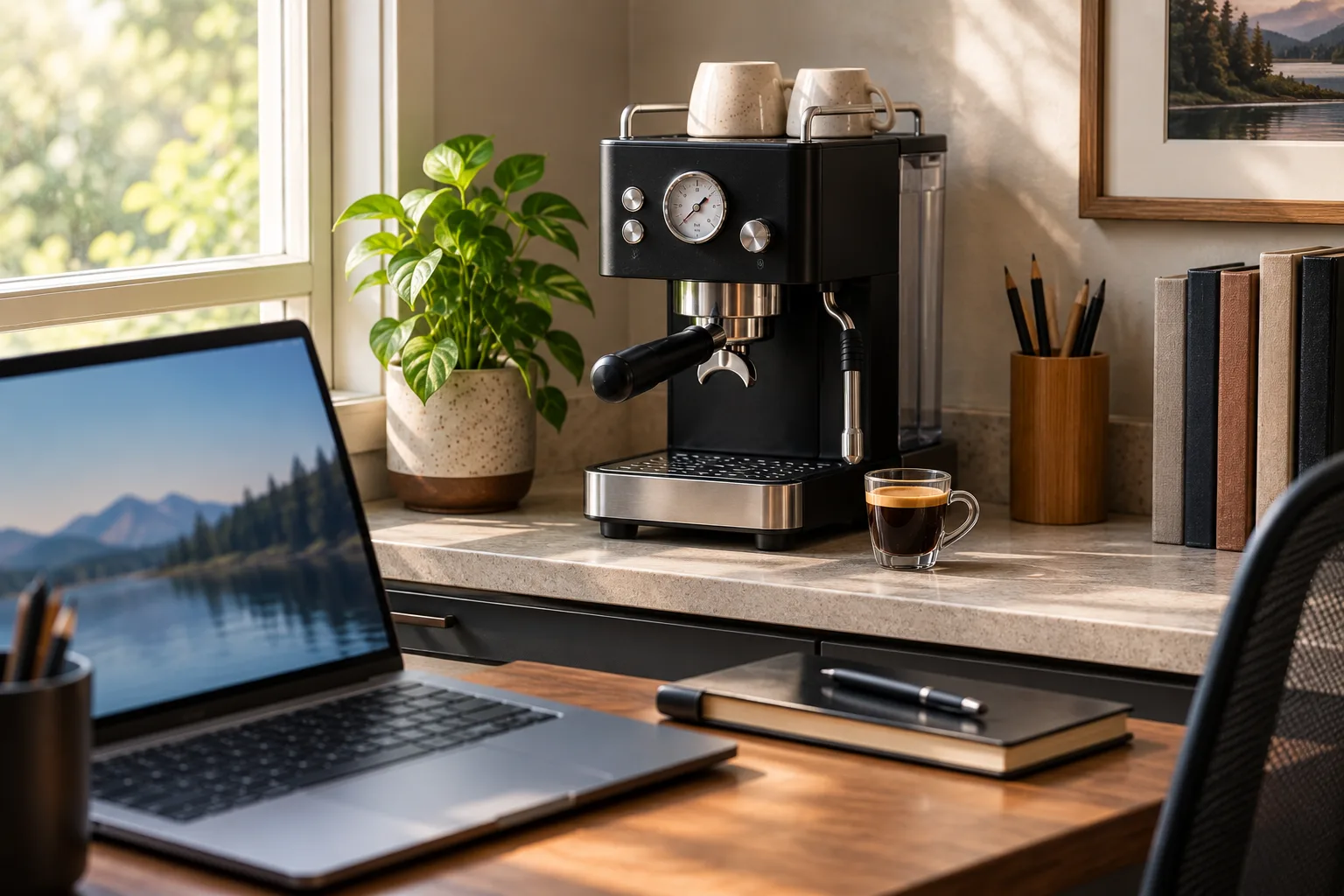
If you're brewing for one, whether that's a home office setup or a single-person household, your priority isn't raw speed or capacity. It's low friction. You want to walk up, pull a shot, and get back to work without watching over the machine or running a cleaning cycle every other day.
A simple semi-automatic single-boiler machine fits this situation best. You control the shot manually. There's no complicated temperature routine to learn, and maintenance is minimal because you're not scaling up the internals to handle constant back-to-back use. If you also want milk drinks, a single boiler still handles that fine for one person a day. You're just accepting the temperature-switch wait between espresso and steam, which barely registers when you're only making one drink at a time anyway.
Low volume also means you can get away with a smaller water reservoir and a smaller machine overall without it ever feeling like a limitation. You're refilling it every few days regardless of tank size, so there's no reason to pay for capacity you won't use. If budget is a factor, this is also the use case where an entry-level machine makes the most sense, since light use won't expose the shortcuts in a budget build. Our picks for the best espresso machine under $500 lean heavily toward machines that suit exactly this kind of single-user routine.
Don't overlook noise and heat-up time either, since those matter more in a single-person office setup than they do in a busy family kitchen where nobody's on a video call ten feet away. A pump that runs loud for fifteen seconds isn't a big deal in a kitchen full of morning chatter, but it's a different story when it's you, a closed door, and a call that started thirty seconds ago.
Similarly, a machine that needs a long warm-up before it's ready to pull a shot is more noticeable when you're the only one using it, and every use starts from cold. Check the warm-up time before buying if your schedule doesn't allow for a five-minute wait every time you want a cup.
Best Setup for a High-Volume Household (Multiple Daily Drinkers)
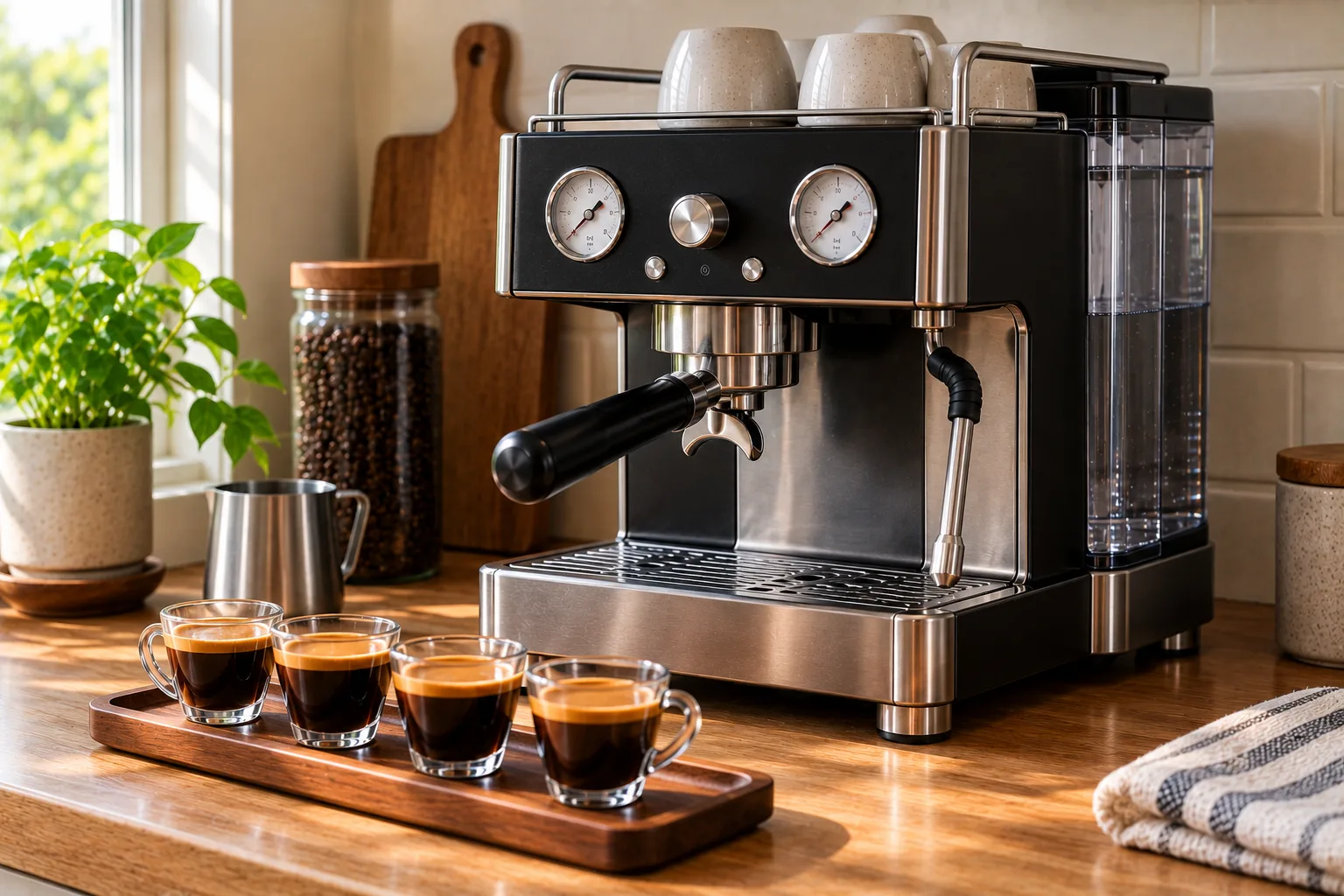
Two or more people pulling shots and steaming milk every morning changes the math entirely. The bottleneck in a single-boiler machine, waiting for the boiler to shift from brew temperature to steam temperature and back, turns from a minor inconvenience into a real delay when several people are waiting.
Heat exchanger and dual boiler machines exist specifically to solve this. A heat exchanger machine keeps a steam boiler at temperature while a tube running through it heats water for brewing on demand, so you can steam and brew without the multi-minute wait a single boiler needs to switch modes. Dual boiler machines take it a step further with two fully independent boilers, one dedicated to brewing and one to steam, so both stay at their ideal temperature simultaneously with no compromise.
Neither of these is small. The extra hardware needed to run two thermal systems takes up more room, and that's a fair trade if your household is generating the demand to justify it. For the full mechanical breakdown of how these designs differ, see our single boiler vs. dual boiler guide.
Reservoir size matters more here too. A tank that's fine for one person's daily cup will need refilling constantly if four people are pulling shots before work. Look for a larger water reservoir and, if you're going through beans quickly, a hopper or bean container sized for how much the household consumes, not just what looks proportional to the machine.
Recovery time is another factor that only shows up once you're running multiple drinks back to back. A machine that pulls one excellent shot in isolation can still feel sluggish in a household setting if it needs several minutes to reheat and stabilize before the next shot. Heat exchanger and dual boiler machines generally recover faster between shots than single boilers, which is part of why they're worth the extra size and cost once you're regularly serving more than one or two people in the same morning window.
If you're weighing whether your household needs that jump, ask yourself how often two people want espresso within five minutes of each other. If the answer is "most days," you'll notice the recovery-time difference, not the shot quality.
Best Espresso Machine for Travel
Travel is really its own category, separate from everything above. No countertop machine, however compact, is built to survive a suitcase or run without a wall outlet, so if you're after espresso in a hotel room, a campsite, or an Airbnb with no equipment, you're looking at manual pump espresso makers instead: small hand-operated devices that build pressure by hand rather than with an electric pump and boiler.
These are a different tool than anything else in this guide. They skip boilers and reservoirs entirely, usually work with hot water you supply from a kettle or thermos, and trade consistency and ease for portability. They're worth knowing about if travel espresso is a real need, but they're outside this site's focus. Our coverage focuses on countertop machines, and the comparisons above apply there.
Matching the Machine to the Use Case
Line these use cases up, and a pattern shows up fast: the question that matters most isn't "what's the best espresso machine" in the abstract. It's "how many drinks, how often, in how much space." A small kitchen and a single-person household often want the same answer: compact, single-boiler, low-maintenance, even though the reasons are different (one is a space constraint, the other is a volume constraint). A high-volume household needs to spend its size and budget solving the brew-to-steam bottleneck, because that's the real daily friction point, not cosmetic upgrades. And travel needs are solved by a completely different product category, not a smaller version of the machines above.
If you're still narrowing things down, our how to choose an espresso machine guide walks through the full decision process step by step. Our breakdown of espresso machines by price tier is a useful second filter once you know which use case you're buying for.
For a closer look at two compact Breville machines, see our Bambino vs Bambino Plus comparison.
Which One to Buy
No single compact espresso machine is best for everyone. There's a machine that fits your counter, your household's morning rush, or your desk, and matching that use case correctly will do more for your day-to-day happiness than chasing a slightly better price or a slightly higher-rated model. Figure out where the machine lives and how many people are using it, then shop within that category. That's a better filter than price alone, and it's the one that will hold up once the machine is sitting on your counter instead of in a browser tab.
Weighing two specific models against each other? See how Breville compares to De'Longhi head to head.
For more on choosing and comparing machines, see the Espresso Machines hub.