
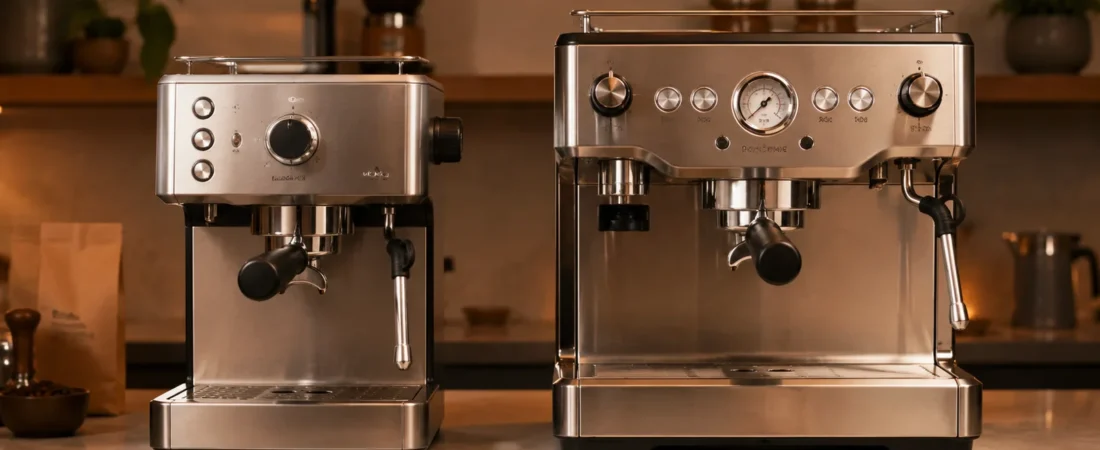
Once you get past choosing between semi-automatic and super-automatic, the next big decision hiding inside almost every espresso machine listing is boiler configuration. Single-boiler vs. dual-boiler espresso machine comparisons show up constantly in buying guides, and the price gap between the two can run into the hundreds of dollars. Most of those guides treat it as a pure spec sheet question. For a beginner, it's a timing question: does this matter yet, or is it something you grow into?
We've already covered starter-kit combinations and why the grinder matters more than the machine. This article picks up where those leave off, once you're comparing specific machines and boiler specs start showing up in every listing.
Single Boiler vs Dual Boiler Espresso Machine: Why It Matters More Than It Looks
An espresso machine needs two very different water temperatures to do its job. Brewing espresso wants water around 195 to 205 degrees Fahrenheit. Steaming milk wants water closer to 250 degrees, pushed out as pressurized steam. How a machine manages those two jobs, with one heating chamber or two, shapes everything from your morning routine to your final price tag.
This isn't a cosmetic feature like a drip tray design or a housing color. It changes how consistent your shots are, how long you wait between drinks, and how much you'll spend both upfront and over the life of the machine. Understand it before you fall in love with a specific model, not after.
How a Single Boiler Espresso Machine Works
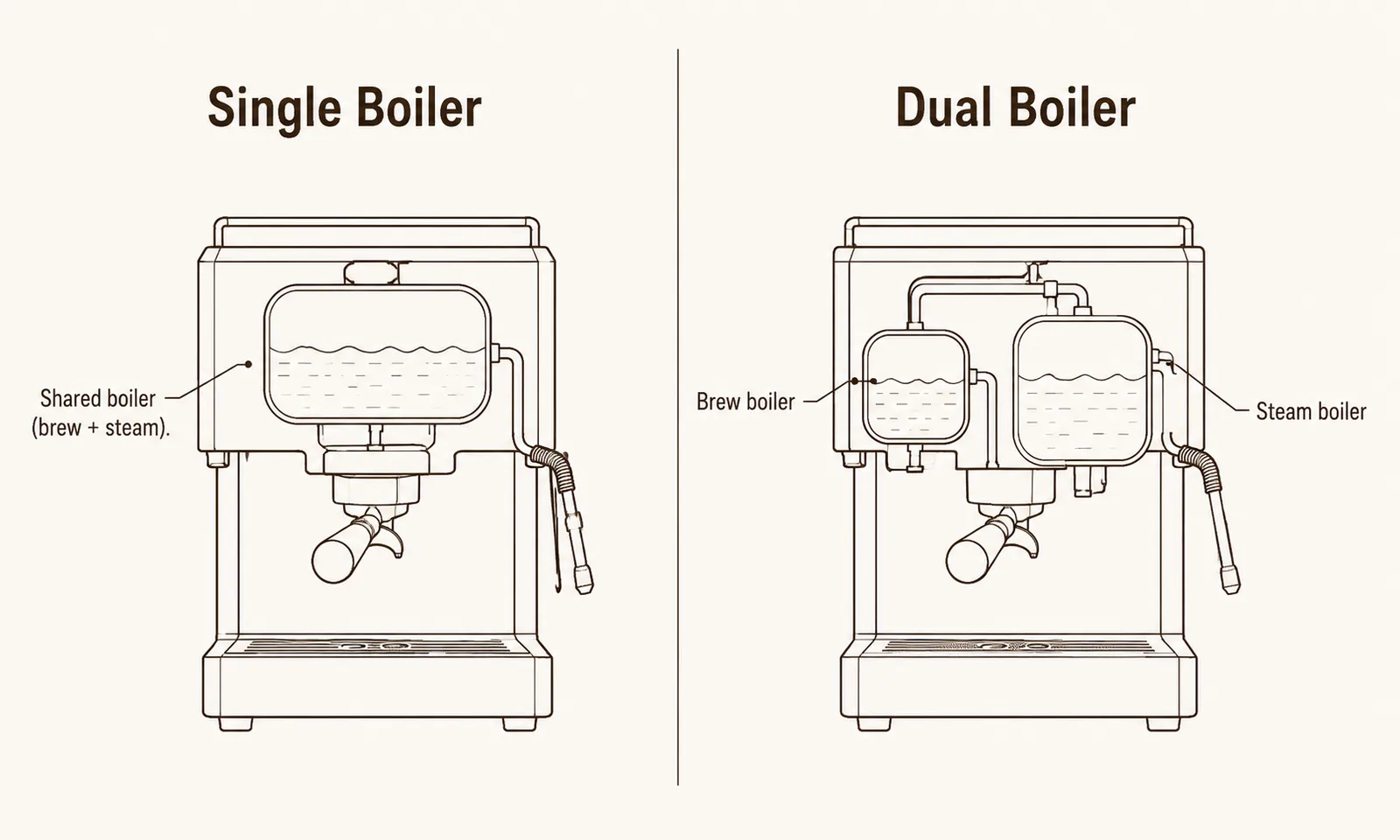
A single-boiler machine has one heating chamber that handles both brewing and steaming. You set it to brew temperature, pull your shot, then wait for it to climb to steam temperature before you can froth milk. Some machines handle that transition in under a minute. Others take closer to three or four minutes, especially cheaper models with smaller boilers.
The tradeoff is straightforward. You get a simpler machine, usually at a meaningfully lower price, with fewer parts that can fail. You give up speed and, if you're making milk drinks daily, a bit of patience. If you mostly drink straight espresso or an occasional milk drink, that wait rarely matters. If you're making lattes for two people every morning before work, it adds up fast.
How a Dual Boiler Machine Works
A dual boiler machine uses two separate heating chambers, one dedicated to brewing and one dedicated to steaming, running at the same time. You don't have to wait for the machine to switch temperatures because it never has to. You can pull a shot and steam milk back-to-back, sometimes even at the same time on higher-end machines with independent controls for each boiler.
That independence is also why dual boilers tend to hold temperature more consistently shot after shot. Clive Coffee's comparison of the two configurations notes that a dedicated brew boiler can hold water within a degree or two of your target temperature consistently. That's because it isn't being pulled toward steam temperature between drinks the way a single boiler is. For someone dialing in shots and trying to understand why one pull tastes different from the last, that consistency removes a variable you'd otherwise have to think about.
The cost of that consistency is real. Dual boiler machines typically start several hundred dollars above a comparable single boiler machine, and the extra boiler, extra plumbing, and often more complex electronics mean more that can eventually need service.
Where Heat Exchanger Machines Fit In
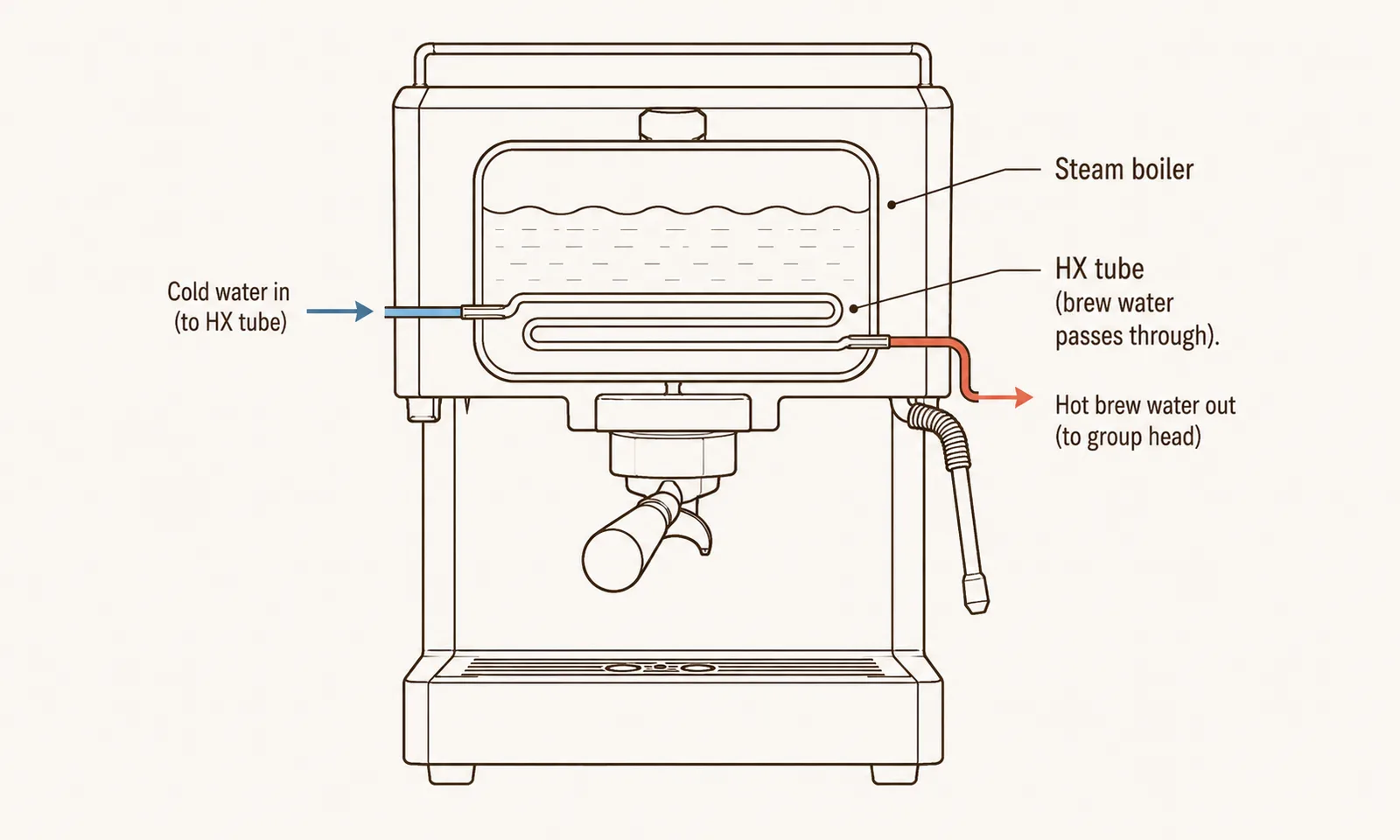
You'll run into a third term while shopping: heat exchanger, often shortened to HX. A heat exchanger machine has one main boiler kept at steam temperature. A separate tube of fresh water runs through it and gets heated to brew temperature on its way to the group head (the part of the machine the portafilter locks into). It's a middle path. You get near-simultaneous brewing and steaming like a dual boiler, at a price and mechanical complexity closer to a single boiler.
The tradeoff with heat exchanger machines shows up in something called temperature surfing, the habit of running water through the group head to bring it back down to brew temperature after the machine has been idle. It's a learnable habit, but it's one more thing a beginner has to pick up that dual boiler owners don't need to think about at all.
What to Look For Before You Buy
Temperature stability. Look for machines with PID temperature controllers, which actively regulate boiler temperature instead of just cycling a thermostat on and off. A PID matters more on single-boiler and heat-exchanger machines, where temperature swings are more likely, than on a dual boiler with a stable dedicated brew boiler.
Boiler size. A larger boiler, even on a single boiler machine, recovers heat faster and holds temperature more steadily than a small one. Two single boiler machines at similar prices can behave very differently depending on boiler capacity.
Realistic daily use. Count how many milk drinks you make on a typical morning, not on your best day. Someone making one latte a day has very different needs than someone making four.
Plumbed vs reservoir. Dual boiler machines are more likely to offer a plumbed-in option, which removes the water tank refill task entirely. It's not a dealbreaker either way, but worth knowing before you commit to a kitchen layout.
Boiler Type by Budget and Use Case
Under $400: Single boiler, PID-equipped if possible. At this price, you're choosing between a basic single boiler and a slightly better single boiler with temperature control. Prioritize the PID. It does more for shot consistency at this budget than any other single feature.
$500 to $900: Heat exchanger territory. HX machines start to make sense here, giving you near-simultaneous brew and steam without the price jump of a full dual boiler. If milk drinks are part of your daily routine and your budget allows it, this tier is often the better beginner fit than stretching for a dual boiler.
$1,000 and up: Dual boiler. Once you're in this range, dual boiler machines become realistic, and the simultaneous brew-and-steam workflow plus very stable temperature start to justify the price for someone who already knows espresso is a long-term habit, not a passing interest.
Common Mistakes Beginners Make With Boiler Choice
The most common mistake is buying a dual boiler machine before knowing whether espresso is going to stick. It's the right answer for someone who has already been making espresso for months and knows they'll keep going. For someone buying their first machine, it's often better to spend that money on a better grinder.
The second mistake is underestimating boiler size on a budget single-boiler machine. Not all single boilers are equal, and a machine with a tiny boiler can leave you waiting far longer between brew and steam than the "single boiler" label alone suggests.
The third mistake is assuming heat exchanger machines require no extra skill. Temperature surfing is simple once you know it, but nobody enjoys learning it by accident because a shot came out scorched.
When to Upgrade From Single Boiler to Dual Boiler
The real signal to upgrade isn't a specific month or dollar amount. It's when the wait between brewing and steaming becomes a daily annoyance rather than a minor inconvenience, or when you're making milk drinks for more than one person every morning and the sequential wait is costing you time. If you've been happily pulling shots on a single boiler for a year and the wait has never bothered you, no rule says you need to upgrade.
If counter space matters as much as boilers, see our guide to the best compact espresso machine for each use case.
The Espresso Machines hub has the rest of our guides on choosing and comparing machines.
What to Read Next
If you haven't settled on machine type yet, our manual vs semi-automatic comparison is worth reading first, since that decision comes before boiler configuration for most beginners. And since the grinder affects your shots more than any boiler spec, why the grinder matters more than the machine is the other half of this decision.
The Final Take
Single boiler vs dual boiler espresso machine debates are often treated as a simple upgrade path, but for a beginner it's a question of timing. A single boiler with a good PID handles real beginner needs just fine. A dual boiler is worth the price once espresso has become a habit you know you're keeping, not a hobby you're still testing. Buy for where you are, not for where you think you might end up. A properly PID-controlled single boiler espresso machine can pull consistent, cafe-quality shots for years before that upgrade ever becomes necessary.