
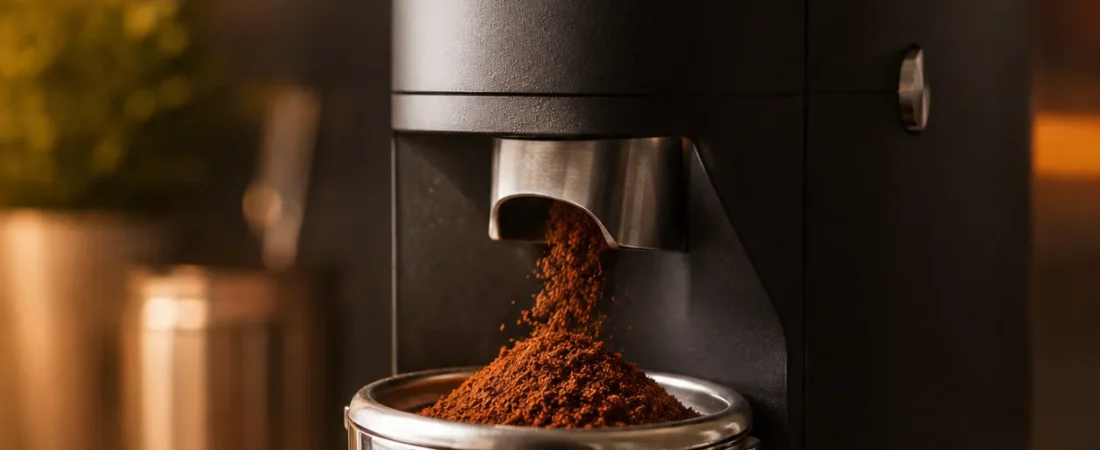
Most people shopping for their first espresso setup spend weeks comparing machines and almost no time thinking about the grinder. That's backward. Grind size issues cause more bad shots than any other single factor, more than dosing errors, tamping technique or equipment faults. If you're trying to figure out the best entry level espresso grinder for beginners, the short answer is this: buy the grinder before you fall in love with a machine, because the grinder does most of the real work.
We've already covered the starter kit combinations that pair specific machines and grinders at three budget levels. This article goes deeper into the grinder side of that decision. It covers why it matters so much, what separates a grinder that can pull a real shot from one that can't, and which options make sense depending on how much you want to spend.
Why the Grinder Matters More Than the Machine
Espresso works by forcing hot water through tightly packed, finely ground coffee at pressure. That only works if the grounds are consistent. Uneven particle sizes create uneven resistance, so water finds the path of least resistance through the puck (the pressed cake of coffee grounds in the basket) instead of moving evenly through all of it. The result is channeling: some of the coffee gets over-extracted (too much pulled from the coffee) and bitter while the rest barely gets touched and stays sour and weak, often in the same shot.
A great machine cannot fix inconsistent grounds. It can hold temperature steady and deliver pressure reliably, but it can't correct an uneven grind. A mediocre machine paired with a good grinder will usually outperform an expensive machine paired with a poor one. This is the part most buying guides skip, and it's why the grinder deserves the bigger chunk of your budget, not the leftover after you've picked a machine.
Burr Grinder vs Blade Grinder
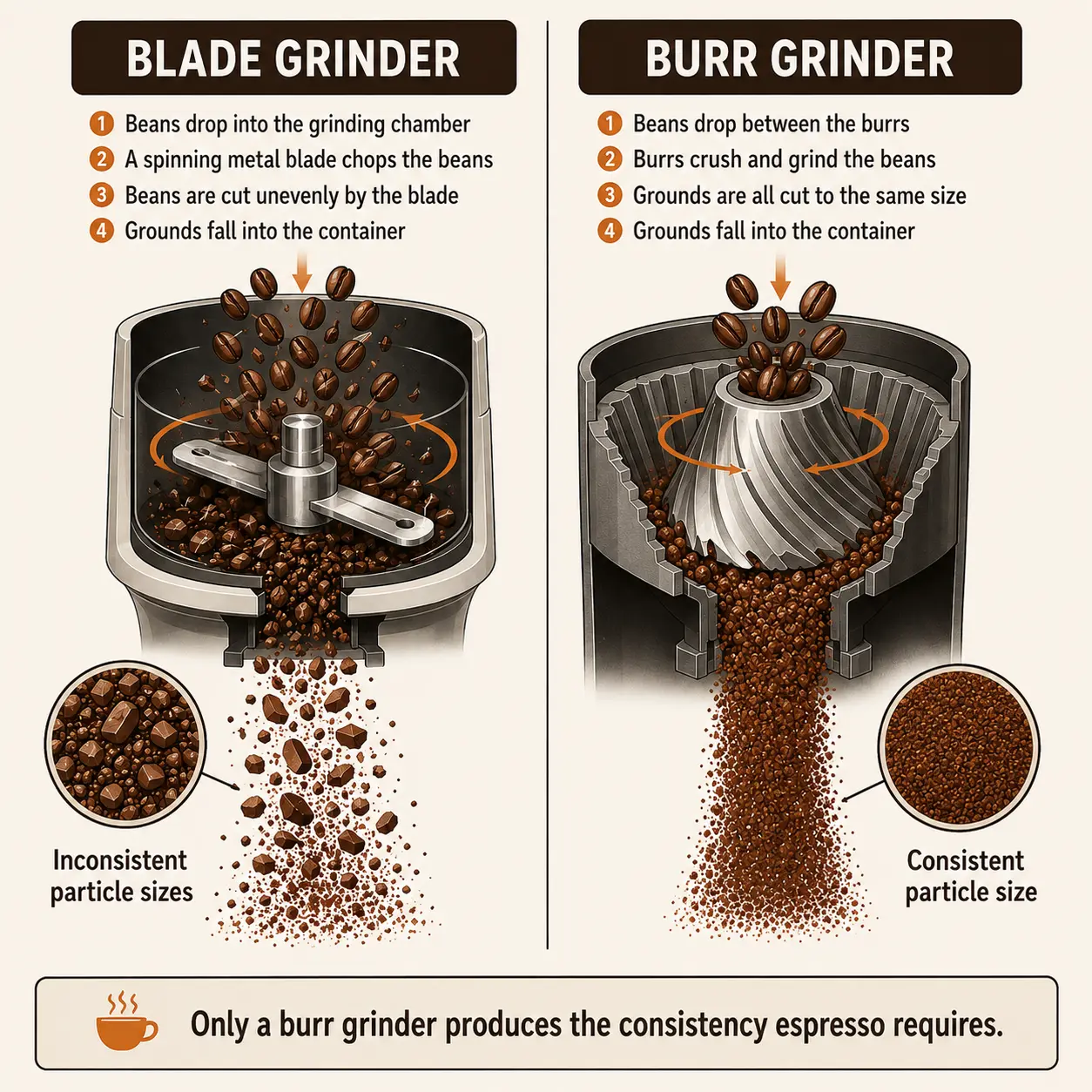
This decision determines whether espresso is possible at all. A blade grinder uses a spinning propeller-style blade to chop beans into smaller pieces. It can't control particle size directly. You get a range of chunks and dust in the same batch, and there's no adjustment dial that reliably changes that. For drip coffee, this inconsistency is forgivable. For espresso, it's disqualifying. Fine particles clog and over-extract while larger chunks under-extract, and no amount of tamping (pressing the grounds down firmly) or machine tweaking fixes it.
A burr grinder uses two abrasive surfaces (the burrs) set a fixed distance apart, and beans get crushed as they pass between them. Adjusting that distance changes the particle size predictably and consistently across the whole batch. Burrs come in two shapes: conical (a cone-shaped burr spinning inside a matching ring) and flat (two parallel discs facing each other). Both can produce excellent espresso. Flat burrs tend to produce a slightly more uniform particle size and are often described as giving more clarity in the cup, while conical burrs are usually quieter and retain less coffee between grinds.
Neither is objectively better for a beginner. What matters is that it's a burr grinder. If a grinder doesn't specify burr type, it's almost certainly a blade grinder, and you should cross it off your list regardless of price.
Stepped vs Stepless Adjustment
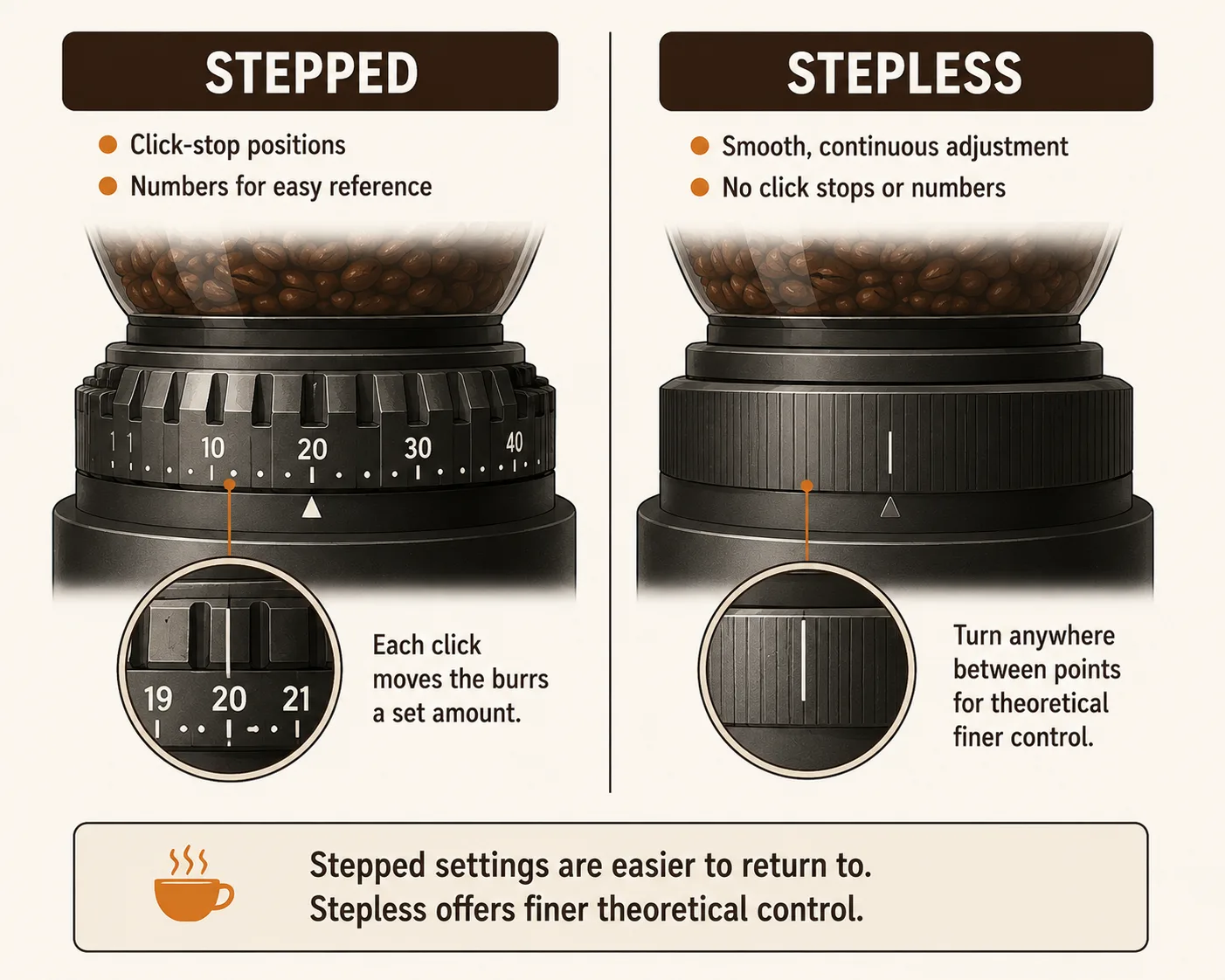
Once you're looking only at burr grinders, the next distinction is how you adjust grind size. A stepped grinder has fixed click positions, like a dial that stops at defined numbers. A stepless grinder lets you rotate the adjustment continuously, with no fixed stops.
For a beginner, stepped adjustment is usually easier to live with. You can write down a setting, know exactly where you were, and move back to it without guessing. Stepless grinders offer finer control in theory, since you're not limited to fixed increments, but that precision is wasted if you don't yet know what you're adjusting for. It also makes it harder to return to a known good setting, since there's no click to feel or number to reference unless the grinder has a printed scale next to the dial. Neither approach is wrong, but if you're comparing two similarly priced grinders and one has stepped adjustment with a numbered scale, that's the easier one to learn on.
What to Look For Before You Buy
Beyond burr type and adjustment style, a few practical factors separate a grinder that's pleasant to use daily from one that becomes a chore.
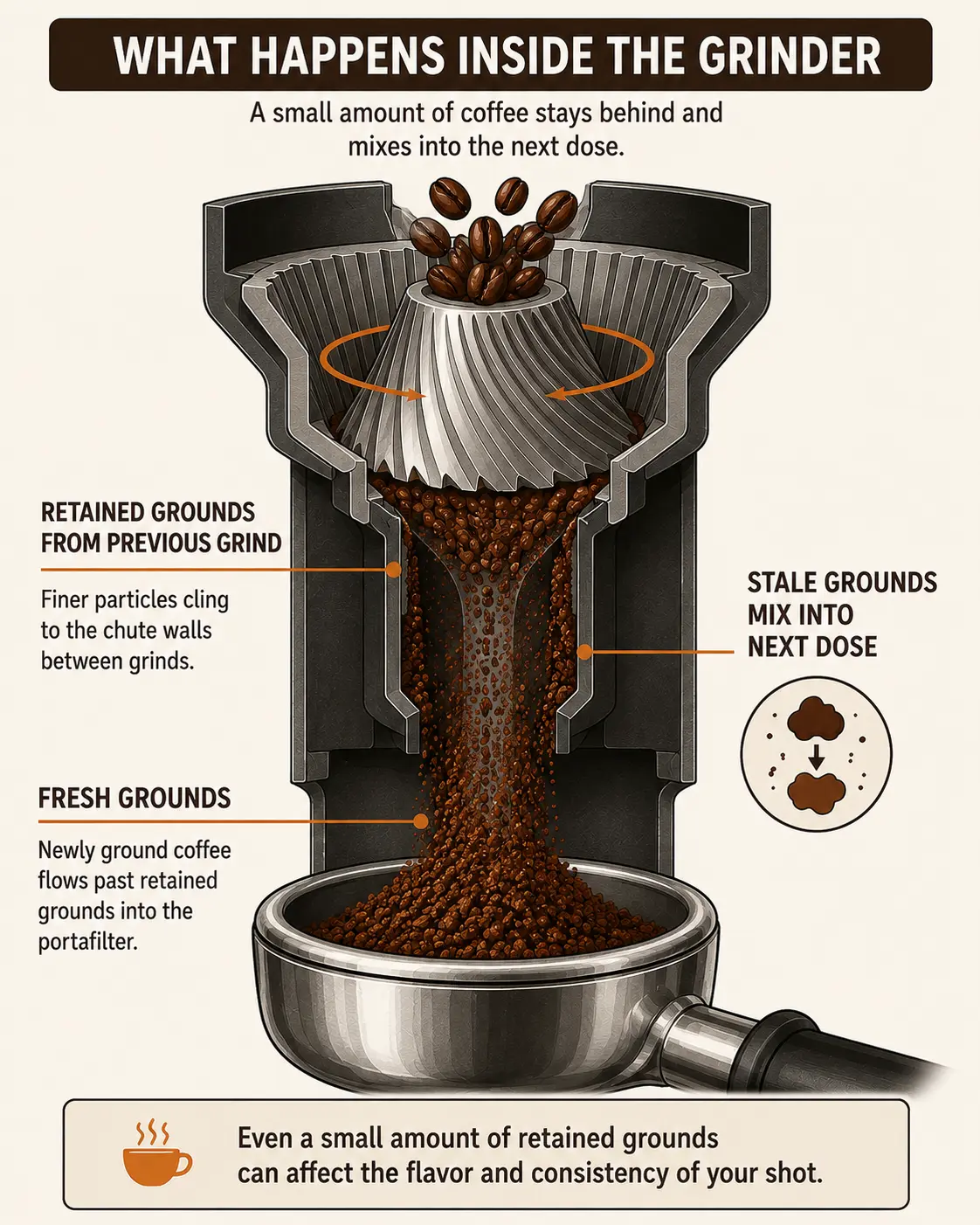
Retention matters more than it should. Retention is the coffee that stays trapped inside the grinder's chute and chamber after you stop grinding, instead of landing in your portafilter. High retention means stale grounds from a previous grind mix into your fresh dose, and it means your dose weight is less predictable shot to shot. Grinders built for single dosing (grinding exactly the amount you need right before brewing, rather than filling a hopper) tend to have much lower retention than hopper-fed grinders designed for cafes.
Consistency across the grind range matters too, particularly at the fine end where espresso lives. Some grinders that grind beautifully for drip coffee get noisy and inconsistent once you dial them down toward espresso fineness. Check whether a grinder is designed and marketed for espresso, not just capable of reaching a fine setting on paper.
Noise level is easy to overlook until you're grinding coffee at 6 am in a house where other people are still asleep. Flat burr grinders and faster-spinning motors tend to run louder. If this matters in your living situation, it's worth checking before you buy, not after.
Best Entry Level Espresso Grinder Picks by Budget
Around $200: Baratza Encore ESP
The Encore ESP is a conical burr grinder that Baratza specifically tuned for espresso, on top of handling drip, pour-over, and other brew methods, which puts it a step above the average general-purpose grinder in this price range. Reddit's r/espresso community consistently ranks it among the most recommended electric grinders for beginners, citing straightforward operation, strong customer support, and grinds that hold up for real espresso, not just pour-over.
It's loud, and its espresso-specific adjustment range is narrower than pricier grinders, but for a first dedicated espresso grinder, it remains one of the most reliable starting points. It's also the same grinder recommended in our starter kit guide: it does the fundamentals well without asking you to spend $500 to get there.
Around $230 to $260: DF54
The DF54 is a single-dose flat burr grinder, and it's roughly half the price of larger flat burr grinders while producing grind quality well above what its price suggests for both espresso and filter coffee. Retention is very low (as little as 0.2 to 0.3 grams), which matters if you care about weighing your dose precisely. The trade-offs are real: burr upgrade options are limited because of its less common 54mm size, the catch cup is plastic, and it can produce more static with lighter roasted beans than some competitors. For someone who has already learned the basics on a beginner grinder and wants flat burr performance without the usual flat burr price, this is a worthwhile step up.
Around $550: Eureka Mignon Specialita
This is the grinder to consider if you'd rather buy once and skip the upgrade cycle entirely. It uses 55mm flat burrs with stepless adjustment (no fixed clicks, so you can stop at any setting), runs exceptionally quiet for its size. It also keeps retention to roughly a gram, which means it works well whether you're single dosing or feeding it from the hopper. One detailed review called it "probably the ideal espresso grinder for most people" for exactly that flexibility. It's not cheap, and the adjustment wheel could use larger, clearer numbering for easier tracking between sessions. But if your budget stretches this far and you already know espresso is a hobby you're committing to, it removes grinder shopping from your list for a long time.
Common Mistakes Beginners Make With a New Grinder
The most common mistake is buying a blade grinder because it's cheap and assuming any grinder is better than none. It isn't. A blade grinder will actively work against you and make it nearly impossible to diagnose whether a bad shot is your technique or your equipment, since the grind itself is inconsistent before you even start.
The second mistake is under-adjusting. New grinders often ship set somewhere in the middle of their range, and espresso needs a fine grind, finer than most people expect the first time they see it. If your shot is pulling too fast and tasting sour or weak, the instinct should be to grind finer before you touch anything else.
The third mistake is ignoring retention, which makes shots taste inconsistent between one day and the next. If your grinder holds onto old grounds, purge a small amount before weighing your actual dose, especially after switching beans.
When to Upgrade Your Grinder
You'll know it's time to upgrade when you've been pulling consistent, repeatable shots for a few months and you start noticing the limits of your current grinder rather than your own technique. Common signals include running out of adjustment range before you reach the grind size you want, dealing with retention that throws off dose consistency, or wanting the extra clarity flat burrs tend to offer over conical ones. There's no fixed timeline for this. Some people are happy on their first grinder for years. Others outgrow an entry-level grinder within a few months once their palate and technique catch up to what the machine can no longer keep pace with.
If budget is the main concern, our budget espresso grinder guide breaks down what each price tier gets you.
Our comparison of single dose vs dosing grinders explains which style suits how you make coffee.
This guide is part of the Espresso Grinders hub, which brings together our guides on grinders for espresso.
What to Read Next
If you haven't settled on a machine yet, our manual vs semi-automatic comparison breaks down which type of machine teaches you more as a beginner. Once you've sorted your grinder and machine, what you need next is a scale and tamper to round out a real setup.
The Final Take
The best entry level espresso grinder isn't the most expensive one or the one with the most features. It's a burr grinder, built for espresso, that you can afford without stretching so far you have nothing left for the machine. Get the grinder right first. Everything else (dialing in your dose, your tamp, your timing) only works if the grounds going into the portafilter are consistent to begin with.
In short, the best entry level espresso grinder is the one that gets grind consistency right without needing a machine's help.
For research on particle size, a 2016 study in Scientific Reportsfound that grinding colder beans gives a smaller, narrower spread of particle sizes.
Once you have a burr grinder, keeping it clean matters almost as much as the grinder itself. See our grinder maintenance guide for burr cleaning and retention tips.