
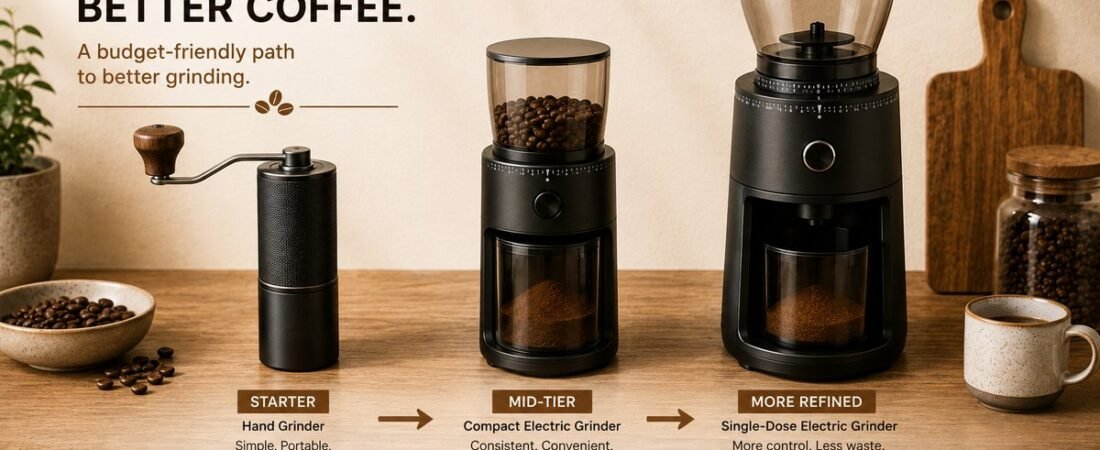
If you're building an espresso setup on a budget, the grinder is the most important choice you'll make. A cheap machine with a good grinder will make better espresso than an expensive machine with a poor one. Grind consistency matters more to shot quality than almost anything else. Below is what each price range gets you, so you can find the best budget espresso grinder for your setup.
Best Budget Espresso Grinder Options by Price Tier
Espresso grinders fall into four price ranges: manual grinders under $200, entry-level electric grinders from about $120 to $300, mid-range electric grinders from $300 to $600, and premium grinders above $600. The entry-level range follows CoffeeGeek's budget range for quality electric grinders. The two higher ranges follow Complete Home Barista's buying guide. These aren't hard cutoffs. Prices shift and models get discontinued, so check the current price before you buy.
Manual Grinders: Under $200
For most people, the best budget espresso grinder is a hand grinder. It's the cheapest way into espresso-capable grinding. Every espresso-capable hand grinder in CoffeeGeek's budget guide costs under $200, including the Kingrinder K2 and the Timemore C5 ESP Pro. The Kingrinder K6 moves 16 microns per click, and its external dial makes it easier to adjust often than the K2, according to Complete Home Barista. Toward the top of this tier, the 1Zpresso J-Ultra moves 8 microns per click for finer control. CoffeeGeek says the 1Zpresso X-Ultra handles espresso and filter equally well.
The tradeoff is time. Complete Home Barista puts hand grinding at 2 to 3 minutes per shot, against about 30 seconds with an electric grinder. For one person that's a small cost. For a household that makes several drinks each morning, it takes a lot longer.
Entry-Level Electric: About $120 to $300
Here you trade hand cranking for a motor without spending mid-range money. The Fellow Opus has 41mm conical burrs, grinds down to espresso fine and is built for single dosing. The Breville Smart Grinder Pro is the common alternative if you want 60 settings and a timer you can set in 0.2 second steps. Near the top of this range, the MiiCoffee DF54 has 54mm flat burrs.
What most grinders in this range don't offer yet is very low retention (old grounds left inside the grinder) or a quick way to clear old grounds when you change beans, though a few models are getting closer. If retention and freshness matter more to you than saving a step every morning, keep that in mind before you buy.
Mid-Range Electric: $300 to $600
Complete Home Barista calls this the enthusiast tier. The Baratza Sette 270 uses 40mm steel conical burrs and is designed for minimal retention. The Eureka Mignon Zero 65 uses 65mm flat burrs with stepless adjustment (no fixed clicks, so you can stop at any setting), and Eureka lists under 0.2g of waste per dose. The Mignon Silenzio 55 uses 55mm flat burrs, also stepless, and is built around quiet operation.
For most home setups, this is where spending more stops making a big difference. Grind consistency in this range is excellent, and more expensive grinders add refinement rather than a different shot.
Premium: $600 and Up
The Niche Zero sits right at the start of this range and is known for its zero retention design, per Complete Home Barista's price guide. Above that, grinders are built for people who treat grinding as a hobby in itself, with larger burr sets and tool-free adjustment.
Unless you're already grinding for multiple people daily or you've outgrown a mid-range grinder's limits, this tier is rarely the right starting point.
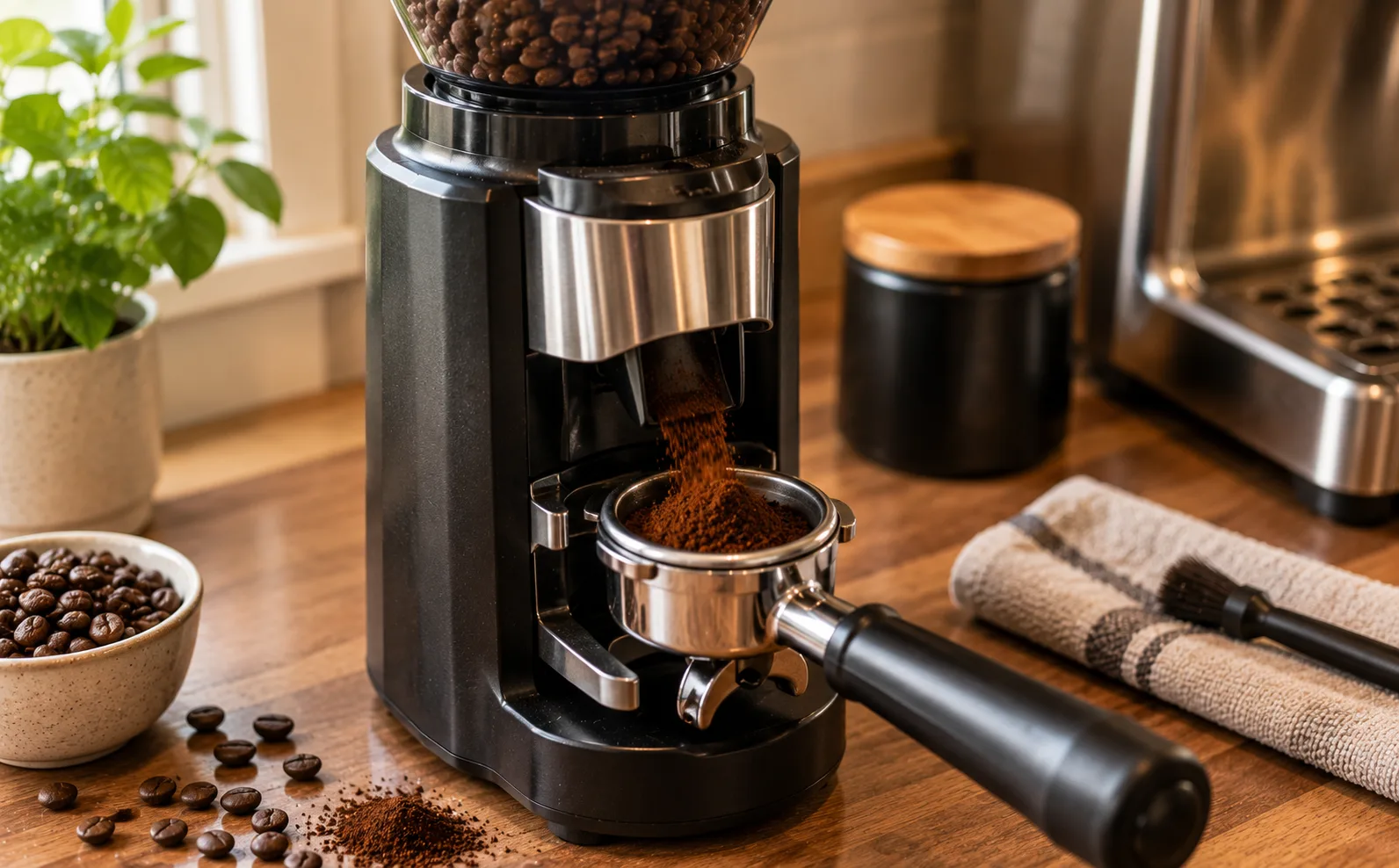
How to Choose the Best Budget Espresso Grinder for You
- New to espresso and price-sensitive: A manual grinder like the Kingrinder K6 gets you espresso-capable grinding for under $200. See our beginner grinder guide for a fuller breakdown.
- Want a motor but not ready for single-dose pricing: The entry-electric tier (Fellow Opus, Breville Smart Grinder Pro) is the best value.
- Serious about consistency and freshness: Mid-range single-dose grinders ($300 to $600) are where most enthusiast recommendations land, and where the jump in shot quality is most noticeable.
- Grinding daily for a household, or treating this as a hobby: Premium single-dose grinders justify their price with retention and consistency that's hard to match below $600.
If you're also deciding between a manual and electric grinder generally, separate from price, our manual vs. electric grinder comparison covers that tradeoff in more depth. And if burr shape (flat vs. conical) is part of your decision, see flat vs. conical burrs. For single-dose-specific tradeoffs like retention and cleanup, see single-dose vs. dosing grinders.
Which One to Buy
The best budget espresso grinder doesn't have to cost $600. A hand grinder under $200 or an entry-level electric in the $120 to $300 range will produce a properly dialed-in shot. The $300 to $600 tier is where retention and consistency stop being compromises, and everything above that is refinement for people who have made grinding a hobby. Match the tier to how often you're grinding and how much the last 10% of consistency matters to you, not to what looks impressive on a spec sheet.
The best budget espresso grinder for you is the one that fits how often you grind and how many drinks you make, not the most expensive one you can afford.
For research on grind consistency, a 2016 study in Scientific Reportsfound that particle size depended on bean temperature, not origin: colder beans ground finer and more evenly.
The choice between hand and motor power is covered in manual vs electric coffee grinders.
Burr shape is the other big variable. Our guide to flat vs conical burrs explains what changes in the cup.
For more on grinders for espresso, see the Espresso Grinders hub.