
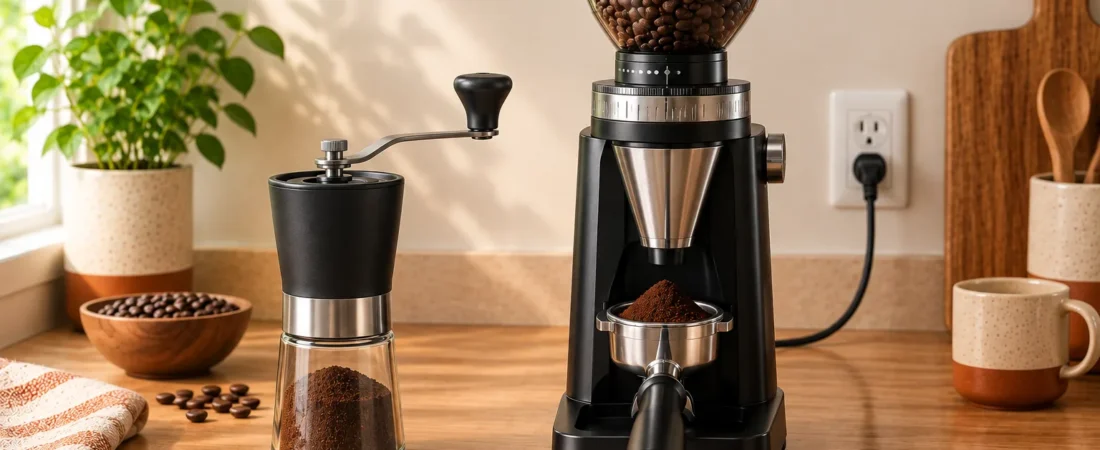
Manual vs electric coffee grinder isn't a quality question. It's a question of budget and how much effort you want in your morning routine. Both formats span cheap and mediocre to expensive and excellent. What separates them is how much money you need to spend to hit a given grind quality, and how much physical work you're willing to put in every time you want coffee.
Online discussions of this topic split into two camps. Half insist manual is the only "real" way to grind, and half say anyone without a hand injury or a lot of free time should just buy electric. Both sides are half right, and both ignore the real variable: what you're brewing, how many cups, and what you're willing to spend to get there. This guide breaks that down.
Manual vs Electric Coffee Grinder: The Real Tradeoffs
Strip away the marketing, and the manual vs electric coffee grinder decision comes down to a handful of concrete tradeoffs:
- Price for equivalent grind quality. A manual grinder is significantly cheaper than an electric grinder with comparable burrs and consistency. You're paying for burr quality, not a motor.
- Effort. Every dose you grind by hand, you crank by hand. Coarse, drip-style grinds are quick. Fine, espresso-style grinds take more revolutions and more effort. It can feel like a small workout if you grind espresso every morning.
- Speed. Electric wins. Press a button and the grind is done in seconds.
- Noise. Manual grinders are silent. Electric grinders are not. Some are louder than others, but none are silent.
- Portability and power. Manual grinders need no outlet and pack down small, which matters for travel, camping, or a work desk. Electric grinders need a plug and counter space.
- Volume. If you're grinding for more than one or two people, or brewing multiple times a day, the effort cost of manual grinding adds up fast. Electric scales better.
Neither format has an inherent quality ceiling or floor. You can buy a bad manual grinder and a bad electric grinder, and you can buy an excellent version of either. The decision is about what you're trading (money, effort, noise, and convenience), not about which one grinds "better" in the abstract.
Where this gets confusing is that people often compare a mid-range manual grinder to a cheap electric grinder, conclude "manual is better," and stop there. That's not a fair test of manual vs. electric. It's a test of a $60-plus burr set against a $20 blade grinder. Compare grinders at the same actual quality tier and the format itself stops being the thing that determines whether your grind is consistent. What it does still determine is price and effort, and those are the two things worth weighing.
When a Manual Grinder Makes Sense
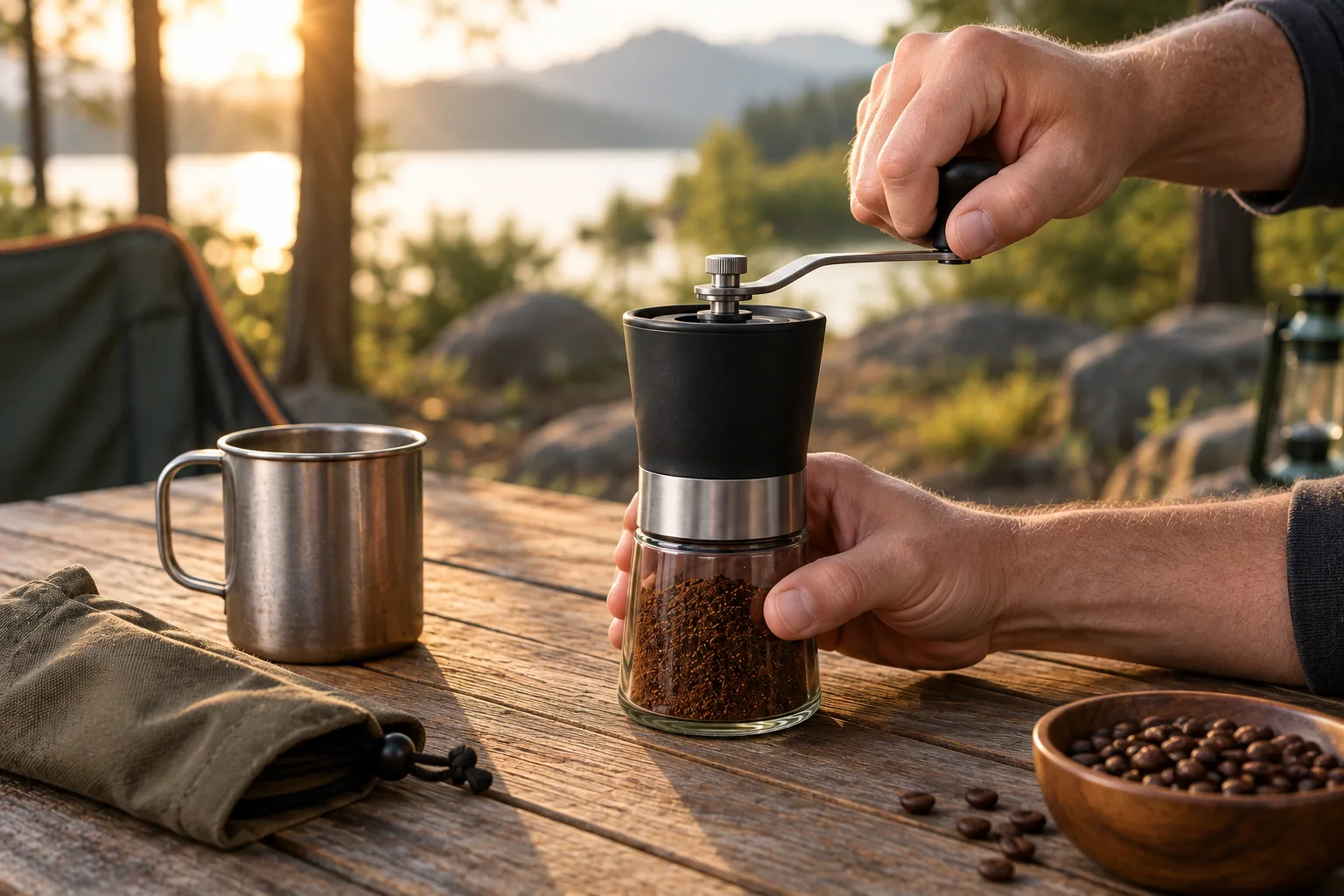
A manual grinder is the right call if any of these describe you:
- You're on a tight budget but want real grind quality. Because manual grinders skip the motor, gearing, and housing that drive up electric grinder costs, you can get burrs that outperform a similarly-priced electric grinder. If you want to see how this compares in a specific price bracket, our Best Espresso Grinder for Beginners guide covers where manual and entry electric options land.
- You only make one or two cups a day. At low volume, the effort hardly matters.
- You travel or camp with your coffee habit. No outlet needed, and manual grinders are compact enough to pack.
- You want a quiet kitchen. No motor means no noise, which matters if you're grinding before anyone else is awake.
- You mostly brew drip, pour-over, or French press. Coarser grinds require far fewer revolutions than espresso-fine grinds, so the manual effort stays low.
The one thing to know going in: manual grinders are almost always conical burr designs, not flat. That's not a downside. Conical burrs are well suited to hand grinding and produce good results across brew methods, but it does mean you're choosing a burr geometry by choosing "manual," in most cases. Flat-burr manual grinders do exist, but they're the exception, not the rule, so don't assume you'll find one easily if flat burrs are a hard requirement. For what that geometry changes in the cup, see our flat vs. conical burr grinder breakdown.
Be honest with yourself about the espresso-grinding part specifically. Fine, espresso-ready grounds need considerably more crank revolutions than a coarse drip grind, and that effort compounds. A bad night's sleep or a sore wrist makes the fortieth crank feel a lot longer than the first. Plenty of people do this daily without complaint, but plenty of others buy a manual grinder for espresso, grind twice, and never touch it again. If you're not sure which camp you're in, that uncertainty alone is worth weighing against the money you'd save.
When an Electric Grinder Makes Sense
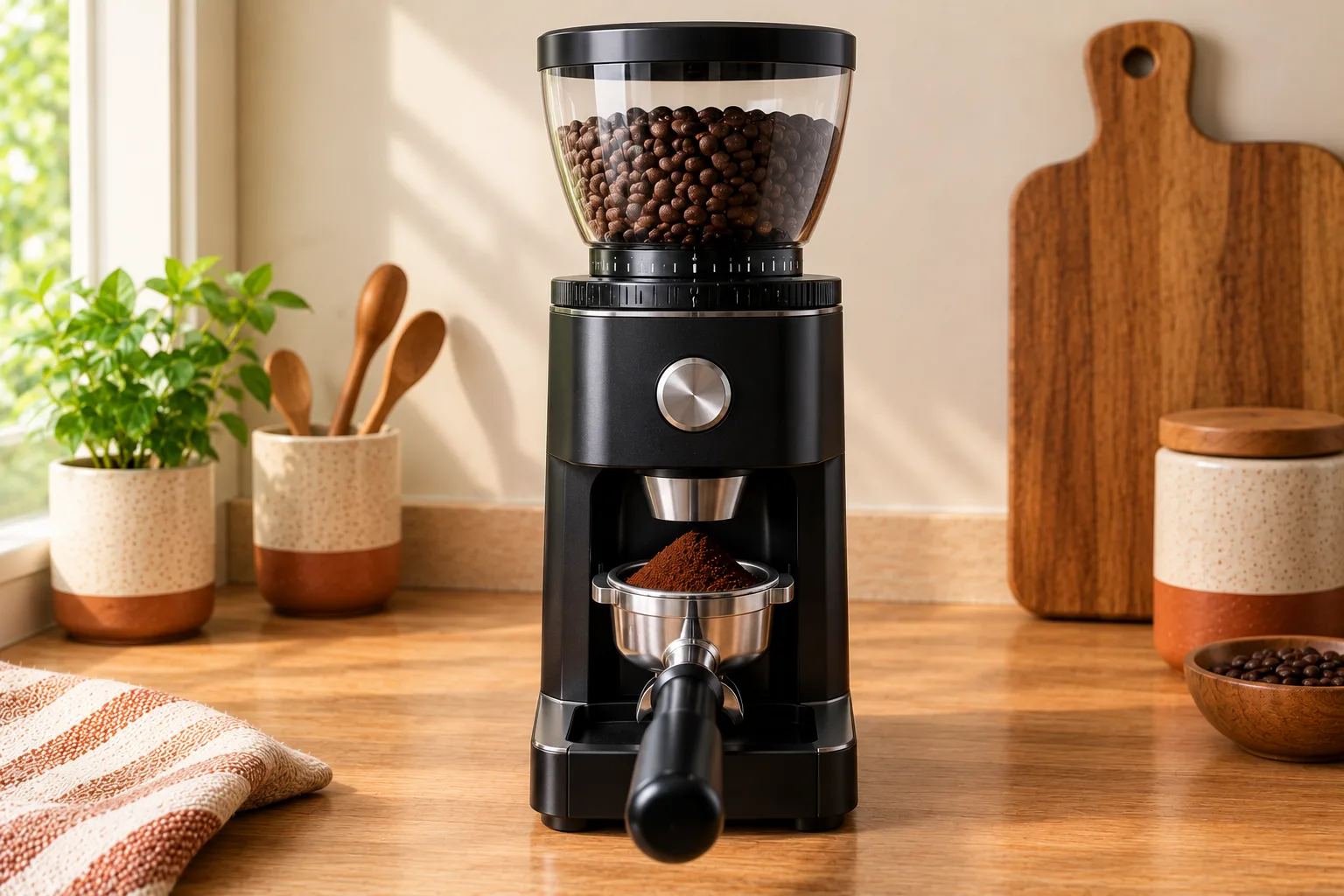
An electric grinder is the better fit if any of these describe you:
- You grind espresso daily, or grind for more than yourself. Cranking fine, espresso-ready grounds by hand every morning becomes tiring quickly, especially for two-plus people or multiple drinks.
- You want speed and don't want to think about it. Electric grinders turn "grind coffee" into a ten-second task instead of a minute or two of active effort.
- You want more options at every price point. Electric grinders come in a much wider range of prices and burr sizes than manual grinders, so you can shop by feature, hopper capacity, or dosing style rather than just budget.
- You brew across multiple methods and want to switch grind settings fast. Adjustable electric grinders make it quicker to move between, say, espresso and drip without re-dialing by hand each time.
The tradeoff worth knowing: sustained heavy grinding can build up motor heat, which in theory can affect the grounds. For home use, even a household grinding espresso for several people every morning, this is a minor factor, not something to worry about. It matters more for commercial-volume grinding than for anything happening in a home kitchen, where a grinder runs for a few seconds at a time rather than continuously for minutes on end.
It's also worth being clear about what "electric" doesn't automatically buy you. A cheap electric grinder isn't a shortcut to the grind quality of a good manual grinder. Plenty of budget electric grinders use blade mechanisms instead of burrs, which chop rather than crush and produce wildly inconsistent particle sizes no matter how long you run them. If you're comparing electric options, make sure you're comparing burr grinders to burr grinders. A blade grinder isn't part of this conversation. It's a different category with a lower ceiling.
Electric grinders also come in single-dose and hopper-fed designs, which is a separate decision from manual vs. electric. If you're shopping electric, it's worth understanding that distinction before you buy. See single-dose vs. dosing grinder.
Burr Type: What to Know Either Way
Burr type is a separate axis from manual vs. electric, but the two overlap in practice. Manual grinders are nearly always conical burr. The geometry suits a hand crank, and you'll find it in the overwhelming majority of manual models on the market. Electric grinders span flat and conical burrs across their price range, so if burr geometry is a priority, electric gives you more choice.
Neither burr type is objectively better. They produce different particle distributions and, for some drinkers, different flavor characteristics. If that distinction matters to your buying decision, read the full comparison in flat vs. conical burr grinder before you commit to either a manual or electric model.
The practical takeaway for most people shopping manual vs. electric: don't let burr type be the tiebreaker unless you already have a strong preference. Decide manual or electric first, based on budget and effort, then pick the best burr grinder you can afford within that format. Trying to optimize burr geometry, format, and price all at once is how people end up paralyzed by choice on a decision that, at the beginner and intermediate level, doesn't need to be that complicated.
Manual vs Electric Coffee Grinder Models for Espresso
These seven grinders keep coming up in espresso buying advice, and each has enough owner reviews to judge. The ratings reflect what owners report on Amazon, checked in October 2026, plus a second store's reviews where available. The notes under the table come from reading the critical reviews, not just the averages. A 4.6 average can hide a problem that shows up repeatedly in the one- and two-star reviews.
| Grinder | Type | Burrs | Adjustment | What owners rate it |
|---|---|---|---|---|
| KINGrinder K6 | Manual | 48mm conical, stainless steel | 16 microns per click | 4.6 out of 5 from 1,010 Amazon ratings |
| 1Zpresso J-Ultra | Manual | 48mm conical, cut for espresso | 8 microns per click | 4.6 out of 5 from 399 Amazon ratings |
| Timemore Chestnut C3 ESP Pro | Manual | 38mm conical | About 23 microns per click | 4.6 out of 5 from 153 Amazon ratings |
| Breville Smart Grinder Pro | Electric | Conical, stainless steel | 60 settings | 4.5 out of 5 from 7,009 Amazon ratings, 4.7 out of 5 from 534 Best Buy reviews |
| Baratza Encore ESP | Electric | 40mm conical | 40 settings, 1 to 20 in small steps for espresso | 4.0 out of 5 from 1,410 Amazon ratings, 4.8 out of 5 from 25 Seattle Coffee Gear reviews |
| DF54 (Turin, MiiCoffee) | Electric, single dose | 54mm flat | Stepless | 3.8 out of 5 from 670 Amazon ratings, 181 of 213 reviews at five stars on Turin's own store |
| Eureka Mignon Specialita | Electric | 55mm flat, hardened steel | Stepless | 4.2 out of 5 from 202 Amazon ratings, 4.6 out of 5 from 82 Seattle Coffee Gear reviews |
Manual grinders
KINGrinder K6. The least expensive grinder on this list. Owners most often praise the all-metal build and the small adjustment steps, which make it easier to dial in espresso. The complaints that repeat in the critical reviews are practical: the handle or its knob working loose, setup and zero-point instructions that are hard to follow, and the effort of cranking an espresso dose every morning. A group of similar two-star reviews from late September 2026 complain about counter space, which doesn't fit a hand grinder, so the older, more detailed reviews are the better guide.
1Zpresso J-Ultra. Built for espresso, with the finest adjustment in the 1Zpresso range at 8 microns per click. Owners praise the precision and the build. Repeated complaints include the handle grip or wooden knob coming loose, the magnetic catch cup dropping off, and how hard it turns at espresso settings. Comments on value are mixed at its higher price.
Timemore Chestnut C3 ESP Pro. It has the smallest burrs at 38mm and a folding handle that suits travel. Owners rate the grind consistency and the value well. Many critical reviews focus on the seller rather than the grinder, such as open-box units and missing manuals. The most common complaint is setting the zero point after cleaning, which several owners only managed with a video.
Electric grinders
Breville Smart Grinder Pro. The most reviewed grinder here by a wide margin. Owners like the range of settings, the timed dosing, and the removable tray that makes cleanup easy. The critical reviews repeat two issues: reliability, with some units failing within months while others last years, and grounds left behind in the chute. A few owners also say it struggles to grind fine enough for their machine.
Baratza Encore ESP. It splits settings 1 to 20 into small steps for espresso and keeps 21 to 40 for brewed coffee, and it comes with a dosing cup that fits 54mm and 58mm portafilters. Its Amazon average is lower than its reputation, with about 1 in 5 ratings at one or two stars. The critical reviews point to the amount of plastic, including a thin hopper and a switch that feels cheap, and to some owners not getting fine enough for their machine. Baratza's support comes up often in those same reviews, mostly for replacement parts and calibration help.
DF54. A single-dose grinder with 54mm flat burrs, stepless adjustment (no fixed clicks, so you can stop at any setting), and a bellows to push out leftover grounds. It has the lowest Amazon average here, and the reviews show why: nearly every critical review on the MiiCoffee listing mentions clogging or grounds stuck in the chute at fine espresso settings. Turin's current version (v4.1) lists an updated declumper and a larger exit chute, which targets that complaint. Ratings on Turin's own store are much higher, but that store is owned by the brand.
Eureka Mignon Specialita. The most expensive grinder on this list, with 55mm hardened steel flat burrs, stepless adjustment, and a sound-insulated body. Owners praise how quiet it is and how consistent the grind is. Critical reviews mention occasional jams that require removing the hopper to clear, timed doses drifting by a gram or two, and a few units failing in the first months.
Read the ratings together with the complaint patterns. A grinder with a 3.8 average and one clear, fixable problem can suit you better than a 4.6 grinder with an issue you would run into every morning.
Which One to Buy
Manual vs electric coffee grinder isn't about which one makes better coffee. Both can, at the right price tier. It's about your budget and your patience. If you want the best grind quality for the least money, don't mind a bit of arm work, brew mostly drip or pour-over, or need something portable, go manual. If you grind espresso daily, grind for more than yourself, or just want speed and don't want to think about it, go electric and budget accordingly for the burr quality you want.
If you're still torn, default to how you brew day-to-day rather than how you'd like to brew in an ideal world. Someone who brews pour-over on weekends and drip on weekdays loses almost nothing by going manual. Coarse grinds are quick regardless of format. Someone whose daily habit is a shot of espresso before work loses real time and real effort every single morning if they buy manual and then discover the crank count for fine grinds. Match the tool to the routine you're going to run, not the one you're hoping to build.
And don't treat this as a permanent decision. Grinders, manual or electric, tend to outlast a lot of other kitchen gear, but plenty of people start with a manual grinder to keep costs down while they're dialing in technique. They move to electric once the daily habit is set and the cranking starts to feel like a chore. Buying the wrong format isn't a disaster. It's a resellable mistake, not a permanent one.
If you're still narrowing down a specific model, our Best Espresso Grinder for Beginners guide is the natural next stop. It covers picks across both formats at entry-level prices.
Grind consistency can be measured. Researchers writing in Scientific Reportsin 2016 found that bean origin made no difference to particle size, while grinding colder beans gave smaller, more uniform particles.
To see what each price tier gets you, read our budget espresso grinder guide.
This guide is part of the Espresso Grinders hub, which brings together our guides on grinders for espresso.