
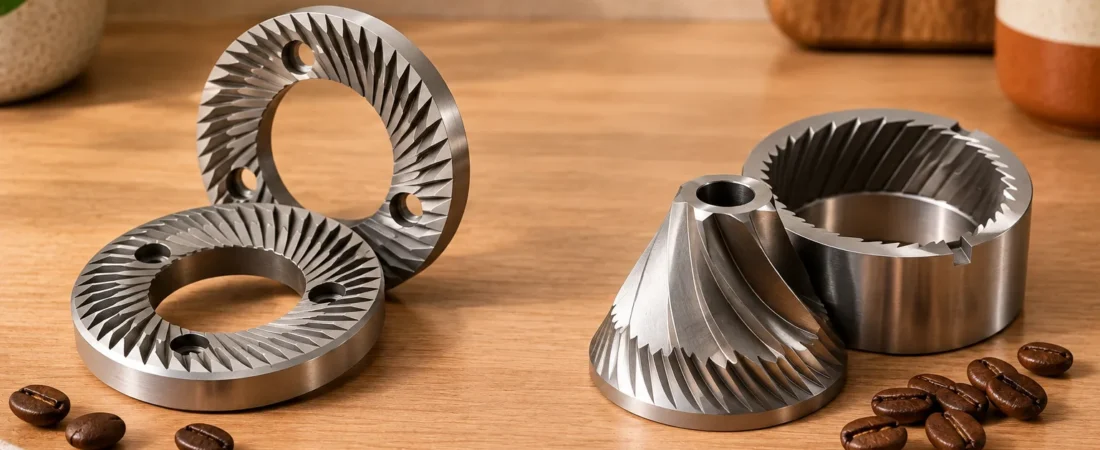
The conical vs flat burr grinder debate shows up in every grinder comparison thread you'll find, and it usually produces more argument than useful information. Reddit's r/espresso has entire megathreads devoted to it, forum posts run to hundreds of replies, and somewhere in there someone always insists one shape is objectively superior. It isn't. Both burr shapes can produce excellent espresso, and the real differences between them are narrower and more practical than the internet argument suggests.
This isn't a "which one wins" article. It's a breakdown of what changes mechanically, what changes in your cup, and what doesn't change at all no matter how confidently someone tells you otherwise.
Conical vs Flat Burr Grinder: The Mechanical Difference
The names describe the burr shape, and the shape is the entire distinction. Everything else people argue about is downstream of this one design choice.
Flat burrs are two flat, ring-shaped discs set parallel to each other, one fixed and one spinning. Coffee falls between them and gets sheared as it moves outward from the center toward the edge, where the particles finally escape. Because both surfaces are flat and the geometry is consistent all the way around, flat burr sets are generally associated with a more uniform particle size distribution. Fewer stray fines (very tiny coffee particles), fewer large pieces, a tighter grind curve. That consistency is a big part of why flat burrs show up in most higher-end and commercial-style grinders.
Conical burrs use a cone-shaped inner burr that spins inside a ring-shaped outer burr. Coffee moves down and outward along the cone rather than straight out across a flat plane. This geometry tends to run quieter than flat burr grinders at a comparable size and motor speed, which is one reason conical burrs dominate the home grinder market. It's also nearly universal in manual hand grinders, where a compact cone-and-ring setup is far easier to build into something you can hold and crank by hand.
Neither shape is "better" in the abstract. They're two different solutions to the same problem, cutting whole beans down into a consistent size, and each comes with trade-offs that show up in cost, noise, and grind consistency rather than in some fundamental quality gap.
What Changes in the Cup (and What Doesn't)
This is where the argument gets heated. Some real differences exist. Others are repeated so often online that they've hardened into "facts" that don't hold up well under scrutiny.
What's real: at a given price and quality tier, flat burrs tend to produce a somewhat more uniform particle size distribution than conical burrs. Espresso uses a very fine grind, and small inconsistencies matter more there than they do for drip or pour-over. That uniformity can translate to a slightly more even extraction and a shot that's a bit more forgiving to dial in. This is a real, testable difference, though it's most noticeable when you're comparing burrs at similar price points, not just shape in isolation. A cheap flat burr grinder won't out-grind a good conical one.
What's disputed: you'll frequently see the claim that conical burrs run cooler than flat burrs and therefore preserve more of the coffee's aromatic compounds. The idea is that flat burrs, spinning faster in many designs, generate more friction heat and cook off delicate aromatics before the coffee even hits water. This claim is repeated as settled fact in many buying guides. It shouldn't be.
Real-world heat differences between conical and flat burr grinders, at the grind volumes and speeds a home espresso drinker deals with (18 to 20 grams, ground in a few seconds) are small. The aromatic-preservation claim in particular is not well-supported by rigorous, controlled side-by-side testing. It sounds plausible, but it hasn't been proven. Treat it as an unresolved claim, not a reason to buy one burr shape over the other.
What barely matters: flavor "character" attributed to burr shape alone. Conical burrs supposedly producing rounder, sweeter shots. Flat burrs supposedly producing brighter, more defined ones. You'll find people who swear by this, and you'll find controlled comparisons where trained tasters can't reliably tell the difference once grind size and dose are matched. Bean origin, roast level, freshness, and how well you dial in the shot all have a far bigger effect on flavor than burr geometry does. If you put a bad flat burr grinder next to a good conical one, the good conical grinder wins every time. Shape isn't the deciding variable. Quality is.
Cost and Availability Differences
The practical differences live here, and it's the part beginners should weigh more heavily than the flavor debate.
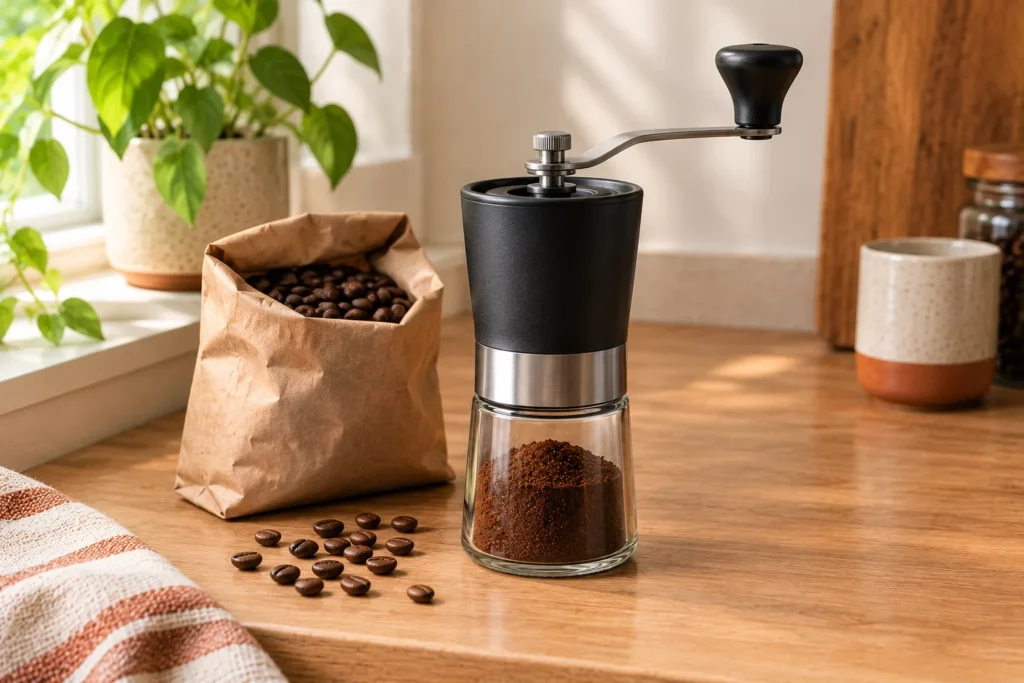
Conical burrs are generally more affordable at the entry level. If you're looking at electric grinders under roughly $200, or at manual hand grinders at any price, you're almost certainly looking at conical burrs. The design is cheaper to manufacture at small scale and is the default for compact, quiet, budget-friendly grinders. This is also why conical burrs are the standard in nearly every manual grinder on the market, from budget hand grinders to premium ones.
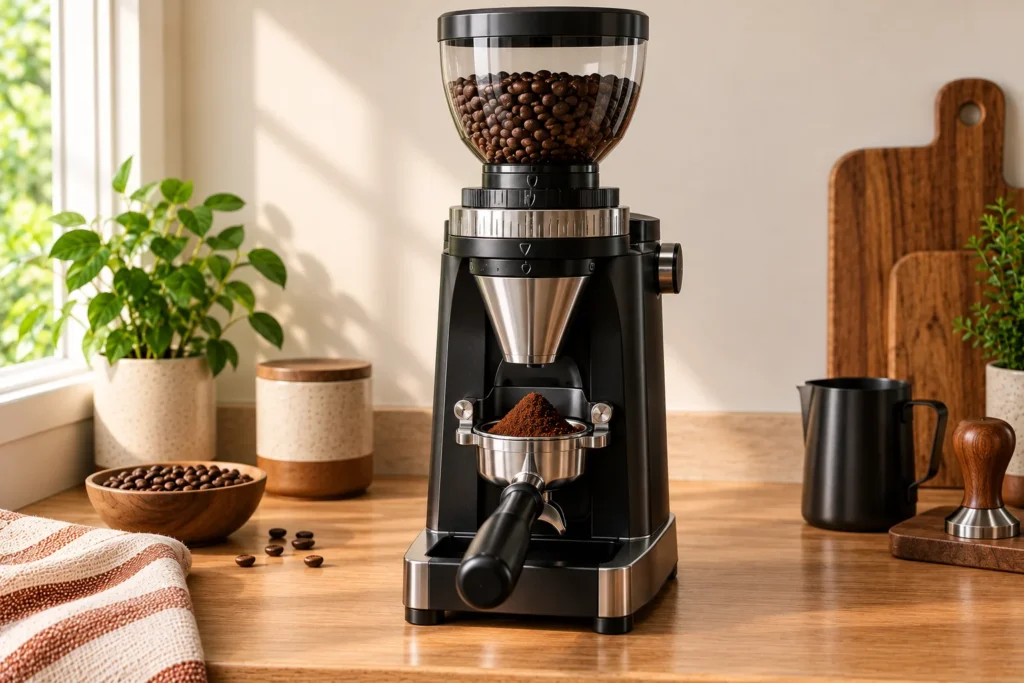
Flat burrs tend to cost more at a comparable quality tier. They require more precise manufacturing to keep two parallel discs properly aligned, and they're the burr shape you'll find in most higher-end prosumer and commercial-style electric grinders. If you're shopping in the higher price brackets, flat burr options become far more common, and the added cost usually buys tighter tolerances and more grind consistency rather than a fundamentally different mechanism.
None of this is a hard rule. Exceptions exist in both directions, but it's a reasonable pattern to shop by. If you're comparing an electric grinder to a manual one on cost and convenience grounds, our manual vs. electric coffee grinder comparison covers that decision separately from burr shape.
Which Should You Buy?
Stop trying to pick a burr shape and start picking a grinder.
If you're new to espresso and working with a limited budget, a solid conical burr grinder, electric or manual, will get you a good shot without the debate mattering at all. At the low end of the price range, grind consistency will be limited more by overall build quality and motor/mechanism precision than by whether the burrs are cone-shaped or flat. Our best espresso grinder for beginners guide leans conical for exactly this reason. It's where the value is at that price tier.
If you've got a bigger budget and you want small improvements, your recipe is already dialed in, you're comparing beans and roast dates, and you want the grinder to be the last variable you have to think about, a good flat burr grinder's tighter particle distribution is a legitimate, if modest, upgrade. It won't transform a mediocre shot into a great one, but it removes one more source of variability once everything else is already sorted.
One more variable worth factoring in that has nothing to do with burr shape: how the grinder doses. If you're deciding between grinding straight into the portafilter (the handle that holds the basket of coffee) for each shot versus a grinder built around a hopper and dosing chamber, that's a separate decision from conical vs. flat. See our single-dose vs. dosing grinder comparison for that.
Which One to Buy
The conical vs flat burr grinder question isn't a "which is better" question. It's a "what are you optimizing for" question. Flat burrs generally deliver more uniform grind particle size, which matters at the margins for espresso, and they tend to show up in pricier, higher-end grinders. Conical burrs are generally quieter and more affordable, and they dominate the budget and manual grinder markets for good reason. The claim that conical burrs run cooler and preserve more aroma gets repeated constantly, but it's disputed and not backed by rigorous testing. Don't let it decide what you buy.
Buy based on your budget, your grinder type (manual or electric, single-dose or hopper-fed), and the build quality of the specific model, not the shape of the burr inside it.
When people ask about conical vs flat burr grinder differences, the answer is that burr shape rarely decides which grinder to buy on its own. Budget, dose format, and build quality matter more.
For how researchers measure grind size, see this 2016 Scientific Reports study, which found that colder beans grind into smaller, more even particles.
Burrs need regular cleaning to keep grinding evenly. See espresso grinder maintenance for how and how often.
For more on grinders for espresso, see the Espresso Grinders hub.