
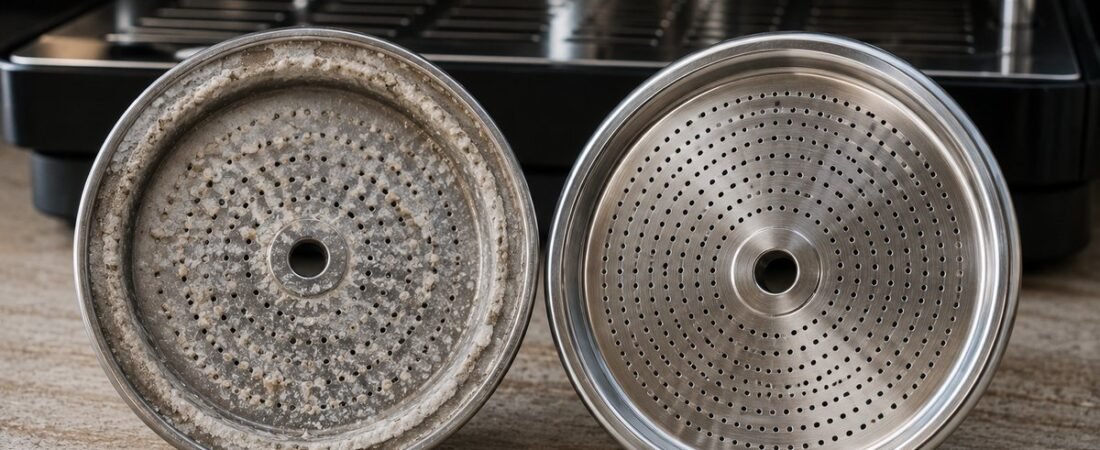
Everything else in this hub covers coffee and milk residue, organic buildup that backflushing and the monthly deep clean both handle. Scale is a completely different problem. It’s mineral, not organic; it comes from your water rather than your coffee, and neither backflushing nor a soap-and-detergent soak touches it. A machine can be spotless by every other measure in this hub and still be quietly filling with limescale.
The confusing part is that many people assume a water filter solves this permanently. It doesn’t. Filtered water slows scale buildup. It doesn’t stop it, and how fast it comes back depends on something you don’t control day to day: how hard your local water actually is.
Why Filtered Water Doesn’t Stop Scale
Water is a natural solvent, and as it moves through soil and rock on its way to your tap, it picks up dissolved calcium and magnesium. That’s just how water works everywhere, filtered or not. A standard water filter reduces chlorine, sediment, and some other compounds, but it typically leaves most of that dissolved calcium and magnesium behind, and it’s supposed to, because a small amount of mineral content is actually part of what makes coffee taste right. Water that’s been stripped of every mineral produces flat, lifeless espresso.
The problem isn’t the minerals being in your water. It’s what happens to them once your machine heats that water. Heat drives dissolved calcium and magnesium out of solution, and they precipitate as solid limescale on every hot surface the water touches: inside the boiler, along heating elements, and in narrow water lines. Filtered water still carries some of these minerals, just fewer than unfiltered tap water, so descaling isn’t a question of if but of how often.
How Water Hardness Determines Your Schedule
Water hardness is the one number worth tracking down for your own setup. It can change the answer by a factor of four or more. It’s usually measured in parts per million (ppm). Most water utilities publish this figure for their local supply, so a quick search often gets you the number. If not, a cheap test strip gives you a same-day answer.
As a rough guide:
- Under 50 ppm (soft water): descale roughly every 4 to 6 months.
- 50 to 100 ppm (soft to moderate): every 2 to 3 months.
- 100 to 200 ppm (moderate to hard): every 4 to 8 weeks.
- Over 200 ppm (hard to very hard): every 2 to 4 weeks, or seriously consider a dedicated water softening filter for your machine’s supply line. At that hardness level, descaling alone becomes a constant chore rather than routine maintenance.
These are starting points, not fixed rules; a machine you use twice a day accumulates scale faster than one you use twice a week, even with identical water. Treat the ppm-based schedule as your baseline and adjust down (more frequent) if you’re a heavy daily user, or if you start noticing the signs below before your next scheduled descale.
Choosing a Descaling Solution
Two real options exist, plus one alternative worth being cautious about.
Commercial descaling solution (Dezcal, Durgol, and similar espresso-specific products) is formulated to dissolve mineral scale effectively while staying safe for the seals, gaskets, and metals inside your machine. This is the safest default, and most manufacturers recommend it in their manuals.
Food-grade citric acid is a cheaper DIY alternative that works well specifically on calcium-based scale. A common ratio is about 25 to 30 grams (roughly 2 tablespoons) of citric acid dissolved per liter of water. It’s effective and inexpensive, but check your machine’s manual first; some manufacturers explicitly discourage citric acid for certain internal materials.
Plain vinegar is the one to use with caution. It’s acidic enough to dissolve some scale, but it’s also harsh enough to potentially damage certain rubber seals and metal components over repeated use, and it leaves a strong smell and taste that’s genuinely difficult to rinse out completely. Only use it if your specific machine’s manual explicitly says it’s safe; don’t assume it’s a safe universal substitute the way it sometimes is for household kettles.
The Descaling Procedure, Step by Step
- Empty the water tank and remove the portafilter and any baskets. You want the machine as empty as possible before introducing descaling solution.
- Mix your descaling solution according to the product’s instructions (or the citric acid ratio above), and fill the tank.
- Run the solution through every water path: the group head, the steam wand, and the hot water dispenser if your machine has one, either manually cycling each output or using a dedicated descale program if your machine has one.
- Let it dwell. Most solutions call for stopping partway through and letting the solution sit inside the machine for several minutes to work on stubborn deposits before continuing. Check your product’s label for the exact time.
- Finish running the solution through until the tank is nearly empty, making sure you’ve cycled through each output at least once.
- Rinse thoroughly. This step matters as much as the descaling itself. Fill the tank with clean water and run at least one to two full tanks through the same paths the descaler used, until the water coming out has no smell or taste of the descaling solution.
- Run a final check. A quick water-only shot pulled and discarded, plus a steam wand purge, confirms nothing acidic is left before you make a drink you’ll actually drink.
Skipping or rushing the rinse step is the most common way this process goes wrong. Leftover descaling solution in your next few shots tastes distinctly sour, bitter, or simply “off,” and you can avoid it with one extra tank of clean water.
Signs You’re Overdue
Water flow that’s noticeably slower than it used to be, especially through the hot water spout or steam wand, is one of the clearest scale signals. Mineral deposits physically narrow the passages minerals travel through. A machine that takes longer to reach brewing temperature, or a boiler that seems to run louder than it used to, both point in the same direction. And if your local water tests in the moderate-to-hard range and it’s been more than two months since your last descale, that alone is reason enough to run one rather than waiting for a symptom to show up.
Common Mistakes
Assuming a water filter means you can skip descaling. Filters slow the process; they don’t stop it. Every machine still needs a schedule.
Guessing at your water hardness instead of checking it. The difference between soft and hard water can shift your descaling interval by months, not days. That’s worth the five minutes it takes to look it up or test.
Using plain vinegar without checking your manual. It can work, but it can also damage certain components and leave a lingering taste. Confirm your specific machine allows it first.
Rushing the rinse. One tank of clean water often isn’t enough after a real descale. Run a second if there’s any lingering smell or taste.
Waiting for a symptom before descaling on a hard-water schedule. By the time flow visibly slows down, scale has already had real time to build up inside the boiler, not just in places you can see.
Descaling Espresso Machine: Putting It Together
Descaling is the one maintenance task in this hub that has nothing to do with coffee or milk residue; it’s entirely about your water, and it’s the one job a filter alone won’t let you skip. Figure out your actual water hardness once, set a descaling schedule around that number instead of a guess, and treat the rinse step as important as the descale itself. That’s the whole descaling espresso machine routine: hardness first, schedule second, rinse always. Do that, and scale stays a non-issue instead of the slow, invisible buildup that eventually makes a machine noticeably slower and hotter to run than it used to be.
What to Check Out Next
The last piece of this hub is grinder maintenance: burr cleaning and retention management, the maintenance step most home setups skip entirely, even though it affects flavor just as directly as everything covered here.
For the chemistry behind why scale forms in the first place, Wikipedia’s overview of limescale covers how dissolved minerals come out of solution when water is heated.