

The flat white vs cappuccino question comes up constantly, and the two drinks can look almost identical: a small white cup, espresso underneath, steamed milk on top. Baristas treat them as completely different drinks, and once you know what to look for, so will you. The difference isn’t size, and it isn’t the espresso. It comes down to what happens to the milk before it ever reaches the cup.
The Core Difference: Milk Texture, Not Size
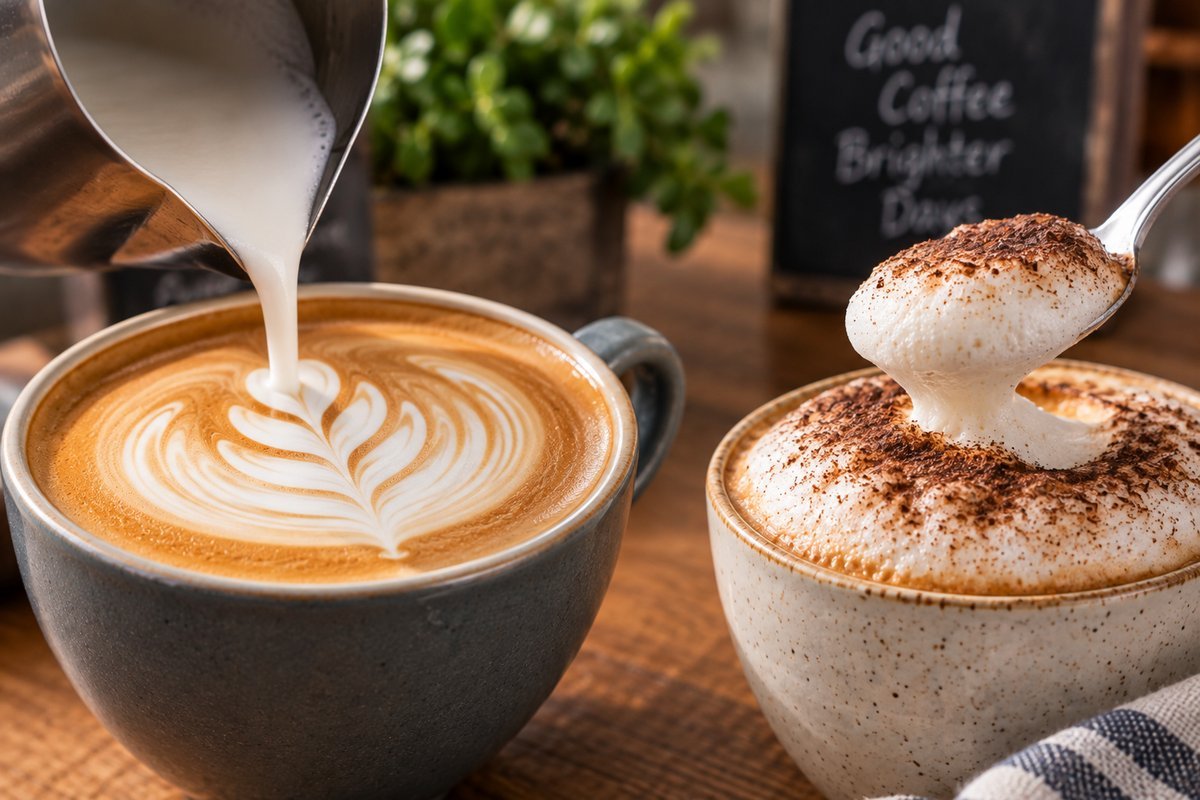
A cappuccino is built on foam. The barista steams the milk hard enough to trap a thick layer of air, then spoons or pours that foam on top of the espresso in a cap that can run half an inch deep. Cut a cappuccino in half, and you would see three distinct layers: espresso, steamed milk, and a dense white foam cap sitting above it.
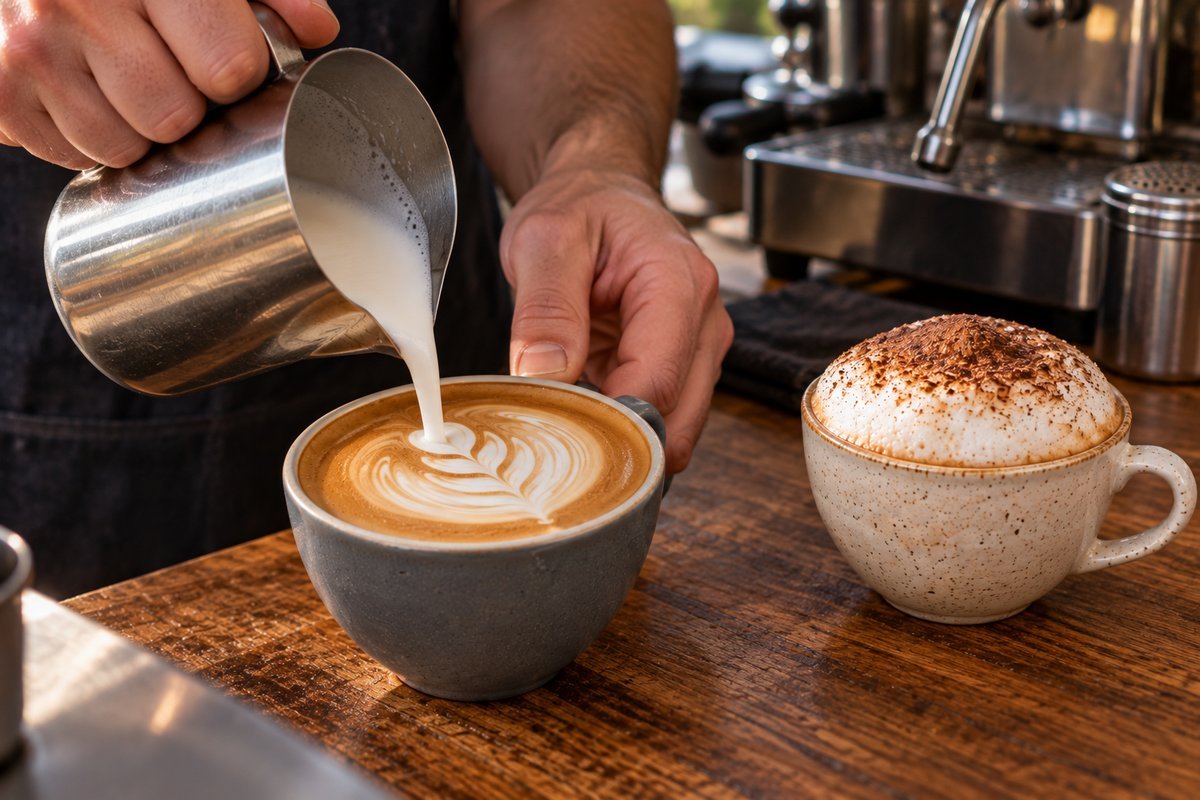
A flat white skips that layered structure entirely. Baristas steam the milk into what they call microfoam: air worked in so finely that the milk turns silky and glossy rather than airy. There is a thin skin of foam on top, usually just a few millimeters, but it blends into the milk instead of sitting on it like a cap. Pour a cappuccino and a flat white side by side, and the cappuccino visibly rises with foam while the flat white stays flat, which is exactly where the name comes from.
Shot and Size: How They Actually Compare
Traditionally, a cappuccino uses a single espresso shot and a flat white uses a double, often pulled as a ristretto, a shorter and more concentrated shot made with less water. In practice, most American cafes now pull a double shot for both drinks by default, so this old distinction has mostly disappeared behind the counter even though traditional Italian shops still hold to it.
Size follows a similar pattern of shrinking difference. A traditional Italian cappuccino runs 5 to 6 ounces. A flat white, born in cafes that wanted something between a cappuccino and a latte, usually lands in the 5 to 7 ounce range. Order either one at a specialty shop, and you’ll likely get a similar amount of liquid. Order a cappuccino at a shop that pads it with extra foam, though, and it will look bigger while actually containing less milk.
Caffeine: Closer Than You’d Think
Because both drinks are commonly pulled with a double shot today, the caffeine is roughly the same: about 80 to 150 milligrams, depending on the shop’s shot size and bean. The one place caffeine still splits is a cafe that keeps the cappuccino as a true single-shot Italian drink, which drops its caffeine to roughly half of the flat white’s. If caffeine content matters to you, ask what shot size the shop defaults to rather than assuming it from the drink’s name.
Calories: A Smaller Gap Than People Assume
This is where the milk-texture difference actually shows up on the nutrition label, even though it barely shows up in the cup size. Milk foam is mostly air, so a cappuccino’s thick foam cap adds very few calories or fat. A flat white’s thinner, denser microfoam holds more actual milk in the same amount of space, so a flat white typically runs a bit higher in calories and milk fat than a similarly sized cappuccino, though nowhere near as far apart as either drink is from a latte, which is mostly steamed milk with almost no foam at all.
With whole milk, expect a 6-ounce cappuccino to land somewhere in the 60 to 80 calorie range and a similarly sized flat white to run maybe 15 to 25 calories higher. Switch to non-fat or oat milk, and both numbers move together, since the ratio between them stays roughly the same.
Where the Names Actually Come From
The cappuccino’s name is the older story. It traces back to the Kapuziner, a coffee drink served in 18th-century Viennese cafes and named for its resemblance to the brown robes and hoods worn by Capuchin friars. Italian cafes picked up the idea and refined it into the espresso-and-foam drink known today sometime in the early 20th century, once espresso machines became common.
The flat white’s origin is genuinely disputed, and both Australia and New Zealand claim it. Sydney cafes were serving something called flat white coffee by the early 1980s, and one Sydney barista has said he brought the idea south from cane-farming communities in far north Queensland. New Zealand has its own competing claims, including a well-known account from Bar Bodega in Wellington, where the drink is said to have come out of a failed cappuccino in 1989. The milk would not hold a proper foam cap that day, so the barista served it flat instead, and the name stuck. Whichever origin story is true, the flat white did not reach most of the world until specialty coffee culture exported it in the 2000s and 2010s, decades after the cappuccino had already become a cafe standard.
Which One Should You Actually Order
In the flat white vs cappuccino decision, order a cappuccino if you want a lighter mouthfeel with a distinct foam cap you can taste separately from the espresso and milk underneath, and if you like a drink that looks and feels a little more substantial for its actual milk content.
Order a flat white if you want the espresso flavor to come through more directly, with milk that tastes silkier and more integrated rather than sitting on top as a separate layer. It is also the better choice if you have had cappuccinos that felt like mostly foam and wanted something that tastes more like actual milk and espresso.
| Feature | Cappuccino | Flat White |
|---|---|---|
| Milk texture | Thick foam cap | Silky microfoam |
| Traditional shot | Single espresso | Double or ristretto |
| Typical size | 5 to 6 oz | 5 to 7 oz |
| Caffeine (modern cafes) | 80 to 150 mg | 80 to 150 mg |
| Calories (6 oz, whole milk) | 60 to 80 | 75 to 100 |
| Origin | Vienna and Italy, 18th to 20th century | Australia or New Zealand, 1980s |
Common Mistakes People Make With Each
Assuming size tells you the drink. A cappuccino padded with extra foam can look identical in volume to a flat white while containing noticeably less actual milk.
Ordering a flat white expecting a stronger drink. The espresso amount is often the same as a cappuccino’s, or only slightly more. What changes is how integrated the milk tastes, not the shot’s intensity.
Judging caffeine by the name alone. Unless you know the shop’s default shot size, guessing caffeine content from cappuccino versus flat white is no longer reliable.
Frequently Asked Questions
Is a flat white stronger than a cappuccino?
Not necessarily. Both are commonly made with the same double shot at most modern cafes. The flat white’s espresso flavor tastes more present because the milk is less airy, not because it has more espresso.
Which has more caffeine, a flat white or a cappuccino?
At most modern cafes, they are close to identical since both use a double shot by default. A cafe that still pulls a true single-shot Italian cappuccino will have noticeably less caffeine than its flat white.
Can I order a flat white at any coffee shop?
Most specialty and chain coffee shops carry it now, though smaller independent cafes that stick to traditional Italian drinks may not. It is close enough to a small latte that most baristas can approximate it even if it is not on the menu.
Why does a flat white have less foam than a cappuccino?
The barista steams the milk differently. Cappuccino milk is steamed to trap more air, building a thick foam layer that separates from the liquid milk underneath. Flat white milk is steamed into microfoam, working the air in so finely that it stays blended with the milk instead of rising to the top.
Is a flat white just a small latte?
They are closer to each other than a flat white is to a cappuccino, but they are not the same. A latte usually has even less foam than a flat white and comes in a larger size, 8 ounces or more, so the espresso-to-milk ratio is more diluted.
The Bottom Line
Size will not tell you which drink you are holding, and lately neither will the shot count. The real flat white vs cappuccino difference is what the barista did to the milk before either one ever reached you: whipped into a thick, separate foam cap, or worked into a single silky texture that carries the espresso through every sip. Once you know to look at the milk instead of the cup, you will not mix them up again.
Related comparisons: see how a cappuccino compares to a latte or how a cortado differs from a latte.