
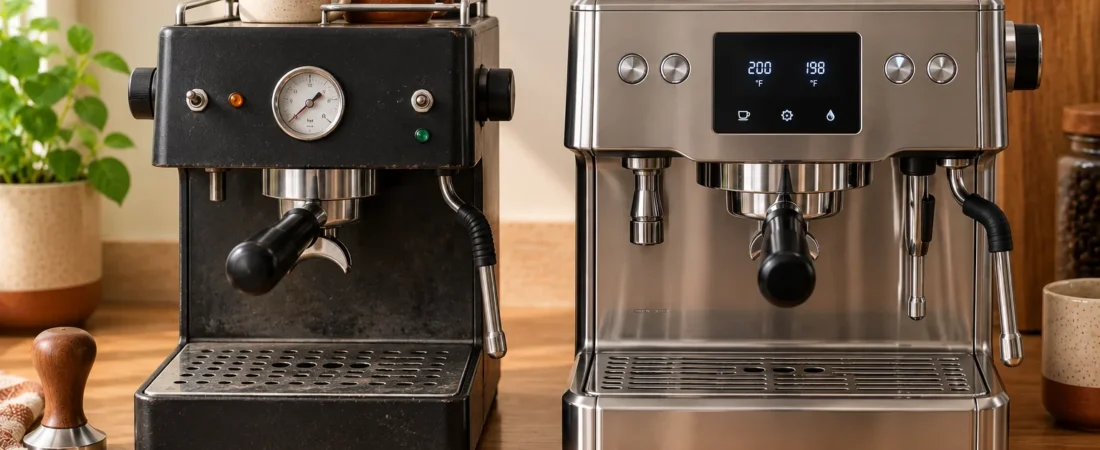
So, how long do espresso machines last? The answer depends mostly on how the machine heats water and how well it's maintained. Published estimates run from about 3 to 7 years for entry thermoblock (a heater that warms water as it flows through) machines to 10 to 20 years for dual boilers. A well-maintained machine can go well past the top of its range. A neglected one can fail well short of it. The number on the box matters less than what you do with the machine after you buy it.
That's why "how long will it last" isn't the most useful question. A more useful question is: when does it make sense to upgrade, versus fixing what's wrong and keeping going? That's what this guide is for.
How Long Do Espresso Machines Last?
Complete Home Barista estimates 3 to 7 years for thermoblock machines, 7 to 12 for single boilers, 10 to 15 for heat exchangers and 10 to 20 for dual boilers. Pro Coffee Gear gives 4 to 6 years for the Breville Bambino and Bambino Plus, 7 to 15 for semi-automatics in general and 4 to 8 for super-automatics. Neither guide says where its numbers come from, so treat them as rough ranges and a starting point, not a deadline. An espresso machine's lifespan is driven far more by maintenance than by the machine itself.
Descale regularly, clean the group head and portafilter (the handle that holds the basket of coffee) after every use, and use filtered or soft water, and you can push a machine well past the top of its range. Skip descaling, run hard tap water through it for years, and let gaskets dry out and crack, and you can be looking at a dead pump or a scaled-solid boiler well short of it.
In other words: two identical machines, bought the same day, can have wildly different lifespans depending entirely on how you treat them. That's worth understanding before you even start thinking about repair versus replace.
It's also worth separating two different questions that tend to get lumped together: "how long will this machine physically function" and "how long will this machine satisfy me." A machine can run for 6+ years and still leave you wanting something different. Faster recovery, a bigger boiler, more consistent temperature. That's not a machine failure, and it's not a lifespan question at all. It's a fit question, and it deserves its own answer rather than getting folded into "is my machine dying?"
What Shortens a Machine's Lifespan
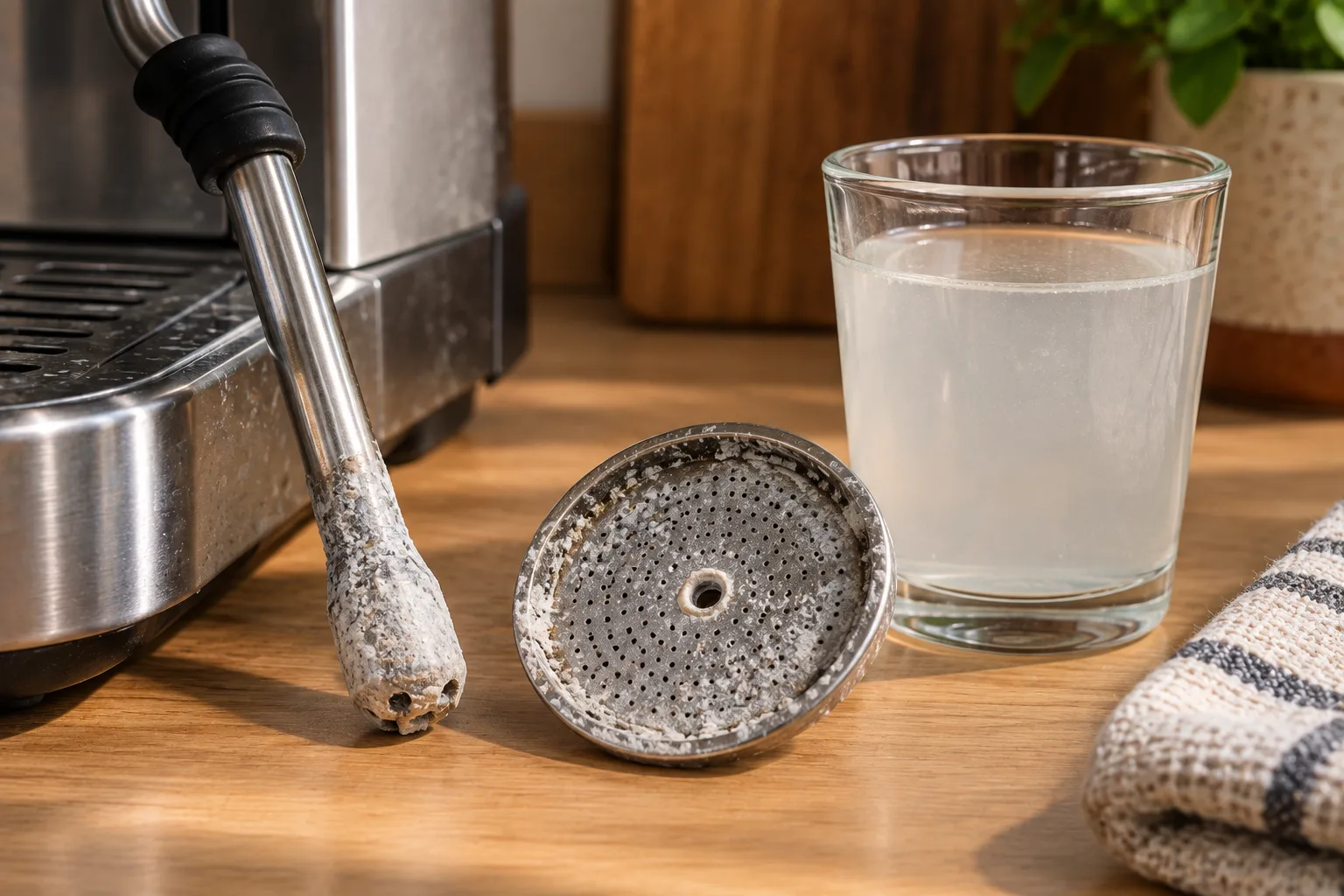
If you want your machine to land at the long end of its range, or beyond it, these are the things to watch:
- Scale buildup. This is the single most common cause of premature failure. Hard water leaves mineral deposits inside the boiler, in the lines, and around the heating element. Left unaddressed, scale restricts flow, stresses the pump, and can eventually cause a boiler to fail outright. If you're not descaling on a regular schedule, and you're not running filtered water, this is very likely what will take your machine down early.
- Skipped cleaning. Coffee oils build up in the group head (the part of the machine the portafilter locks into) and portafilter basket over time. It's not just a taste issue. Buildup can affect seals and flow paths too.
- Dried-out gaskets and seals. Rubber gaskets degrade with heat cycling and age regardless of use. A machine that sits unused for long stretches can develop seal problems faster than one used daily, since the rubber dries out rather than staying conditioned.
- Hard startups and shutdowns. Machines left on 24/7 without ever powering down, or ones that get unplugged from the wall instead of shut down properly, put extra wear on internal components.
Notice that almost none of this is about the machine's build quality. It's about what happens to it after it leaves the box. A $400 machine that's descaled every few months will often outlast a $1,200 machine that never sees a descaling solution.
This is also why lifespan estimates are inherently ranges rather than fixed numbers. No manufacturer can tell you exactly how long your machine will last, because they don't control your water hardness, your cleaning habits, or how often you run a descaling cycle. These figures are averages for typical use, not a countdown timer. Treat it as a baseline to beat, not a deadline to dread.
Signs It's Time to Upgrade (Not Just Repair)
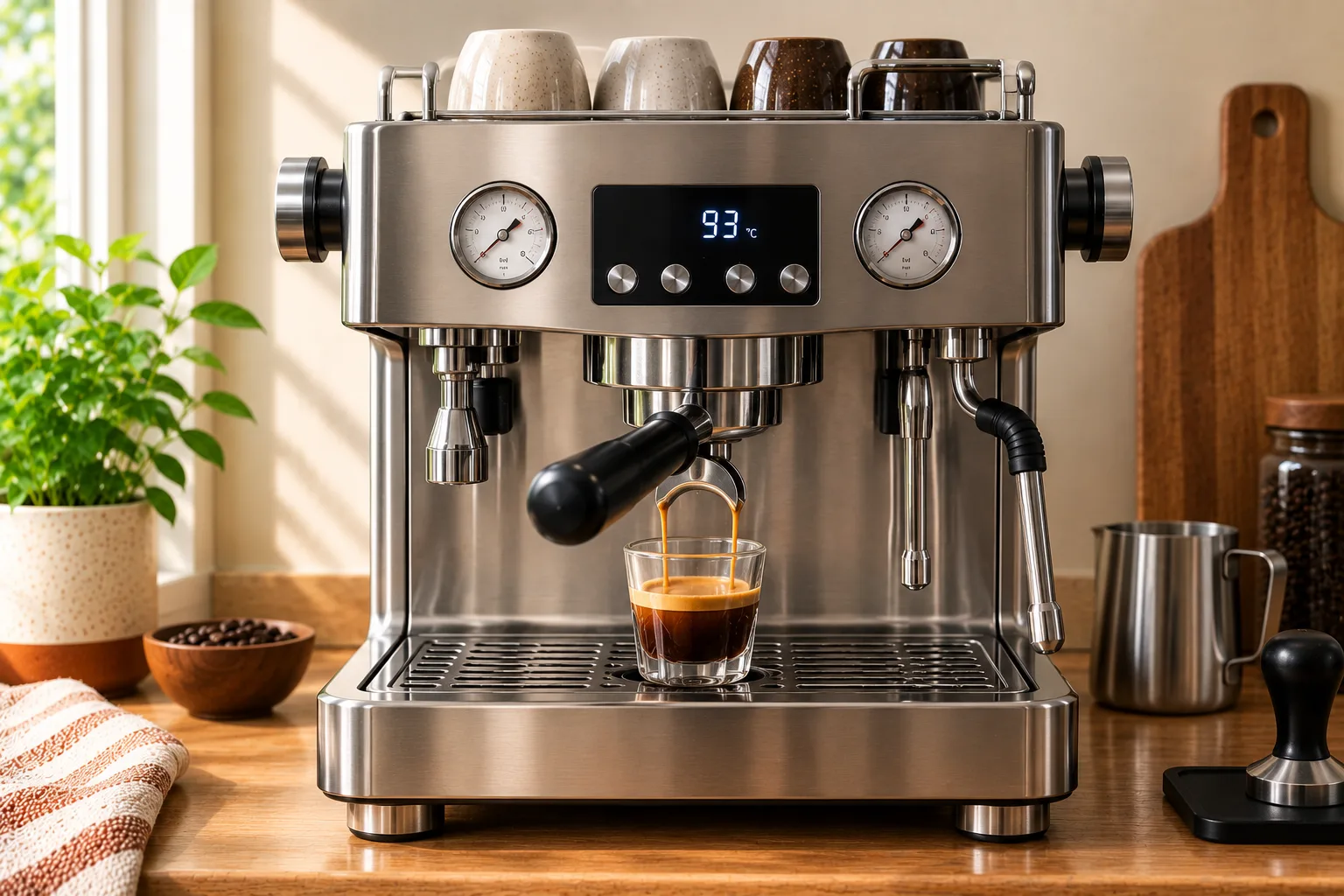
Some situations point toward replacing the machine rather than fixing it. Here's what those look like:
- You've outgrown single-boiler wait times. If you're regularly making multiple drinks back to back and you're tired of waiting for the boiler to recover temperature between shots and steaming, that's an ongoing problem a repair won't fix. It's a structural limitation of the machine. Our single-boiler vs. dual-boiler breakdown covers exactly what changes when you move up.
- You want features your current machine physically can't support. PID temperature control, dual boilers, pressure profiling (changing the pressure during the shot). You can't add these to an existing machine. If you've hit the ceiling of what your current setup offers and you know what you want next, that's an upgrade decision, not a repair one.
- Repair costs are creeping toward replacement cost. If you're looking at a repair bill that's a large fraction of what a new machine would cost, especially a second or third repair in a short span, you're often better off putting that money toward a new machine with a fresh warranty.
The common thread: these are cases where the machine itself is the limitation, not just one broken part. If you find yourself explaining a problem in terms of what the machine can't do, rather than what's broken on it, that usually means it's time to upgrade rather than repair.
There's also a less obvious version of this: your habits changed, not the machine. Maybe you started making espresso for the whole household instead of just yourself. Maybe you got serious about latte art, and now steam power matters to your results. The machine didn't get worse. You just outgrew what it was built to do. That's still a legitimate reason to upgrade, even if the machine itself is running fine.
Signs You Should Repair or Descale Instead of Replace
On the other side, plenty of "my machine is dying" moments are really overdue maintenance or a single fixable part. Repair (or just a proper descale) makes more sense when:
- It's one isolated issue on an otherwise good machine. A worn gasket, a failing pump, a sticky valve: these are common, well-understood repairs on machines that are otherwise performing fine. If everything else about the machine works and you like how it makes coffee, fix the one broken thing.
- You haven't descaled in a while. Weak flow, longer heat-up times, or odd pump noises are often scale, not a dying machine. A thorough descaling cycle solves more "is my machine dying" situations than people expect. Try this before assuming the worst.
- The repair cost is well below replacement cost. If a technician quotes you a fraction of what a comparable new machine costs, that's usually the better financial move, especially on a machine you already know and like.
Rule of thumb: if the problem is specific and the fix is cheap relative to a new machine, repair. If the problem is really "this machine can't do what I want it to do," that's an upgrade conversation, not a repair one.
Pro Coffee Gear and Complete Home Barista both put the line at about half the price of a comparable new machine. Above that, replacing usually makes more sense.
Before you assume a repair or replacement is needed, run a proper descaling cycle and give the machine a thorough clean. It sounds too simple, but a surprising number of "my machine is dying" situations turn out to be exactly that: scale that's been quietly accumulating for a year or two, finally showing up as weak pressure, slow heating, or a noisy pump. It costs almost nothing and takes an afternoon. Rule it out before you spend real money.
What to Consider Before Upgrading
If you've landed on "yes, it's time to upgrade," a few things are worth sorting out before you buy:
- What specifically is limiting you now? Recovery time between drinks, steam power, temperature stability, workflow for multiple drinks. Naming the actual bottleneck keeps you from overbuying (or underbuying) on your next machine. Our guide to choosing an espresso machine walks through this in more detail.
- Your realistic budget tier. Espresso machines span a huge price range, and capability doesn't always scale linearly with price. See our breakdown by price tier for what you get at each level.
- Whether you're solving the right problem. Sometimes what feels like a machine problem is a grinder problem, or a water quality problem, or a dialing-in problem. Make sure the machine is the bottleneck before you spend on a new one.
- Whether a budget-tier machine solves it. Not every upgrade needs to be a big jump. If you're just tired of a worn-out entry-level unit, something like our best espresso machine under $500 picks might be all the upgrade you need.
Summary
Estimates run from about 3 to 7 years for entry machines to 10 to 20 for dual boilers, and those numbers mostly reflect maintenance. Descale it, clean it, treat it reasonably, and it'll likely outlast the average. Neglect it, and it won't come close.
When something goes wrong, don't default to replacing it. Check whether it's scale, check whether it's one fixable part, and compare the repair cost to a new machine before you decide. Upgrade when the machine itself is the limitation (wait times, missing features, or repair costs that no longer make sense), not just because it's a few years old.
So, how long do espresso machines last in practice? Long enough to be worth maintaining well. With descaling and cleaning on schedule, most machines can reach the top of their range.
Mineral scale is the main reason machines wear out early. The U.S. Geological Survey notesthat scale from heated hard water shortens the life of water-heating equipment.
Before deciding it is time to upgrade, make sure basic upkeep is not the real issue. See our machine maintenance guide for the daily, weekly, and monthly routine that keeps a machine running its full lifespan.
The Espresso Machines hub has the rest of our guides on choosing and comparing machines.
Scale is one of the most common reasons machines fail early, so follow a regular descaling protocol.