
Espresso machines rarely fail because a part wears out. They fail because mineral buildup and old coffee oils accumulate quietly, shot after shot, until a gasket leaks or a solenoid clogs. None of the maintenance that prevents this takes long. The problem is almost never the task itself â it’s that it has to actually happen on schedule, and most of it is invisible until it’s already a problem.
This guide lays out exactly what to do daily, weekly, monthly, and every few months to keep a home espresso machine and grinder running for years, not a couple of seasons. Nothing here requires professional tools or more than about 30 minutes a month, total.
Daily Maintenance
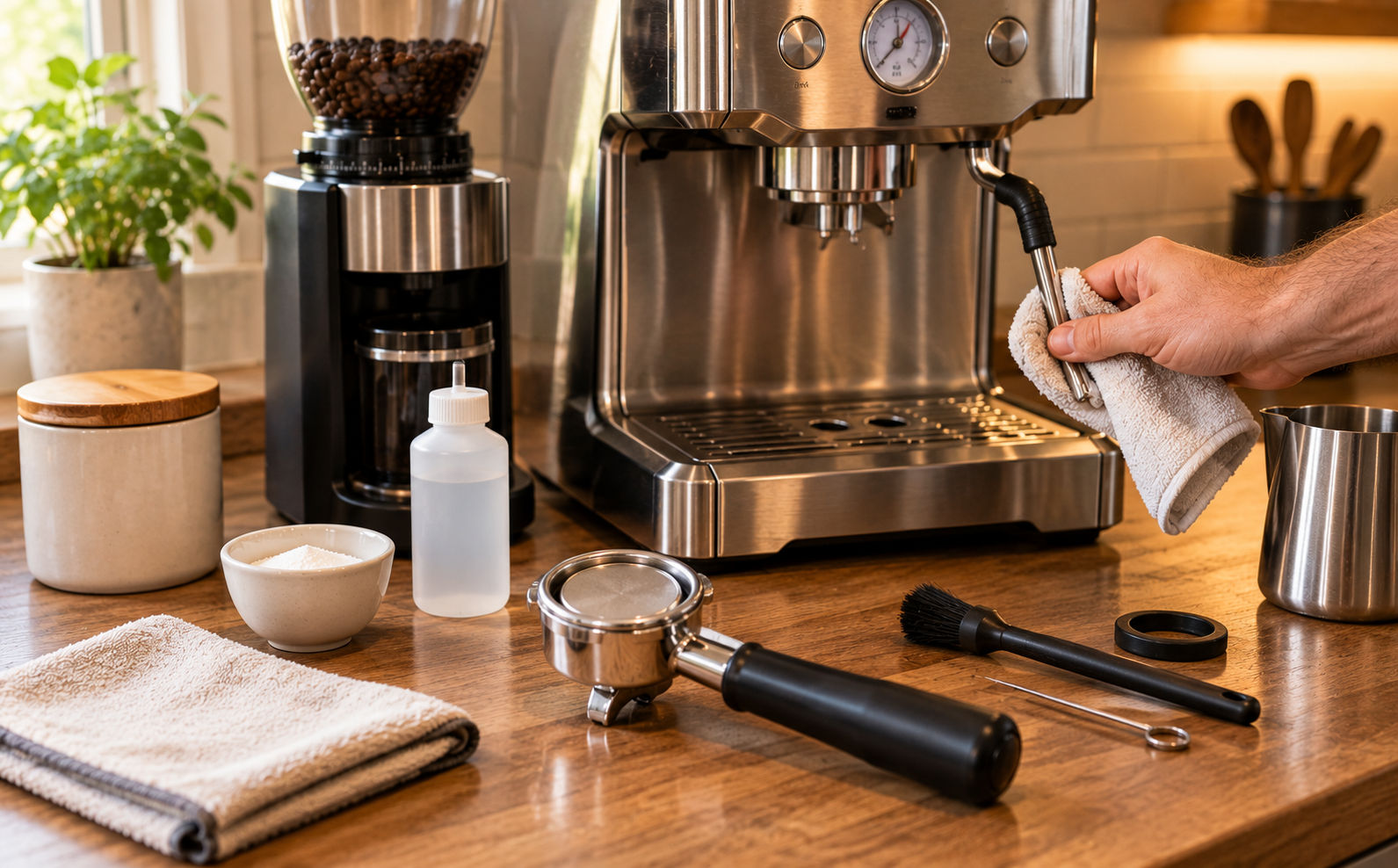
The daily routine takes about five minutes and prevents most of the buildup that eventually causes bigger problems. Do this every time you pull a shot, not just at the end of the day.
Purge the group head for a few seconds before locking in the portafilter â this flushes out old, cooling water and any loose grounds sitting in the group. After the shot, remove the puck immediately rather than letting it sit; old, wet coffee grounds left in the portafilter are one of the most common sources of the stale, rancid smell people mistake for a machine problem when it’s actually just neglected cleaning.
If you steam milk, wipe the steam wand immediately after every use, while the milk residue is still warm and easy to remove, and purge a short burst of steam through it afterward to clear the internal tip. Milk residue left on a wand for even a few hours hardens and becomes far harder to remove later, and residue left inside the tip itself can restrict steam flow over time.
Finally, empty the drip tray before it overflows and give the portafilter a quick rinse under hot water. None of this requires disassembly or products â it’s rinsing and wiping, and it’s the single highest-leverage maintenance habit for machine longevity.
Weekly Backflushing
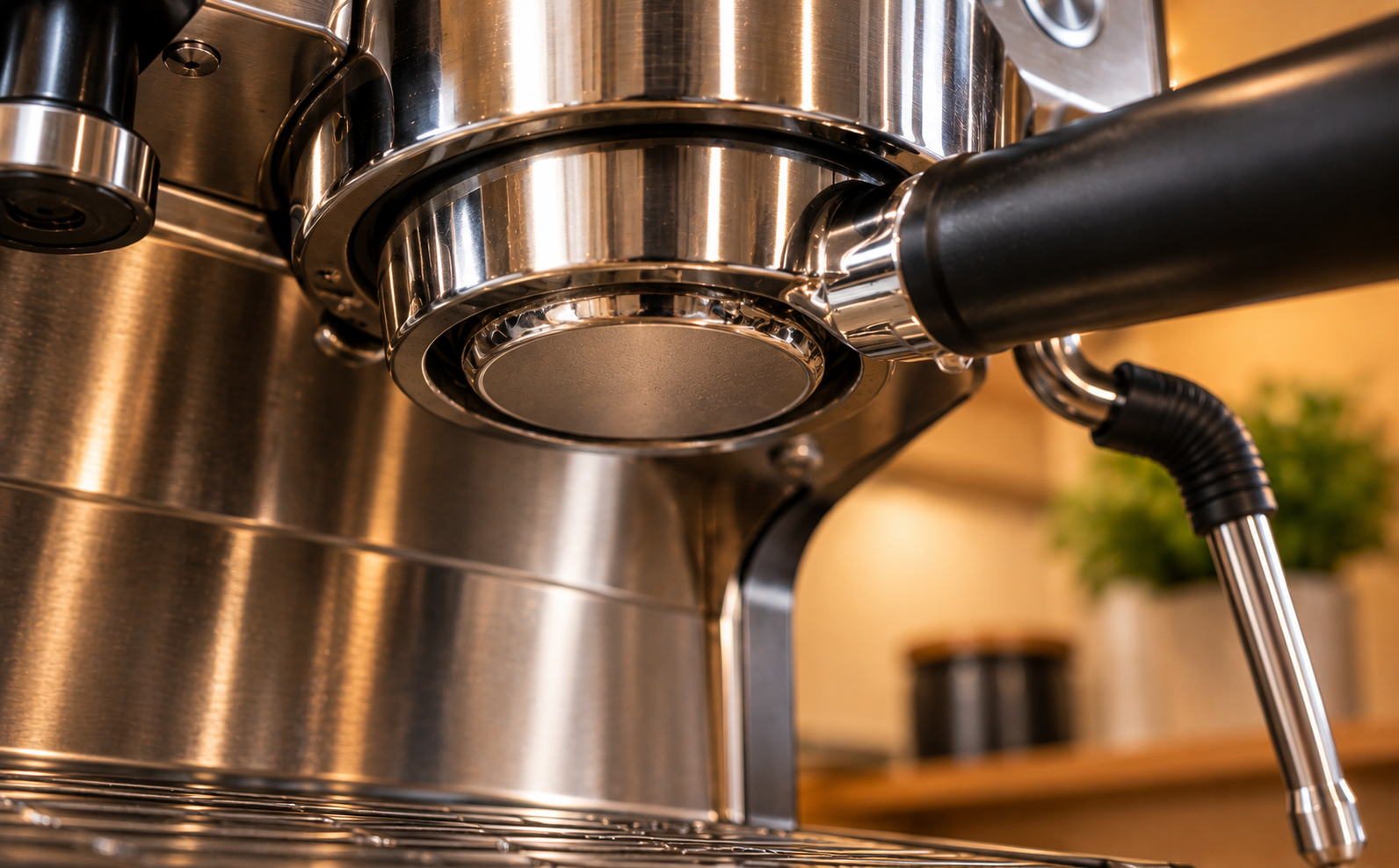
Backflushing is different from the daily rinse â it forces water backward through the group head’s internal pathway to flush out coffee oils that build up where a simple rinse can’t reach. If your machine has a 3-way solenoid valve (most prosumer semi-automatics do â check your manual if you’re not sure), it can handle backflushing safely; machines without one generally can’t and shouldn’t be backflushed the same way.
To backflush, insert a blind filter basket (a solid disc with no holes, usually included with the machine) into the portafilter, lock it into the group, and run the brew cycle for a few seconds at a time, several times, letting the machine pause between cycles. This forces water through the group’s internal valve backward, clearing the coffee oil residue. Do this weekly with plain water, and do it with a proper espresso machine cleaning detergent roughly once a month â the two aren’t the same thing, and plain water alone won’t fully break down oil buildup over time.
Skipping backflushing is one of the most common reasons a machine that looks clean on the outside still tastes increasingly bitter or muddy shot after shot â the buildup is inside the group head, not somewhere you’d see it.
Monthly Deep Clean
Once a month, go beyond the weekly routine. Backflush with an actual espresso machine cleaning detergent (never regular dish soap, which can leave residue and doesn’t break down coffee oils the same way) following your machine’s instructions for cycle count and rinse cycles afterward.
Remove the shower screen â the perforated metal disc the water passes through on its way into the puck â and soak it in hot water with detergent, then scrub it gently with a soft brush to clear the small holes. A clogged shower screen restricts and unevenly affects water flow into the puck, which can cause channeling-like symptoms that have nothing to do with your tamp or distribution.
Soak your portafilter baskets in the same detergent solution â oil residue builds up in the tiny holes over time and gradually restricts flow, which shows up as a shot that runs slower than it used to at the same grind setting. And clean the steam wand tip specifically, not just the exterior: unscrew or detach it if your machine allows, and soak it separately to clear any milk residue that’s built up inside the small holes at the tip.
Descaling Protocol
Descaling is different from cleaning â cleaning removes coffee oils and milk residue, while descaling removes mineral scale (limescale) that builds up from the minerals naturally present in water, even filtered water. Scale builds up inside the boiler, heating element, and internal tubing where you can’t see it, regardless of how clean the machine looks on the outside.
How often you need to descale depends heavily on your water hardness. If you’re on very hard water, you may need to descale monthly; on soft or well-filtered water, every two to three months is often enough. Most machines display a descale reminder based on shot count or time, which is a reasonable default if you don’t know your water hardness â but if you notice slower heat-up times, reduced steam power, or a machine that seems to be struggling more than it used to, descale sooner rather than waiting for the reminder.
Use a descaling solution formulated for espresso machines specifically (not general-purpose descalers, and never vinegar, which can damage internal seals on some machines) and follow your manufacturer’s specific cycle â this is one maintenance step where skipping the manual and guessing can genuinely damage the machine.
Grinder Maintenance
Grinder maintenance is the step most homeowners skip entirely, and it’s a major cause of the inconsistent shots covered in troubleshooting guides â not the grind setting itself, but the grinder’s internal cleanliness.
Coffee oils build up on the burrs over time, especially with darker roasts, and this buildup gradually dulls grind consistency even though the burrs themselves aren’t worn. Most home grinders benefit from a burr cleaning every one to three months depending on volume â remove the burrs according to your grinder’s manual, brush off the built-up oil and fine particles with a stiff (not wire) brush, and reassemble without over-tightening.
Retention â old grounds that stay lodged in the chute or around the burrs between grinds â is the other half of grinder maintenance, and it matters daily, not just monthly. A quick purge or a small brush pass through the chute before collecting your dose reduces stale, previously ground coffee mixing into a fresh dose, a common and underrated cause of inconsistent-tasting shots even when the grind setting hasn’t moved.
Espresso Machine Maintenance: Putting It Together
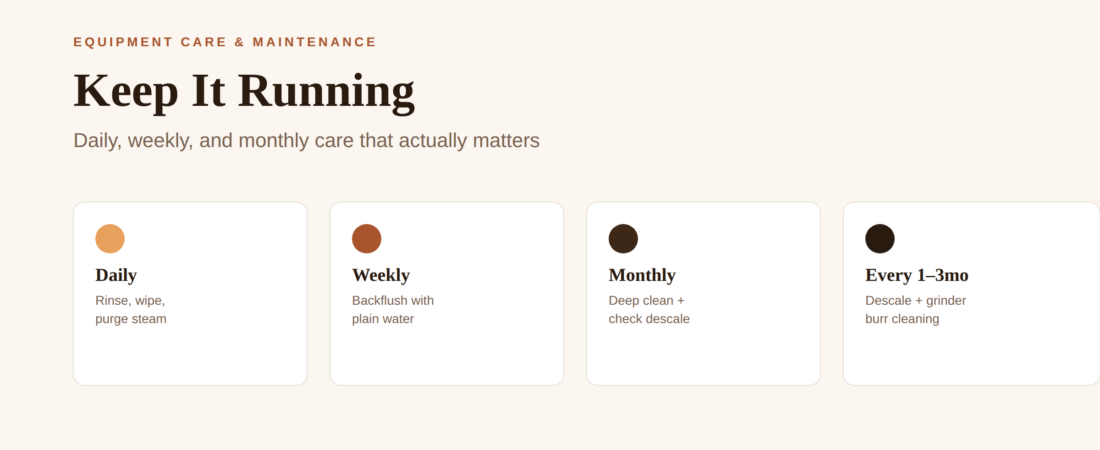
The full schedule is simpler than it looks: rinse and wipe daily, backflush with plain water weekly, deep clean with real detergent monthly, descale every one to three months depending on your water, and clean the grinder burrs every one to three months depending on volume. None of these individually take more than a few minutes â the daily habits especially become automatic within a couple of weeks. What actually prevents equipment failure isn’t any single deep clean; it’s the compounding effect of the small habits happening consistently enough that buildup never gets the chance to become a real problem.
Common Mistakes in Equipment Maintenance
Using the wrong cleaning products is the most damaging mistake â regular dish soap, vinegar, or a descaler not formulated for espresso machines can leave residue, damage seals, or simply not do the job the actual cleaning step requires. Stick to products made specifically for espresso equipment.
The second-biggest mistake is confusing cleaning with descaling, or assuming one covers the other. Backflushing removes coffee oils; descaling removes mineral buildup. A machine can be spotlessly clean of coffee residue and still be accumulating scale internally, and vice versa â they’re separate problems that need separate routines.
The third is treating grinder maintenance as optional. It’s easy to assume a grinder works until it breaks, but oil buildup on the burrs gradually and invisibly degrades grind consistency, long before anything looks or sounds wrong.
What to Check Out Next
If shots have been getting more inconsistent despite good technique, it’s worth checking whether maintenance is the actual cause: Espresso Troubleshooting covers how to diagnose sour, bitter, channeled, and inconsistent shots, including the grinder retention issues this guide touches on. And if you’re still working out your core technique, How to Dial In Espresso covers dose, yield, and extraction time from the ground up.
The Final Take
Espresso equipment is more durable than people expect, as long as you do routine maintenance on schedule. Rinse and wipe daily, backflush weekly, deep clean and check descaling needs monthly, and don’t neglect the grinder. None of it is complicated â it just has to be consistent. A machine cared for this way will outlast one that looks the same on the outside but has years of hidden buildup working against it. Treat espresso machine maintenance as a schedule to follow, not a chore to get to eventually.
For the chemistry that makes descaling part of this routine necessary in the first place, Wikipedia’s overview of limescale covers how dissolved minerals build up inside anything that heats water repeatedly.