
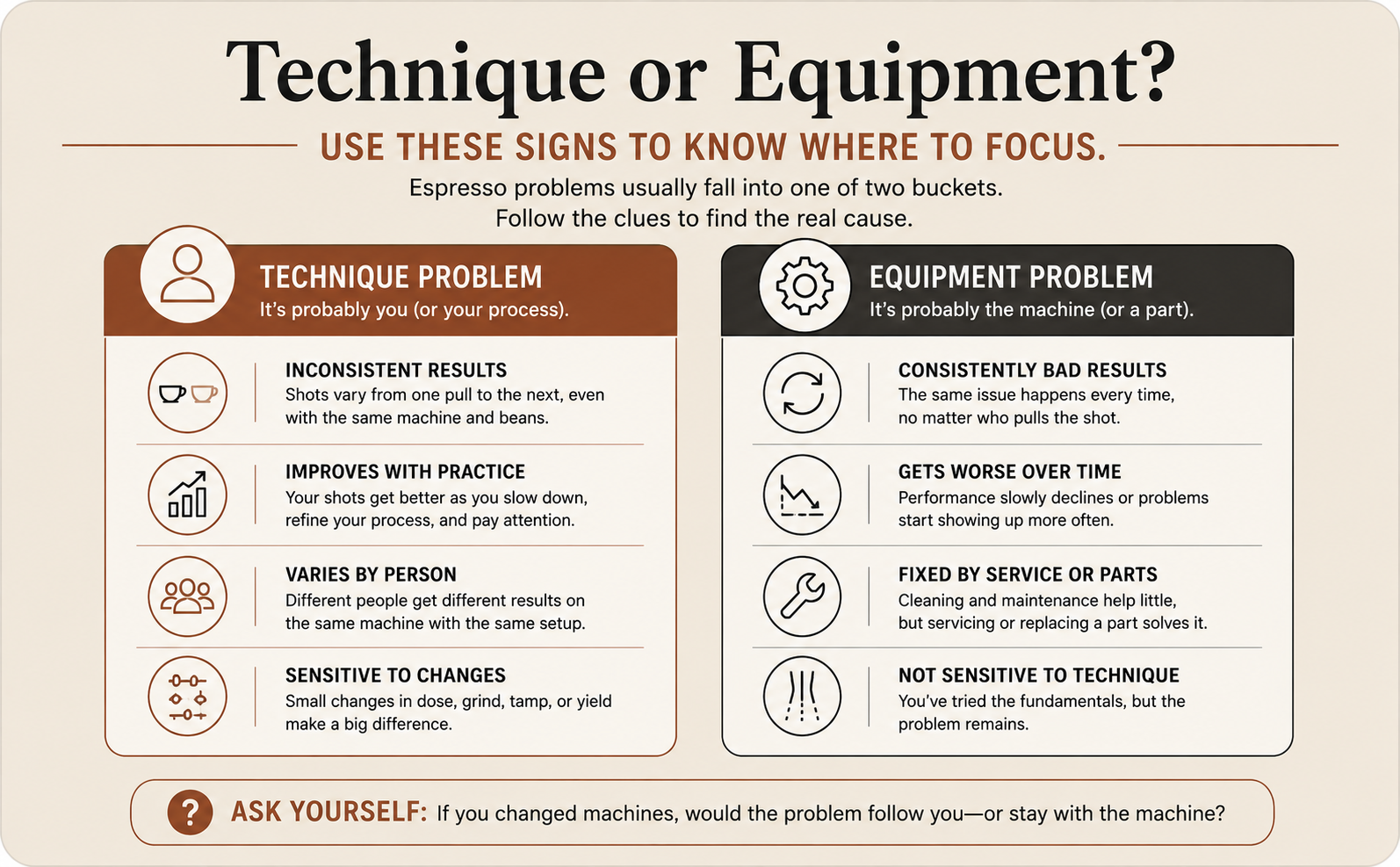
Every one of the problems in this troubleshooting hub, such as sour shots, bitter shots, channeling, and inconsistency, has two possible root causes. One costs you nothing to fix: adjusting how you dose, distribute, or grind. The other costs real money: a worn grinder, a machine that can’t hold temperature, a burr set past its useful life.
Getting the diagnosis wrong in either direction is expensive. Blame the machine when it’s technique, and you spend hundreds of dollars on an upgrade that doesn’t fix anything. Blame your technique when it’s actually the equipment, and you spend weeks second-guessing yourself over a problem no amount of skill can solve.
This isn’t a guessing game. There’s a real test.
The Core Test: Does It Respond to Grind Adjustment?
The single most useful question you can ask is whether the problem changes predictably when you adjust grind size. A shot that’s genuinely a technique or dial-in problem will respond to grind: go finer and it slows down and darkens, go coarser, and it speeds up and lightens, in a way that roughly tracks what you’d expect.
A shot caused by an equipment problem often does the opposite. It stays broken in the same way no matter what you do to the grind, or it responds erratically, in a way that doesn’t track your adjustments at all.
That one difference is usually enough to tell you which bucket you’re in, before you spend a single dollar fixing the wrong thing.
Three Checks You Can Run at Home
The grind sweep. Keep everything else fixed: same beans, same dose, same distribution, same tamp. Then pull three shots: your normal grind setting, three clicks finer, three clicks coarser. Log the shot time and taste each one.
If the results move in the direction you’d expect (finer runs slower and tastes more developed, coarser runs faster and tastes thinner), your grinder is functioning, and this is a dial-in problem, not an equipment one. If the shot time barely moves, or moves the wrong direction, or the taste doesn’t track the timing at all, that’s a real flag.
The bottomless portafilter check. If you own one, or can borrow one, run a shot with it and just watch the puck. A healthy extraction flows evenly and darkens gradually through the shot.
Spraying jets, a fast blonde stream that never darkens, or streams that appear and disappear are the visible signature of channeling, and channeling from an otherwise well-prepared puck (good distribution, level tamp) that keeps happening shot after shot is one of the clearer signs the grind itself, not your prep, is the problem.
The blind-basket pressure and temperature check. If you have a blind disk (a solid disk that replaces the basket for backflushing), lock it in an empty portafilter and run the machine without any coffee. Watch the pressure gauge: it should climb smoothly and settle in the 8 to 10 bar range within a few seconds, and hold there, not spike and collapse or creep up sluggishly.
If your machine has a PID or temperature readout, confirm it’s actually reaching a stable brew temperature (this varies by machine, but wild swings shot to shot, or a machine that never seems to fully arrive at temperature even after a long warm-up, is a real signal) rather than assuming the “ready” light means it’s actually stable.
This test isolates the machine completely. There’s no coffee in the mix at all, so anything that goes wrong here has nothing to do with your grind or your technique.
If all three checks come back clean, the machine and grinder are doing their job, and the problem, whatever it is, lives in technique, beans, or dial-in. That’s genuinely good news: it means the fix is a free change, not a purchase.
Signs It’s Actually Your Grinder
Grinder burrs wear out, and the wear shows up as a pattern, not a single bad shot. Watch for these together, not any one in isolation:
Grind creep. You find yourself dialing finer and finer over weeks just to hit the same shot time, even though your dose, beans, and machine haven’t changed. That drift is the classic sign of dulling burrs. They need a finer setting to produce the same particle size they used to produce at a coarser one.
Channeling that survives good prep. If you’ve ruled out distribution and tamp and you’re still getting inconsistent, sprayed, or fast-blonde shots on a regular basis, worn burrs producing an uneven particle mix- too many fines mixed with too many boulders- is a common cause that no amount of careful puck prep can fully correct.
A flat, dull, faintly bitter taste that dialing in won’t fix. Excess fines from worn burrs over-extract disproportionately, muddying flavor in a way that persists across a reasonable range of grind adjustments.
Physical changes in the grinder itself. Noticeably more heat, more noise, or more effort to grind through the same amount of coffee than it used to take.
On typical steel burrs (the kind on most home grinders in the 50 to 65mm range), rough guidance for a home user pulling two to four shots a day is 3 to 5 years, or somewhere around 750 to 1,000 pounds of coffee. For context, that’s roughly a thousand 12-ounce bags, which is a genuinely long time for most home setups.
Ceramic burrs generally last longer under normal wear, though a chipped ceramic burr needs replacing immediately regardless of hours logged. Before blaming burr wear, rule out a simply dirty grinder. Old grounds and oil buildup in the chamber can mimic several of these symptoms and cost nothing to fix with a real cleaning.
Signs It’s Actually Your Machine
Machine problems tend to show up as consistency failures that don’t track your adjustments at all. The same bad thing happens whether you go finer, coarser, change your dose, or change your tamp.
Temperature that won’t hold. Shots taste noticeably different depending on how long it’s been since the last one, even with identical grind and dose, especially on single-boiler machines that haven’t had time to recover between pulls.
Pressure that won’t build, or that collapses mid-shot, confirmed with the blind-basket test above rather than guessed at from the pressure gauge during a normal shot with coffee in the way.
Water flow that’s noticeably off from what the machine is rated for. A rough home check is timing how long it takes to collect around 250ml of water through the group with no basket in place; a large deviation from your machine’s spec points to scale buildup, a pump issue, or a flow restrictor problem rather than anything you’re doing wrong.
Any of these, confirmed with the blind-basket check rather than assumed, warrants a service call or repair before you adjust your technique. No amount of skill fixes a machine that can’t hold pressure or temperature.
What’s Almost Always Technique, Not Equipment
A few problems get blamed on equipment far more often than they deserve. Sour shots are usually grind-too-coarse or dose-too-low, not a bad machine (see the sour shots guide). Bitter or sluggish shots are usually grind-too-fine or stale beans, not a bad grinder (see Bitter or Sluggish Espresso Shots).
Inconsistency from one shot to the next is very often a dosing or distribution habit that isn’t locked in yet, not the grinder drifting (see Inconsistent Espresso Shots). Run the grind sweep test above before assuming the grinder itself is at fault.
Common Mistakes
Upgrading before testing. A new grinder or machine is an expensive way to find out the real problem was a stale bag of beans or a dose that was never actually measured.
Testing with too many variables changed at once. The point of the grind sweep and blind-basket checks is to isolate one variable at a time. Change grind and beans and dose together, and you’ll learn nothing about which one mattered.
Assuming the “ready” light means stable temperature. Many machines report ready well before the group and boiler have actually settled, especially after a long idle period. Give it real time, or use the blind-basket check to confirm.
Writing off a grinder based on one bad shot. Grind creep and channeling-that-survives-good-prep are patterns over multiple shots, not verdicts from a single pull. One bad shot is far more likely to be a one-off technique slip.
Technique or Equipment: Putting It Together
The question “is this me or the machine” has a real answer, and it doesn’t require guessing. Run the grind sweep first. It costs nothing and rules out or confirms a huge share of problems on its own.
If the shot doesn’t respond the way it should, move to bottomless portafilter and blind-basket checks to isolate the grinder from the machine. Only after those come back genuinely bad is an upgrade the right call, and at that point, you’ll know exactly which piece of equipment to replace, instead of guessing and hoping.
What to Check Out Next
If you haven’t already, work through Bitter or Sluggish Shots, Channeling, and Inconsistent Shots. Most problems that feel like an equipment failure turn out to be one of these, and each one has its own specific fixes to try before you conclude the machine is the problem. Working through that list first is usually faster than any technique or equipment debate.
For a broader technical grounding in what a grind sweep and blind-basket test are actually isolating, Wikipedia’s overview of espresso covers the extraction variables behind both.