
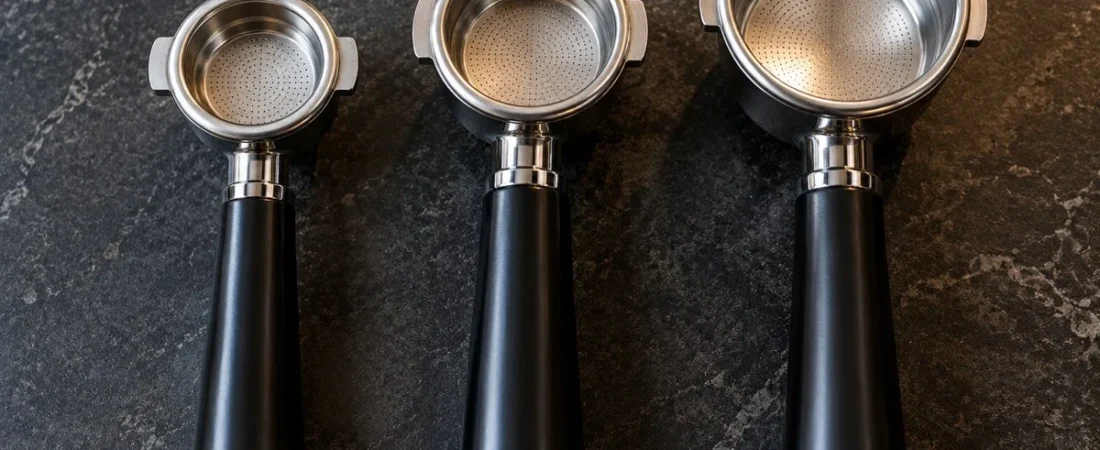
Buy the wrong replacement basket or a tamper that's a few millimeters off, and you'll find out quickly that portafilters aren't a one-size-fits-all part. A tamper that's too small lets grounds pile up around the edges. One that's too big won't seat flush against the basket wall at all. This portafilter size guide covers the four sizes you'll run into, and getting it right starts with knowing which one your machine uses, since that's not always obvious from the box it came in.
The four common portafilter sizes
Most home and prosumer espresso machines land on one of four diameters: 51mm, 53mm, 54mm, or 58mm. The number refers to the inside diameter of the filter basket, not the metal housing around it, which is why two portafilters that look the same size side by side can hold baskets that are several millimeters apart.
58mm is the industry's long-standing commercial standard. E61 group head machines, the Rancilio Silvia, the Gaggia Classic Pro, and most full-size prosumer machines built in the European commercial tradition all use it. If a machine looks like a scaled-down cafe unit, with a chunky group head and a portafilter that takes real effort to lock in, it's almost certainly 58mm.
54mm is Breville's own standard, and it shows up across the brand's most popular models: the Barista Express, Barista Pro, Barista Touch, and Dual Boiler. Breville didn't adopt this size from an existing standard. It's specific to their lineup, which is exactly why a 58mm basket from a different brand won't drop into a Breville machine no matter how close the numbers look.
51mm is the compact-machine size, found on smaller entry-level units like the De'Longhi Dedica line. These machines are built for tight counters, and the smaller group head helps them stay that size. The tradeoff is less room in the basket, which caps how much coffee you can dose for a shot.
53mm shows up less often in the US market. It's an in-between size used by a handful of European models, and it's worth double-checking against your machine's manual rather than assuming, since it's easy to mix up with 54mm at a glance.
How to find out which size you have
The fastest way is the machine's manual or spec sheet, since manufacturers list the group head or basket size directly. If you don't have the manual anymore, most manufacturer websites publish it under support or downloads for the exact model number.
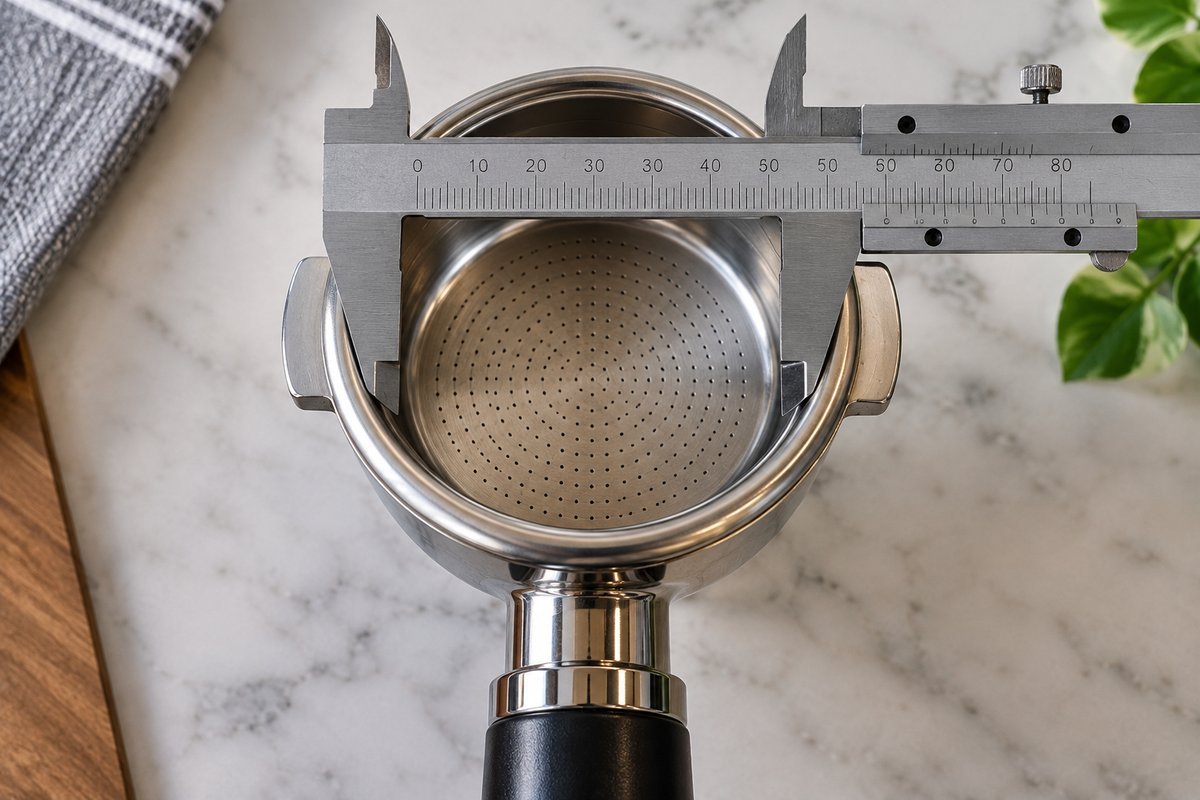
No manual and no model number handy? Pull the basket out and measure the inside diameter with calipers or a ruler, right at the rim where the coffee sits, not the outer lip. A tape measure gives a rough reading, but calipers get you close enough to tell 53mm from 54mm, which a tape measure often can't.
Buying a replacement basket from the same brand as your machine is the safer bet than matching a number alone. Basket depth, dosing capacity, and the exact rim design vary between manufacturers even at the same nominal diameter, so a 58mm basket built for one brand's group head doesn't always sit right in another.
Why the size matters
A basket that's too shallow or too narrow for the machine's group head can leak around the edges during extraction, since the seal depends on the basket and portafilter meeting the group head's gasket at the right dimensions. That shows up as coffee spraying from the sides instead of pouring cleanly from the spouts.
Size also decides how much coffee you can dose. A 58mm basket comfortably holds an 18 to 22 gram double shot with room to spare. Drop to 51mm and you're often capped closer to 14 to 16 grams, which matters if you're used to a recipe built around a bigger dose and switch to a smaller machine expecting the same numbers to work.
Replacement parts also get easier to find the bigger the size. 58mm has the widest choice of aftermarket parts: precision baskets, bottomless portafilters, and dispersion screens from third-party makers who build almost exclusively for that diameter. That's because it covers the widest slice of the prosumer and commercial market. Track down a 51mm precision basket and the options shrink fast, sometimes to just what the manufacturer sells directly.
58mm versus 54mm: does bigger help
Since 58mm and 54mm cover most of the market outside compact machines, it's worth asking whether the bigger size is worth chasing if your machine already came in 54mm. Not on its own. A 58mm basket gives more room for dose experimentation, particularly if you like pulling bigger ristretto-style shots or working with lighter roasts that call for a heavier dose. But dial-in quality comes from grind, dose, and distribution technique long before basket diameter matters. Breville sells a full range of parts, precision baskets included, for 54mm specifically because the size isn't the limiting factor for most home setups.
Portafilter size guide: matching your tamper
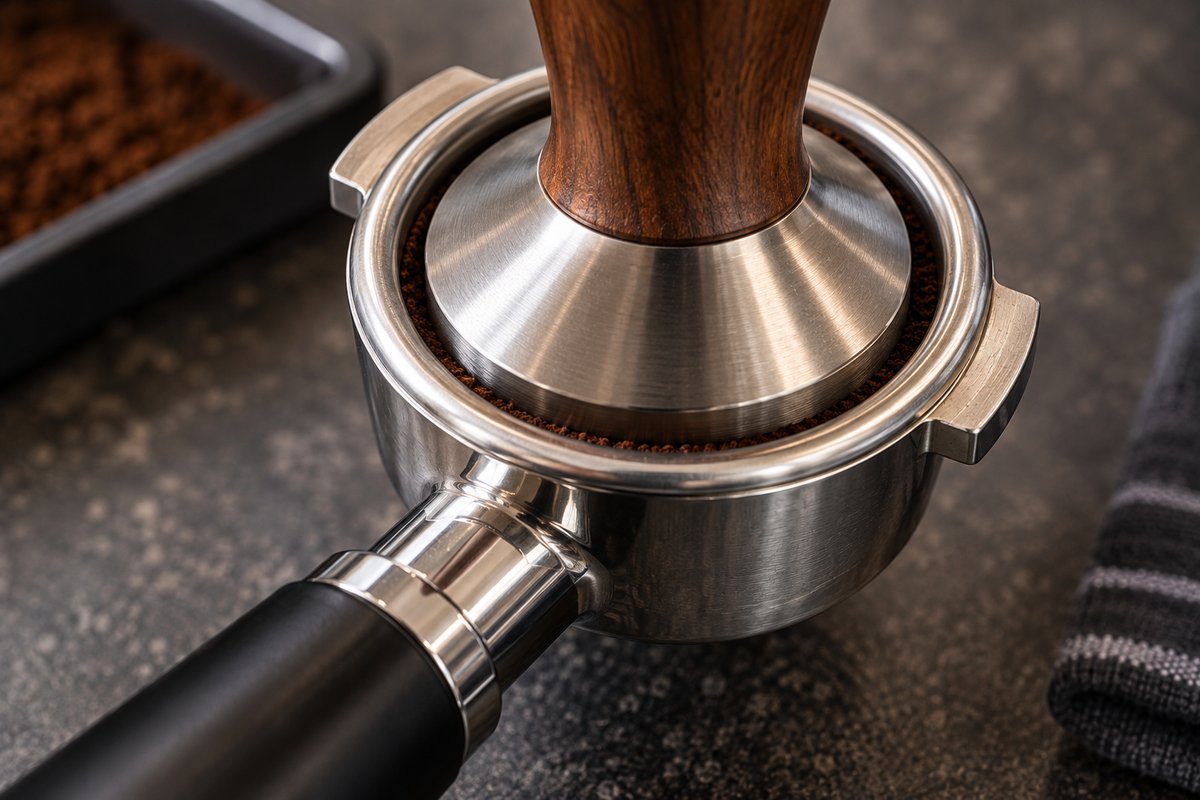
Most of the confusion happens here, because a tamper's stated size and a portafilter's nominal size aren't automatically the same number. A tamper needs to be close to the basket's actual inside diameter, with just enough clearance to move freely without leaving a gap wide enough for loose grounds to collect around the edge.
For a 58mm basket, the actual inside diameter usually measures closer to 58.3 to 58.5mm, so a tamper sized at exactly 58.0mm will feel loose and leave a visible ring of untamped coffee. Most tamper makers sell a 58.35mm or 58.4mm size specifically to fit that wider basket. The same logic applies at every size: check the tamper manufacturer's actual measurement against your basket, not just the rounded number printed on the box.
| Portafilter size | Common machines | Typical matching tamper |
|---|---|---|
| 51mm | De'Longhi Dedica and similar compacts | 50.5mm |
| 53mm | Select European models | 52.5mm |
| 54mm | Breville Barista Express, Barista Pro, Dual Boiler | 53.3mm to 53.7mm |
| 58mm | E61 machines, Rancilio Silvia, Gaggia Classic Pro | 58.3mm to 58.5mm |
Buy from a maker that lists the actual millimeter measurement rather than just "58mm fit," and when in doubt, size down slightly rather than up. A tamper that's slightly too small still compacts the grounds evenly. One that's too big can jam or scrape against the basket wall.
Naked portafilters and sizing
Bottomless (naked) portafilters follow the same sizing rules, since they're built around the same basket diameters, just without the spouted bottom. They're popular for watching extraction in real time and spotting channeling (water rushing through weak spots in the coffee), but they don't change which basket or tamper size you need. If your machine takes 54mm baskets, a bottomless portafilter for it is still 54mm.
Common mistakes people make
Assuming every machine with a large group head is 58mm. Breville's 54mm group heads look substantial next to smaller compacts, which leads people to buy 58mm parts that never fit.
Buying a tamper by its rounded size instead of its actual measurement. Two tampers both marketed as 58mm can differ by a few tenths of a millimeter, which is enough to matter.
Assuming a bottomless portafilter is a universal upgrade. It has to match your machine's existing basket size just like a standard one does.
What to read next
This portafilter size guide covers the sizing side of things, but if you're still deciding what to buy for your setup, Essential Espresso Accessories covers what matters versus what can wait. And if channeling or uneven extraction is the reason you're looking at basket and tamper sizing in the first place, Espresso Tamping and Distribution walks through the technique side of the problem.
Frequently asked questions
What does a portafilter size guide need to tell me?
Mainly two things: which of the four sizes your machine uses, and which tamper diameter matches that basket, since the two numbers aren't always the same.
What is the most common portafilter size?
58mm is the most widespread size across commercial and prosumer machines, though Breville's 54mm standard covers a large share of home machines sold in the US given how popular that lineup is.
Are all 58mm portafilters the same?
No. The nominal 58mm refers to the basket's inside diameter, but basket depth, dosing capacity, and rim design still vary by manufacturer, so parts aren't always interchangeable between brands even at the same stated size.
Can I use a 58mm tamper on a 54mm portafilter?
No. It won't fit inside the basket at all. Tampers need to match the basket they're going into, with only a small amount of clearance.
Does portafilter size affect shot quality?
Not directly, but a mismatched tamper or a leaking seal caused by the wrong basket fit can. The size itself is neutral. Getting the fit wrong is what causes problems.
How do I know if my portafilter is worn out and needs replacing?
Check for a loose fit in the group head, visible wear on the locking lugs, or a basket that no longer sits flush. Any of those is a sign to replace the basket or the whole portafilter rather than keep working around it.
Summary
That's the whole point of a portafilter size guide: sizing looks simple and mostly is, but the number on the box and the actual basket diameter aren't always the same. Check your machine's actual spec before buying anything, measure the basket if you're not sure, and match your tamper to the real diameter rather than the rounded name. Get that part right once, and you won't think about it again.
This guide is part of the Beginner's Essentials hub, which brings together our guides on getting started with espresso at home.