
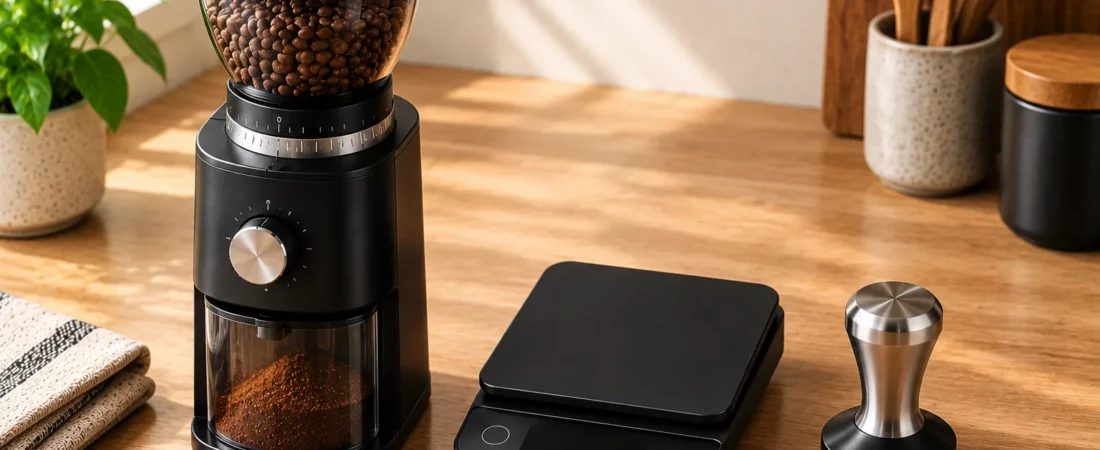
Online coffee forums are full of gear recommendations. Refractometers. Bottomless portafilters. Pressure profiling kits. Puck screens. It is easy to come away thinking espresso requires a small workshop of specialized tools before you can even pull a shot.
It does not. The essential espresso accessories come down to three things: a proper burr grinder, a scale, and a tamper that fits your basket. Everything else is either optional or something you add later once you understand what problem it solves. This article breaks down which is which, and why the order you buy things in matters almost as much as what you buy.
The Three Essential Espresso Accessories You Need
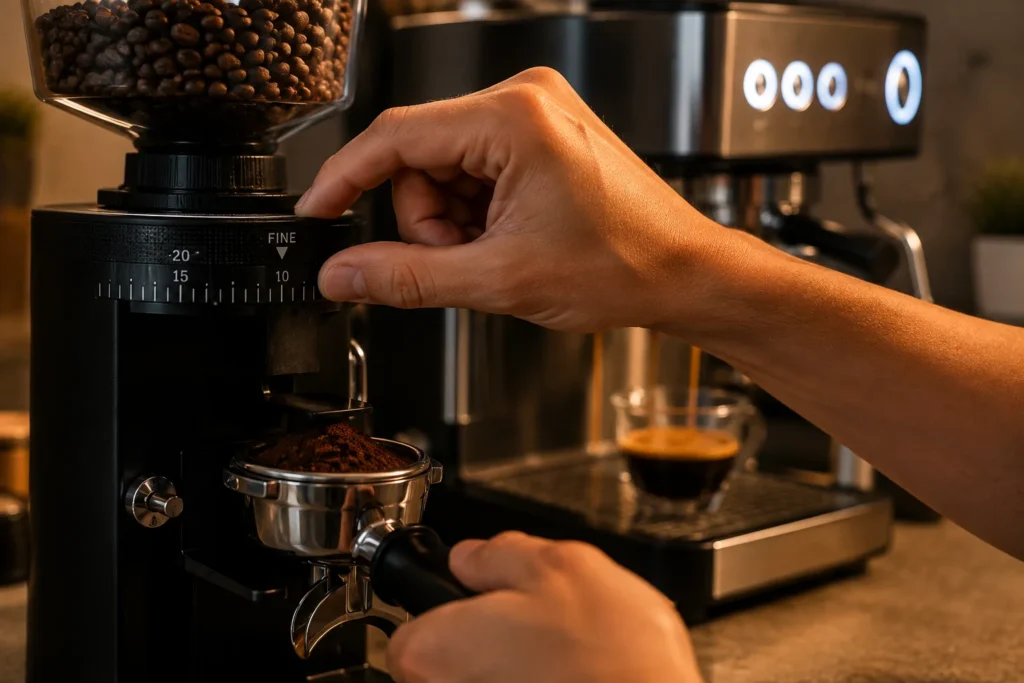
A Burr Grinder
If you take nothing else from this article, take this: the grinder matters more than the machine. Espresso forces hot water through finely ground coffee at roughly 9 bar of pressure for about 25 to 30 seconds (see our full breakdown of how an espresso machine builds that pressure if you want the mechanics). During that short window, particle size consistency decides almost everything about how the shot turns out.
A blade grinder cannot deliver that consistency. It chops beans into a mix of large pieces and dust, and no amount of technique fixes that. Water finds the path of least resistance, rushing through gaps around the big pieces while over-extracting the fine powder around them. The result tastes sour and bitter at the same time, thin in the middle and harsh at the edges. A burr grinder uses two precisely machined cutting surfaces to shave beans into evenly sized particles, which lets water extract properly across the whole puck.
This is why a $50 blade grinder paired with a $600 espresso machine will consistently underperform a $600 machine paired with a $150 burr grinder. The grinder isn't a nice-to-have upgrade. It is the part of the system doing the most work.
A Scale
A scale turns guessing into repeatable technique. Espresso recipes are built on ratios, dose in versus yield out, and without a scale you have no way to know what you did when a shot tastes good, or to fix what went wrong when it does not.
Think of it as a diagnostic tool as much as a measuring one. If a shot runs too fast, weighing your dose tells you whether the problem is too little coffee in the basket or a grind that is too coarse. Without that number, you are left guessing between two different fixes. A basic digital scale accurate to within half a gram is enough. You do not need anything more precise than that to dial in a home setup.
A Tamper That Fits
Tamping (pressing the grounds down firmly) seems like the simplest step in the whole process, which is exactly why beginners get it wrong. The tamper has to match your portafilter basket closely, generally within half a millimeter. A gap that is too loose lets water find a path around the edge of the puck instead of through it, which causes channeling, the same uneven extraction problem a bad grind causes, just from a different source.
You do not need an expensive tamper. A basic one that fits your basket snugly does the same job as a $150 machined one. What you pay above that baseline is mostly aesthetics and feel in the hand, not better extraction.
Why These Three, Specifically
Grinder, scale, and tamper share something the rest of the accessory world does not: each one removes a variable that would otherwise sit between your technique and the result in the cup. A bad grind means you cannot dial anything in, no matter how carefully you do everything else. Skipping the scale means you cannot repeat a good shot or diagnose a bad one. A tamper that does not fit undoes consistent dosing before the water even starts flowing.
Everything covered in the next section is different. Those tools do not remove a variable standing between you and good espresso. At best, they give you more precise information about a process you already have under control.
What Can Wait
A WDT tool. Weiss Distribution Technique, essentially stirring the grounds with a fine needle tool before tamping, helps break up clumps that some grinders produce. If your grinder already distributes grounds evenly, you will not notice much difference from adding one. It is worth five dollars and five minutes to try once you have your grind dialed in, not something to buy on day one.
A bottomless portafilter (one with no spouts, so you can watch the coffee flow). These are diagnostic tools, not requirements. Without the spout that normally hides the underside of the puck, you can watch the shot extract directly and see channeling as it happens. That is useful once you know what you are looking at. For a total beginner, it mostly means a run of messy, spraying shots that teach you less than they frustrate you.
Tamping stations, mats, and dosing funnels. These organize your counter and reduce mess. None of them change what ends up in the cup. Buy them when your workflow annoys you, not before.
Premium tampers. Once your basic tamper fits properly, spending more buys you nicer materials and a better feel in the hand. It does not buy you a better shot. This is the accessory beginners overspend on most often, chasing a solution to a problem the upgrade does not solve.
Refractometers and TDS meters. These measure total dissolved solids to quantify exactly how strong a shot is, which is useful for serious dialing in. They are also unnecessary for someone still learning what a good shot tastes like. Your palate is a better teacher at this stage than a device that reduces the problem to a number.
Quick Answers to the Questions Beginners Ask
Do you need a scale for espresso? Yes, functionally. You can pull shots without one, but you will be guessing at your dose every time, and guessing means you cannot reliably repeat a good result or diagnose a bad one. It is the cheapest of the three essentials, and arguably the one beginners skip most often, usually to their own frustration a few weeks in.
Does a fancy tamper make better espresso? No. Once a basic tamper fits your basket within about half a millimeter, extra spending buys weight, materials, and feel, not extraction quality. Fit is what matters, not price.
Is a cheap grinder good enough to start? Only if it is a burr grinder, not a blade grinder. A cheap burr grinder that produces a consistent particle size will outperform an expensive blade grinder every time. Price matters less here than the grinding mechanism itself.
What to Buy First If Money Is Tight
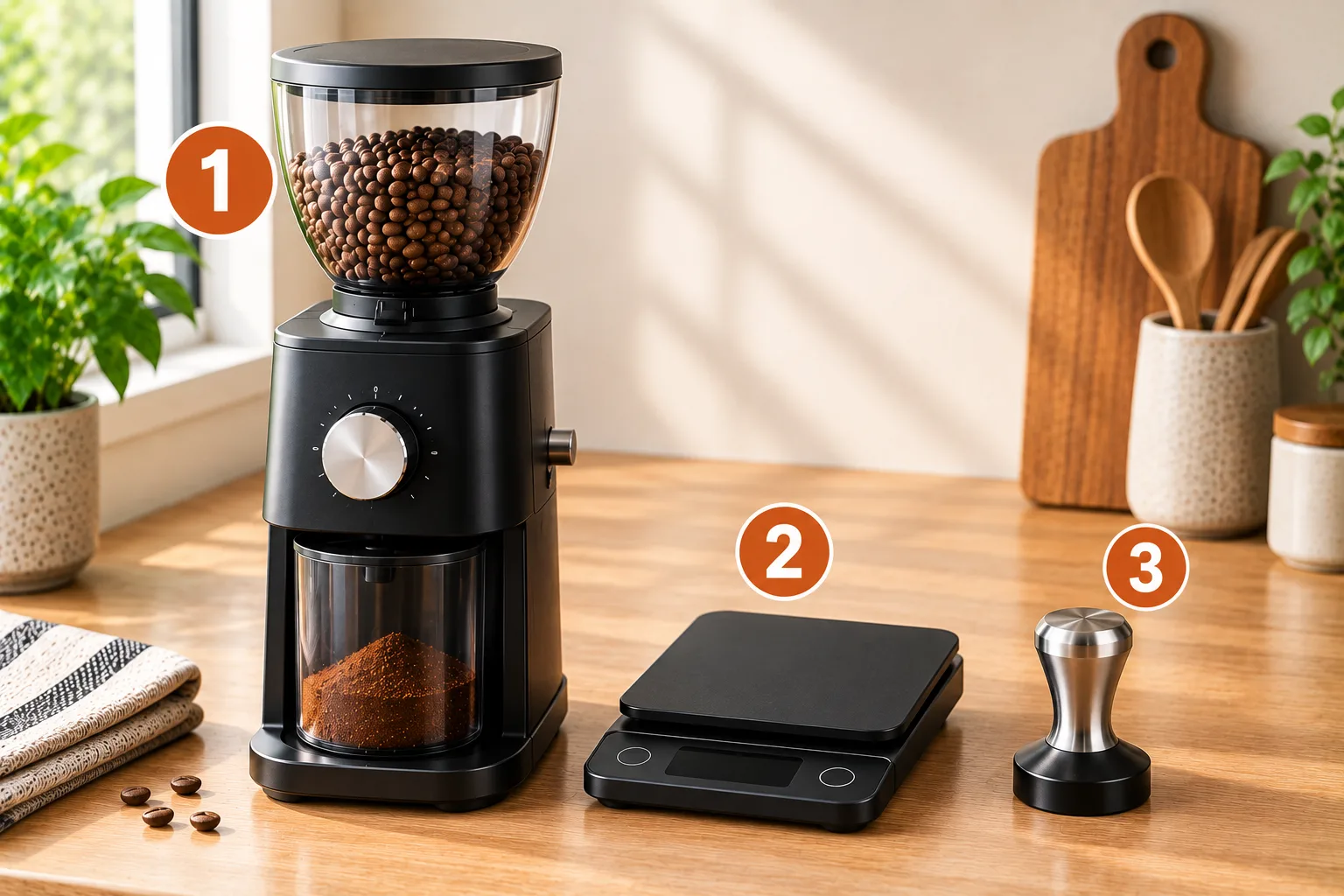
If you can only afford one thing beyond your machine right now, it is the grinder. A great machine cannot fix a bad grind, but a great grinder can produce a solid shot even from a fairly basic machine. If you have not settled on a machine yet, our guide to espresso machine types covers that decision separately. After the grinder, prioritize the scale. It costs the least of the three essentials, and it is the difference between blind guessing and actual troubleshooting. The tamper comes last mostly because a basic one is inexpensive and easy to get right immediately, as long as you check that it fits your basket.
Everything in the what can wait section above should wait until something specific is bothering you about your current setup. A tool that solves a problem you don't have yet isn't a tool. It is clutter.
The Mistake Worth Avoiding
The most common mistake beginners make is not skipping the essentials. It is spending real money on the optional accessories first, because they photograph well and get talked about constantly online, while treating the grinder as an afterthought. A beautiful tamping station next to a blade grinder does not produce good espresso. Get the three fundamentals right, in the right order, and the rest of the gear conversation becomes something you can revisit later with actual experience behind it, rather than something you have to guess your way through now.
Once your grinder, scale, and tamper are sorted, the real work starts: learning what to do with them. That is where dialing in comes in, and it is worth understanding before you spend another dollar on equipment.
Getting your essential espresso accessories sorted in the right order (grinder, scale, tamper) means the rest of the gear conversation can wait. Buy those essential espresso accessories before anything else on your list.
Your tamper needs to match your basket. The portafilter size guide shows how to find your size.
This guide is part of the Beginner's Essentials hub, which brings together our guides on getting started with espresso at home.