
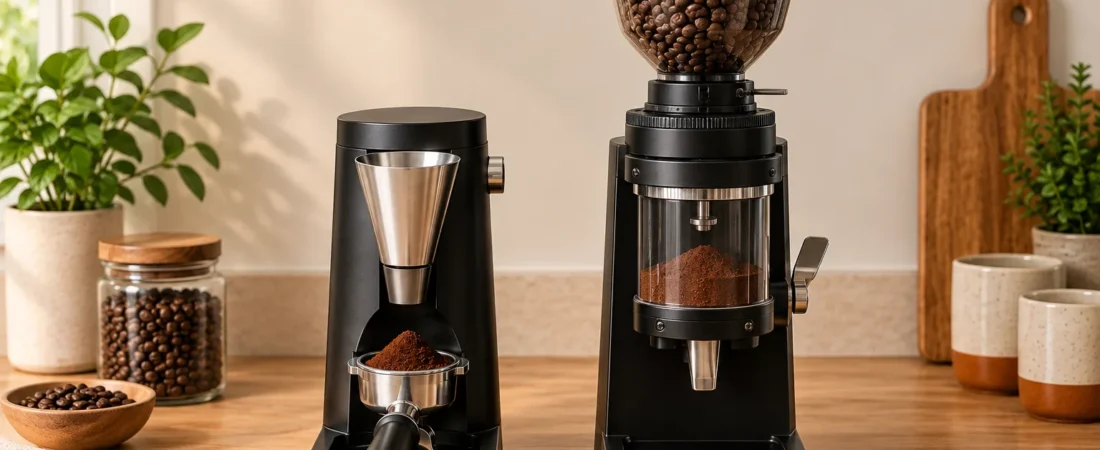
If you've spent any time shopping for a grinder, you've faced this choice: single dose or hopper? A single-dose grinder is a grinder built to grind exactly the amount of coffee you load into it. No hopper full of beans sitting on top, no leftover grounds waiting to come out in your next cup. A dosing (hopper) grinder does the opposite: you fill a hopper once and grind straight from it, dose after dose, for days or weeks at a time. Both grind coffee. How you use them day to day, and what you get out of your beans, is where they split apart.
This isn't just about taste. The two designs solve different problems, and picking the wrong one for your habits means either fighting your equipment every morning or paying for precision you'll never use. This guide covers what each is, where they differ, and how to figure out which one fits your setup.
What Is a Single Dose Grinder?
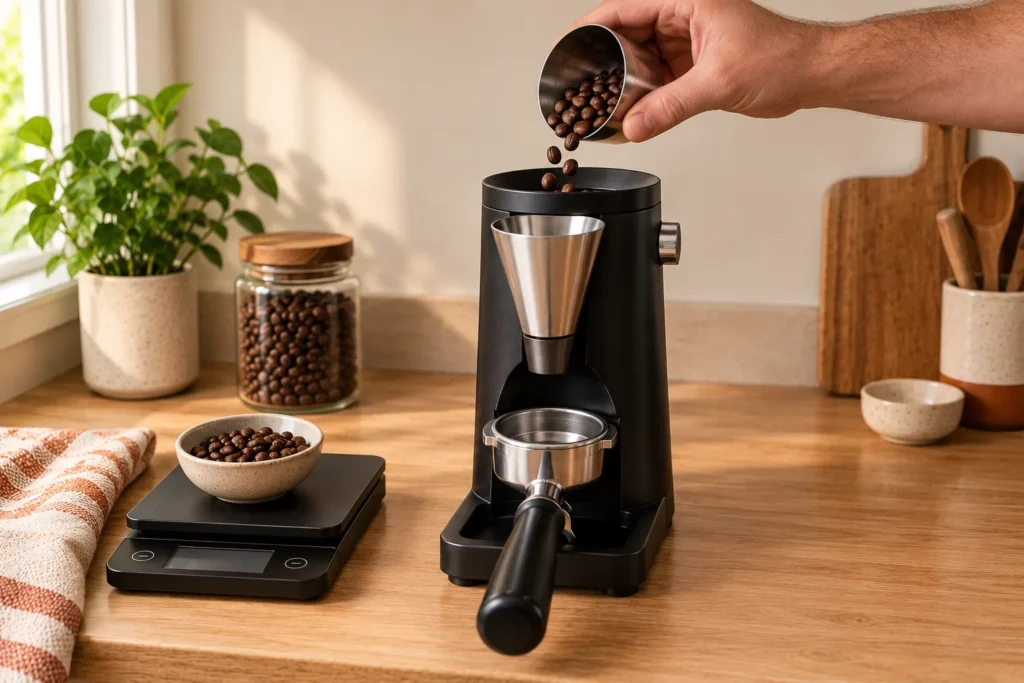
A single dose grinder is built around one idea: you load the exact amount of beans you're about to grind right before you grind, and nothing sits in the grinder afterward. There's no hopper, or if there is one, it's small and meant to be loaded per-dose rather than kept topped off. You weigh out your beans on a scale, drop them into the chamber, grind, and (ideally) get close to all of it out into your portafilter (the handle that holds the basket of coffee) or cup.
Because you're weighing beans in rather than relying on a hopper and a timer or dose counter, single-dose grinding pairs naturally with weighing your dose in grams rather than eyeballing it. That's part of why the category took off alongside the broader shift toward weight-based espresso dosing. If you're already weighing beans, a single-dose grinder just continues that habit through the grinding step instead of interrupting it.
The appeal is straightforward: every dose is freshly measured, nothing goes stale sitting in a hopper, and switching between different beans (say, testing two bags side by side) doesn't mean grinding through a mess of mixed grounds first.
What Is a Dosing (Hopper) Grinder?
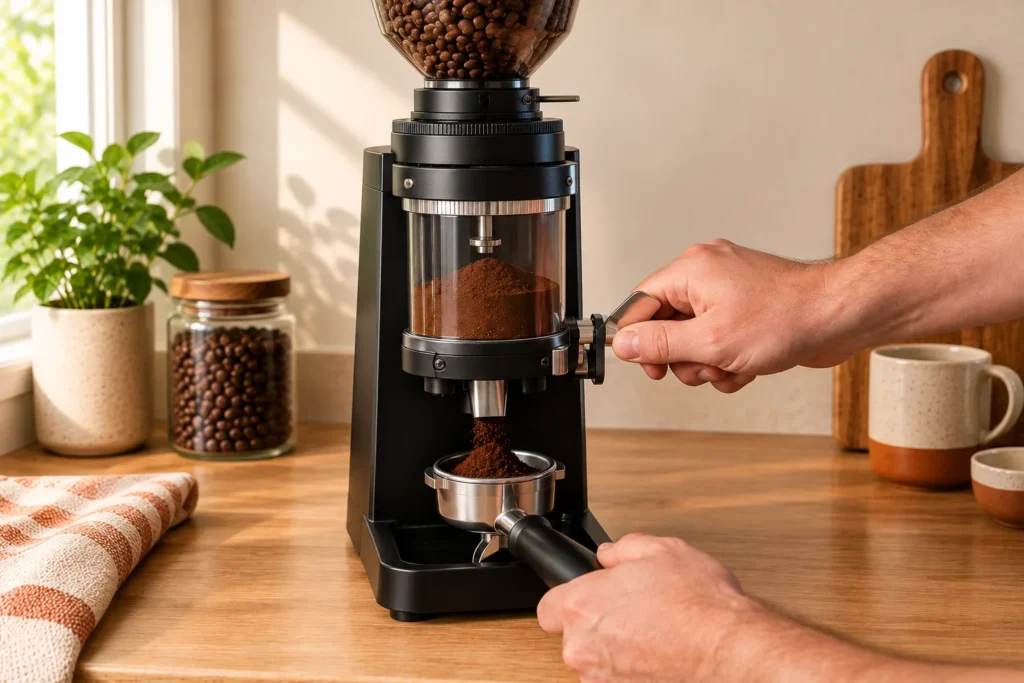
A dosing grinder, sometimes just called a hopper grinder, is built for volume and speed. You fill the hopper with beans, and it stays filled. Every time you want espresso, you press a button or pull a lever, and the grinder feeds beans from the hopper and grinds directly into your portafilter or a dosing cup. No weighing beans beforehand, no loading a chamber. You just grind and go.
This is the format you'll find on most commercial café equipment and on many home grinders built for people who make the same drink, with the same beans, multiple times a day. It's built for repetition and speed, not per-dose customization.
The tradeoff is that beans sitting in an open hopper are exposed to air and light, which means they degas and lose freshness faster than beans kept sealed in a bag until moments before grinding. If you go through beans quickly and stick to one bag at a time, that's a minor issue. If you like rotating between multiple bags or roasters, a full hopper becomes a liability. You either grind through it to switch beans or let part of a bag sit exposed indefinitely.
Retention: The Real Difference Between Them
The term you'll see over and over in single dose grinder discussions is retention. Retention is the ground coffee that stays trapped inside a grinder's chamber and burrs after a dose is finished, instead of coming out with the rest of the grounds. Every grinder has some retention. The question is how much, and what happens to it.
In a hopper grinder, retention matters less because the same beans keep coming through. A few tenths of a gram of stale grounds mixed into the next dose, of the same beans, isn't something you'll usually taste. It's too small to matter in a continuous stream of similar coffee.
In a single-dose grinder, retention matters much more. If you switch beans and a gram of the old grounds is still lodged in the chamber, that's stale, off-profile coffee contaminating your next dose. Because single-dose workflows are often about precision and comparing different beans, that contamination shows up in the cup. This is exactly why low retention is the whole point of the single dose category: minimizing what gets left behind is the design goal that defines it.
The key point: how well a given grinder achieves that goal is not a guarantee that comes bundled with the "single dose" label. Retention depends on burr size, chamber shape, how close the burrs sit to each other, whether the grinder has anti-static treatment on internal surfaces, and other model-specific engineering choices. It doesn't follow some universal rule that single-dose grinders use fundamentally different burr geometry than hopper grinders.
Two grinders marketed as single dose can have meaningfully different retention depending on how their chambers are designed. Many single-dose models are specifically engineered to chase near-zero retention, with funneled chambers, tighter tolerances, and static-reducing coatings, but that's a design choice executed differently from model to model, not an automatic property of removing the hopper.
That's also why you'll see RDT (Ross Droplet Technique, adding a tiny bit of water to beans before grinding) mentioned constantly in single dose circles. It reduces static cling inside the chamber, which helps grounds fall out cleanly instead of sticking to the walls and burrs. It's a workflow habit that compensates for retention, not a fix baked into the grinder itself.
Workflow and Cleaning Differences
Day to day, the two formats feel different to use.
With a single-dose grinder, weighing beans is part of the routine, not an optional extra. You'll want a scale on the counter, and you're loading the chamber fresh for every drink. That adds a step (and a few seconds) to your morning, but it also means you're never grinding more or less than you intend, and switching between bags is as simple as loading different beans. No chamber full of old beans to clear out first, assuming the grinder handles retention well.
With a dosing grinder, the workflow is faster: fill the hopper occasionally, grind on demand the rest of the time. There's no built-in weighing step (though you can still weigh your dose after grinding if you want that precision). It's the better setup if you're making the same drink from the same beans repeatedly and want minimal friction between waking up and having espresso in hand.
Cleaning tends to favor single-dose grinders too, mainly because their whole design is built around clearing the chamber between doses. Brushes, funnels, and sometimes bellows or fans are common accessories specifically for that job. Hopper grinders are typically opened up for a deeper clean less often, since the beans aren't meant to be swapped out constantly, but that also means when you do clean one, there's more built-up residue to deal with.
Which Should You Buy?
This comes down to how you drink coffee, not which format sounds more serious.
A single-dose grinder makes sense if you rotate between different beans or roasters regularly. It also fits if you care about dialing in (adjusting the grind and recipe until the shot tastes right) precisely and want every variable measured, including bean weight. Or you may simply want freshly weighed beans for every single shot rather than beans that have been sitting exposed in a hopper. It's also the more forgiving choice if you only make one or two drinks a day and don't mind the extra 30 seconds of weighing beans.
A dosing grinder makes sense if you stick to one bag of beans at a time and go through it steadily. It also fits if you make multiple drinks a day and want to grind and go without a scale in the loop, or if speed and consistency matter more to you than squeezing out the last percentage point of freshness. It's also generally the simpler, more low-effort option for households where more than one person is pulling shots.
If you're just getting into espresso and aren't sure which camp you're in yet, it's worth reading our guide to the best espresso grinders for beginners. It covers grinders across both formats and will help you figure out what matters for your setup before you commit. And since burr type is a separate decision from single dose vs. hopper, our flat vs. conical burr grinder guide is worth reading alongside this one. You'll want to make both calls together, not just one.
Budget matters here too. Well-designed low-retention single-dose grinders tend to sit at a real price premium over comparable hopper grinders, since the chamber engineering that keeps retention low isn't cheap to manufacture. If you're working with a tighter budget, a hopper grinder, or a manual grinder, which sidesteps a lot of this debate entirely, might get you better grind quality per dollar than a budget single dose model. If you're weighing manual against electric as part of this decision, our manual vs. electric coffee grinder comparison covers that tradeoff directly.
Which One to Buy
A single dose grinder is built to grind exactly what you load, dose by dose, with minimal leftover grounds when it's well designed, and it asks you to weigh beans and load the chamber every time in exchange. A dosing grinder is built for speed and repetition: fill the hopper, grind on demand, and don't think about it again until it's empty. Neither format is objectively better. The right choice depends on whether you value freshness and precision per dose, or speed and simplicity across many doses of the same beans.
If you go the single-dose route, don't assume "single dose" on the box guarantees low retention. That's a per-model engineering outcome, not a category-wide promise. Look at how a specific grinder's chamber is designed, check what other owners report about how clean it runs, and factor in RDT and a cleaning brush either way.
The Espresso Grinders hub has the rest of our guides on grinders for espresso.