
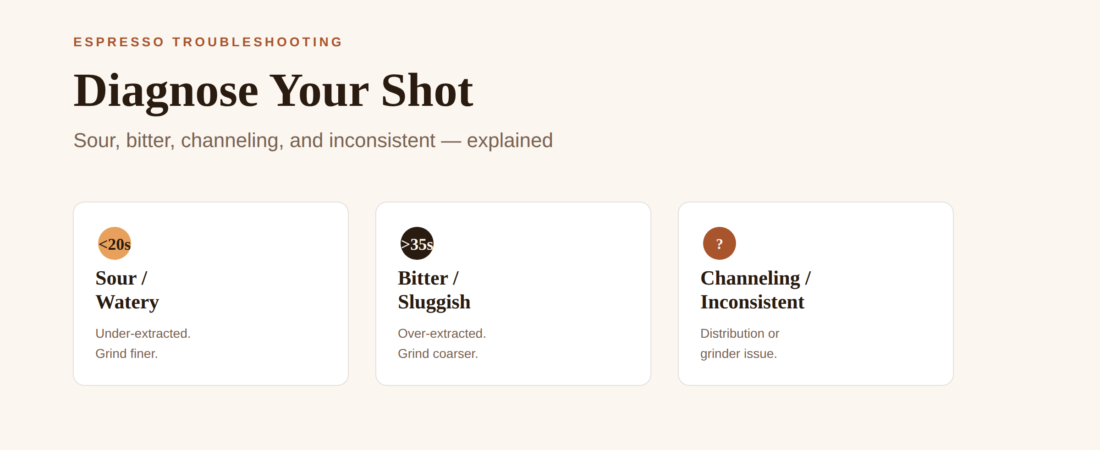
Something’s wrong with your shot, and you don’t know what. It’s sour, bitter, or fine one morning and terrible the next, even with the exact same recipe. The instinct is to blame the machine or the beans. Most of the time, the actual cause is one of three things: grind size, dose and distribution, or extraction time â and once you know which one, the fix takes thirty seconds.
This guide walks through the five problems that cause almost every bad shot at home: sour or watery shots, bitter or sluggish shots, channeling, inconsistency between shots, and â when none of those explain it â how to tell whether you’re dealing with a technique problem or an equipment problem. Read your shot, match it to the section below, and change one thing at a time.
Sour or Watery Shots
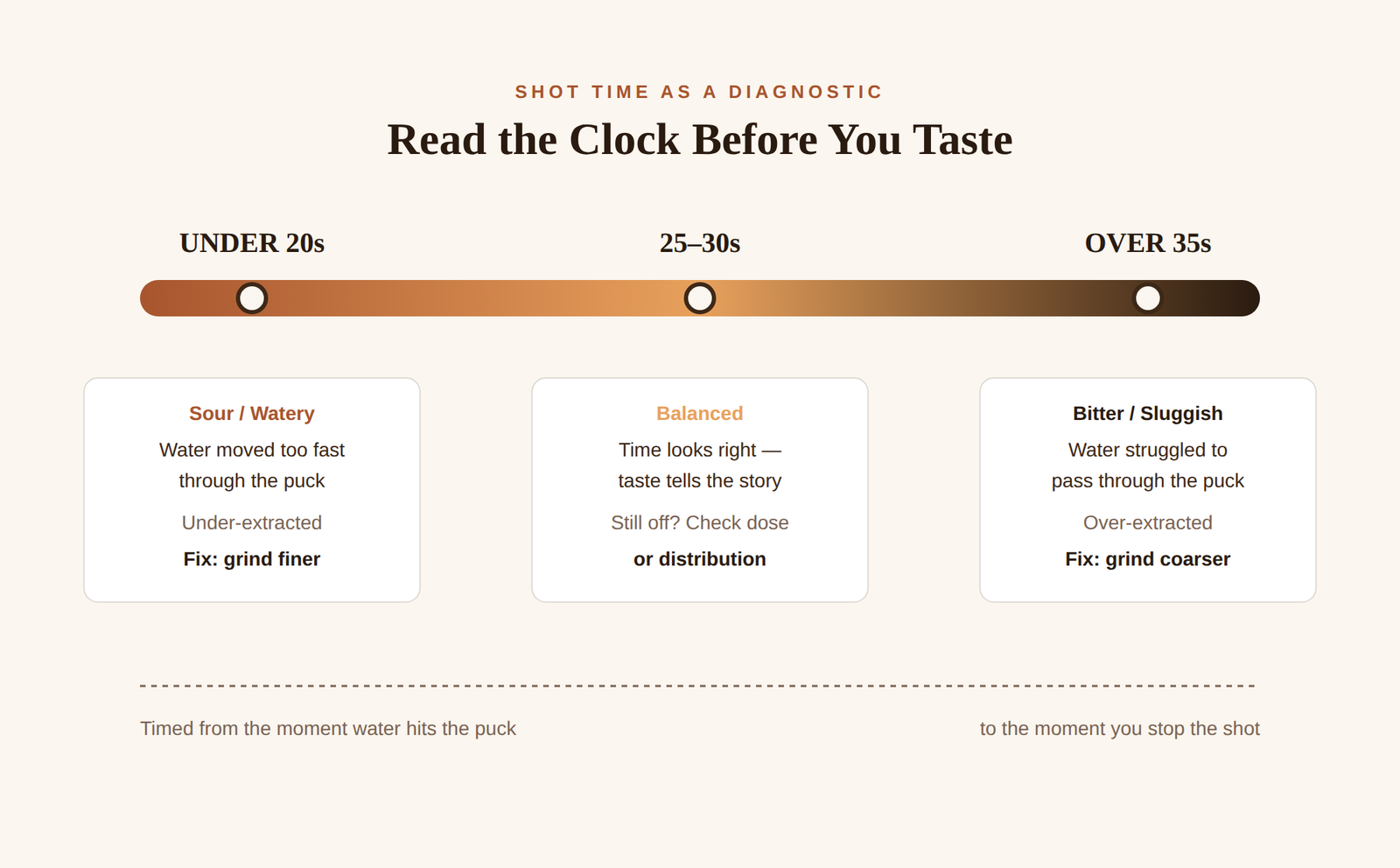
A sour shot tastes sharp and thin, more like unripe fruit or vinegar than coffee. A watery shot tastes weak and hollow, like the flavor never showed up. Both point to the same root cause: under-extraction. Not enough of the coffee’s soluble compounds made it into the cup before the water passed through.
Check your shot time first. If it ran under 20 seconds for a standard double, the water moved through the puck too fast to pull enough flavor out â that’s under-extraction from insufficient contact time, not a flaw in the beans. The fix is to grind finer. A finer grind packs the puck tighter, slows the water down, and gives it more time in contact with the coffee.
If your shot time already looks normal (25 to 30 seconds) but it still tastes sour, the problem is more likely dose or distribution than grind alone. A dose that’s too low for your basket, or grounds that are unevenly distributed before the tamp, both extract less coffee than the recipe assumes even when the clock says everything went fine. Weigh your dose against your basket’s rated capacity before you start adjusting grind size â an 18g dose in a 20g basket will run fast and taste thin no matter how fine you grind.
Grind one or two steps finer, pull another shot, and taste again. If sourness persists after several finer adjustments and the shot is now running past 30 seconds, stop adjusting grind and look at your beans â very light roasts and very fresh beans (under 4 days off roast) can taste bright in a way that resembles sourness even when your extraction is technically correct.
Bitter or Sluggish Shots
A bitter shot tastes ashy, burnt, or dry on the finish, sometimes with a lingering harshness that coats your tongue. It’s the mirror image of sour: over-extraction, where too much came out of the coffee, including compounds that only turn up late in the extraction and taste unpleasant on their own.
Shot time is again the fastest diagnostic. If your double is running past 35 seconds, or the espresso is dripping out in slow, sluggish drops instead of a steady stream, the grind is too fine. A fine grind packs the puck so tight that water struggles to pass through, and the extra time in contact pulls out compounds you don’t want. Grind one or two steps coarser and try again.
If the shot time looks normal but it still tastes bitter, check your machine’s brew temperature before touching the grind further. Water that’s too hot accelerates extraction of bitter compounds even at a correct grind and time â this is a common issue on machines without solid temperature stability, especially early in a session before the group head has fully warmed up. Pulling a blank shot to heat the group, then waiting a minute before your real shot, fixes this on most home machines without buying anything.
Dark roasts are also just more prone to reading as bitter than medium or light roasts at the same extraction percentage â if you’ve correctly dialed in the grind and time and it’s still harsher than you’d like, that may be the bean, not your technique.
Channeling
Channeling is different from a simple sour or bitter shot â it’s a distribution problem, not a grind problem, and grinding finer or coarser won’t fix it. You’ll usually see it before you taste it: the espresso doesn’t flow as one even, syrupy stream. Instead, it squirts unevenly out of the portafilter spouts, sometimes running noticeably faster on one side of the basket than the other, or spraying rather than pouring.
What’s happening underneath is that water is finding a path of least resistance through the puck â a crack, a low-density spot, a gap along the basket wall â and rushing through it while barely touching the coffee everywhere else. The result tastes both sour and bitter at once: thin and sharp from the channeled water that barely touched any coffee, with a harsh edge from the small pockets that got wildly over-extracted. It’s the most confusing shot to diagnose because it doesn’t respond to grind adjustments the way sour or bitter shots do.
The cause is almost always distribution and tamping, not grind size. An uneven pile of grounds in the basket, a tamp that goes in crooked, or knocking the portafilter against something after tamping (which cracks the puck) all create the uneven density that channeling needs to happen. The fix is upstream of the tamp: distribute the grounds evenly before you compress them. A quick WDT pass â stirring the loose grounds with a fine needle tool to break up clumps â combined with a level, straight-down tamp solves most channeling at home without any new equipment.
If you’re tamping level and distributing evenly and still seeing channeling, check your basket. A basket with an uneven hole pattern or a puck that’s noticeably smaller than the basket diameter (from too light a dose) can channel even with perfect technique â worth ruling out before you assume it’s you.
Inconsistent Shots
This is the most frustrating problem because it looks like there’s nothing to fix â you did everything the same way you did yesterday, and today’s shot tastes completely different. Same dose, same grind setting, same tamp, different result.
When the recipe is genuinely identical, and the outcome still varies shot to shot, the grinder is the most common culprit, not your technique. A few specific grinder issues cause this:
Retained grounds â old coffee sitting in the chute or around the burrs from a previous grind â mix into your fresh dose in inconsistent amounts each time, changing the effective grind distribution shot to shot. Purging a few seconds of grounds before collecting your dose, or pulling the hopper and clearing the chute periodically, reduces this.
Static is another common cause, especially in dry climates or dry indoor air in winter â grounds cling to the chute walls and portafilter instead of falling cleanly, so your actual dose varies even when your scale reads the same number going into the hopper. A small amount of water on the beans before grinding (the RDT method â a spray bottle, one or two mists on the beans) cuts static dramatically.
If neither of those explains it, consider bean age and storage. Beans that are degassing rapidly (very fresh, under 4 days off roast) or beans that are stale and losing aromatics both extract less predictably than beans in their stable window, roughly 5 to 21 days off roast for most home setups.
Is It Technique or Equipment?
Most espresso problems at home are technique problems, not equipment problems â but some genuinely are equipment issues, and knowing the difference saves money on upgrades you don’t need. Here’s a simple framework before you consider buying anything.
It’s very likely technique, not equipment, if you can get a good shot sometimes, just not consistently. If the machine and grinder are capable of a great shot on a good day, they’re capable of it every day â the variable is your process, not the hardware. Work through the sections above methodically, changing one variable at a time, before assuming you need new gear.
It’s worth suspecting equipment if: your grinder can’t get fine enough to stop a shot from running fast even at its finest setting (common on cheaper blade or entry-level burr grinders), your machine’s pressure or temperature visibly drifts mid-shot, or you’re seeing the same problem across different beans, different doses, and different tamping approaches with no change in outcome. A grinder that’s run out of adjustment range is the single most common real equipment limitation at home â it’s worth ruling this out specifically before blaming the machine.
Water quality is the equipment-adjacent issue people miss most often. Very hard or very soft water changes extraction in ways that mimic a grind problem, and no amount of grind adjustment fully corrects for bad water. If you’ve worked through every section above and something still feels persistently off, test your water or switch to a bottled or filtered option formulated for espresso before assuming your gear needs replacing.
Espresso Troubleshooting: Putting It Together
Every troubleshooting session follows the same order, regardless of which problem you’re chasing: taste the shot, check the time, identify which of the five problems above it matches, change one variable, and taste again. Sour and watery point to under-extraction and usually a finer grind. Bitter and sluggish point to over-extraction and usually a coarser grind or a temperature check. Channeling points to distribution, not grind. Inconsistency points to the grinder’s retained grounds or static, not your recipe. If none of that explains it after a fair test, it’s worth asking whether the equipment itself has reached its limit.
Common Mistakes When Troubleshooting
Changing more than one variable at once is the biggest mistake people make when troubleshooting espresso â adjust the grind and the dose in the same pull, and you have no idea which change actually fixed (or worsened) the shot. Change one thing, taste, and only then decide on the next change.
The second-biggest mistake is judging a shot on a single pull. Grinders and pucks have some natural shot-to-shot variance â pull two shots at any new setting before deciding it’s dialed in or still off, especially if the first shot came right after a grind adjustment.
The third is skipping the shot-time check. Taste alone can point you in the wrong direction â a shot can taste bitter for reasons that have nothing to do with over-extraction (temperature, bean roast level), and grinding coarser in response to bitterness without checking the time first can push a correctly timed shot into actual under-extraction.
What to Check Out Next
If troubleshooting keeps leading you back to grind and ratio, revisit the fundamentals: How to Dial In Espresso covers dose, yield, and extraction time in more depth, including the brew ratio and taste map this guide builds on. And if you’re newer to espresso generally, What Is Espresso? covers the basics this guide assumes you already know.
The Final Take
Almost every bad shot at home traces back to one of five things: under-extraction, over-extraction, channeling, an inconsistent grinder, or â rarely â genuine equipment limits. None of them require guesswork once you know what to check. Taste the shot, check the clock, match it to a section above, change one thing, and taste again. That loop, repeated a few times, fixes more espresso than any new piece of gear will. That loop is the core of espresso troubleshooting, and it works whether the shot is sour, bitter, or just inconsistent.
For the underlying variables that every one of these fixes is ultimately adjusting, Wikipedia’s overview of espresso covers the pressure, temperature, and grind interactions behind extraction.