

Espresso extraction time for a standard shot is about 25 to 30 seconds. That is the target most guides give for a 1:2 shot, such as 18 g of coffee in and 36 g of espresso out. Some guides allow 25 to 35 seconds, and lighter roasts can run longer and still taste good. The clock is a check on your grind, not a goal of its own. If the shot tastes balanced, the time it took is the right time for that coffee.
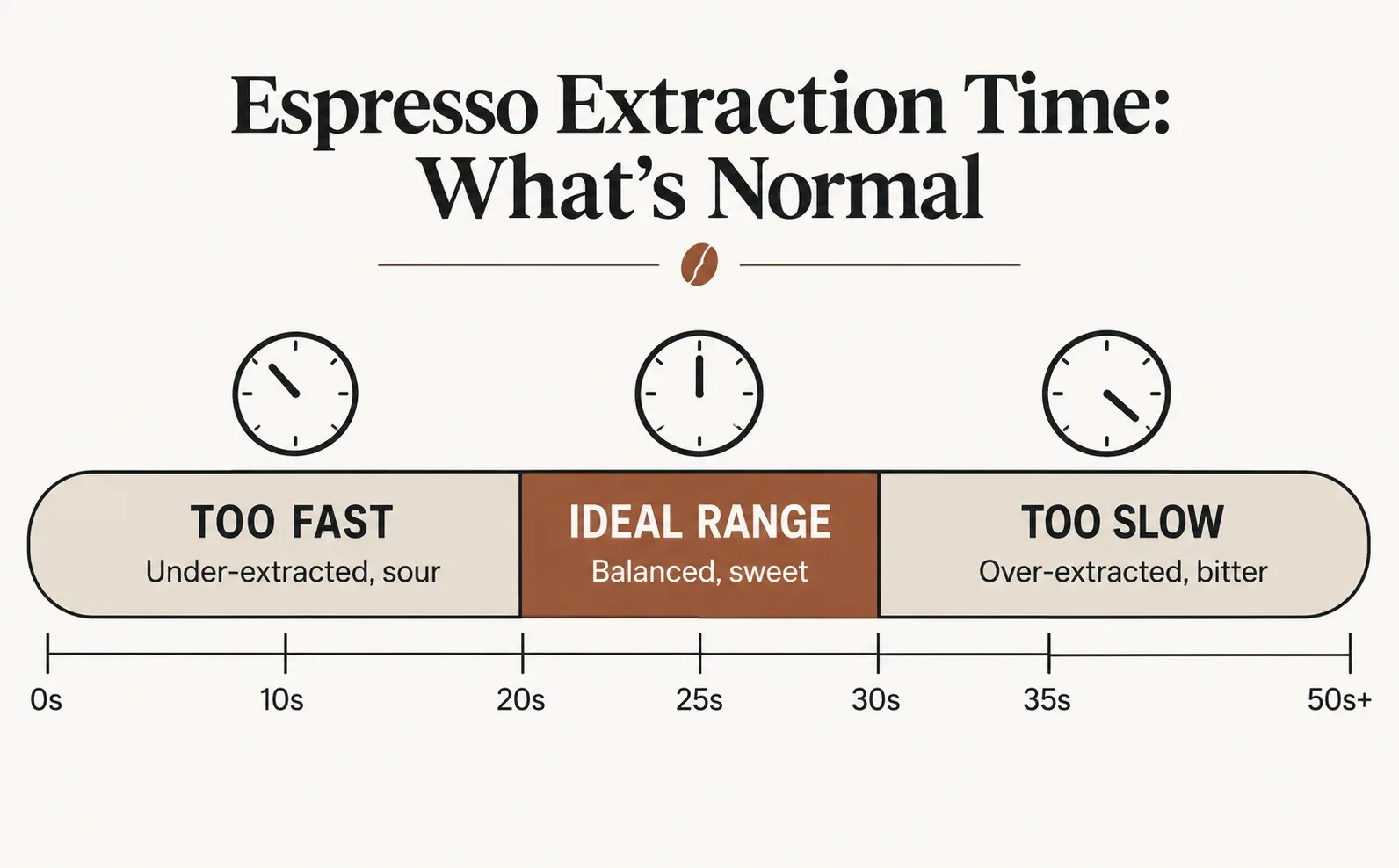
Espresso extraction time at a glance
Use this table to read a shot from its time. The time tells you what probably happened. Taste tells you whether it matters.
| Shot time (1:2 ratio) | What it usually means | Likely taste | What to change |
|---|---|---|---|
| Under 20 seconds | Under-extracted. Water ran through too fast. | Sour, thin, sometimes salty | Grind finer. Check the dose is not light. If it sprayed, check puck prep for channeling. |
| 20 to 25 seconds | A little fast | Bright, can turn sharp | If it tastes sour, grind slightly finer. |
| 25 to 30 seconds | The usual target | Balanced, if the rest is dialed in | Let taste decide. Sour means pull a little more yield. Bitter means a little less. |
| 30 to 35 seconds | A little slow, still fine for many coffees | Fuller, can start to turn bitter | If it tastes bitter, grind slightly coarser. |
| Over 35 to 40 seconds | Over-extracted. Water stayed in the coffee too long. | Bitter, dry, harsh | Grind coarser. Check the dose is not too high for the basket. |

Check your shot time and ratio
Enter your dose and ratio to get a target yield and the usual espresso extraction time. Add your shot time, and your yield if you weighed it, to see what the numbers suggest and what to change.
Shot time and ratio checker
Time ranges are a starting point from published dialing in guides. Taste has the final say.
Shot time checker by Dial In Espresso · dialinespresso.com
When to start the timer
Espresso extraction time depends on when you start counting. Most guides start the clock when the pump starts, which is when hot water first meets the coffee. Some baristas start it at the first drops in the cup instead. The first drops usually appear a few seconds after the pump starts, so the two methods give different numbers for the same shot.
Either way works if you always do it the same way. The 25 to 30 second guideline assumes you start at the pump. If your machine has preinfusion, a slow, low-pressure soak at the start, that time is part of the shot and counts toward the total.

What espresso extraction time measures
Extraction time is how long it takes the water to push through the puck (the pressed cake of coffee grounds in the basket). It is a stand-in for how much resistance the puck offers. A finer grind packs more tightly and slows the water. A coarser grind lets it through faster. A heavier dose or a firmer, more even puck slows the shot. A lighter dose speeds it up.
Time alone does not tell you whether extraction was good. Pair it with the brew ratio and it tells you much more. An 18 g dose that gives 36 g in 28 seconds is behaving as expected. The same dose and yield in 15 seconds means the water found an easy path, which is usually channeling, not a good fast shot.
Why 25 to 30 seconds became the reference
The 25 to 30 second window is a long-standing rule of thumb. It works as a middle ground: slow enough to avoid the sourness of a rushed shot, fast enough to avoid the bitterness of a long one, for a wide range of beans and machines. It is a starting point, not a law. Many good shots run a little faster or slower, especially with light roasts.
Treat the window as the place to start. If a shot inside 25 to 30 seconds still tastes sour or bitter, the time is not the problem. The grind, dose or ratio is. If your shots keep coming out sharp, our guide to sour espresso walks through the fixes.
Time is a symptom, not a cause
There is no dial for shot time. If a shot runs in 18 seconds, you do not make it slower directly. You grind finer, which adds resistance, and the time goes up as a result. A shot dragging past 40 seconds works the same way in reverse: grind coarser, and the time comes down.
This is why watching the clock without tasting leads people astray. A 27 second shot that tastes flat or sour is not correct just because the number matches. Time confirms your grind and dose are in a sensible range. Taste tells you whether the shot worked. See how to dial in espresso for how grind, dose and yield work together.
Common mistakes with espresso extraction time
Treating the window as pass or fail. Changing the grind until the clock matches, even when the shot tastes wrong, is the most common mistake.
Starting the timer at different points. Timing from the pump one day and from the first drops the next makes shots look inconsistent when they are not.
Comparing times across coffees. A 22 second shot on a light roast and a 30 second shot on a dark roast can both be well dialed in for those beans.
Ignoring a fast shot that sprays. A very fast shot with spurting or uneven streams is usually espresso channeling, which is a puck prep problem. Fix tamping and distribution before you change the grind.
Espresso extraction time: putting it together
Start a new coffee at 1:2 and aim for about 25 to 30 seconds. Taste the shot, then adjust the grind: finer if it is sour and thin, coarser if it is bitter and harsh. Let the time land wherever that change puts it. Once the shot tastes balanced, that time is the right one for that coffee, on that machine, that day.
Time is half of the recipe. Our guide to the espresso brew ratio covers the other half.
For more on dialing in a shot, see the Dialing In & Technique hub.
What to read next
For how shot time fits with grind, dose and yield, start with How to Dial In Espresso. If the time looks right but the taste is not, the espresso taste map and the espresso troubleshooting guide walk through reading the cup back to the cause.
Where these numbers come from: Dialling In Basics (espressoaf.com), Dialing In Espresso By Taste (Clive Coffee) and Timing Espresso Shots (Bean Ground).