
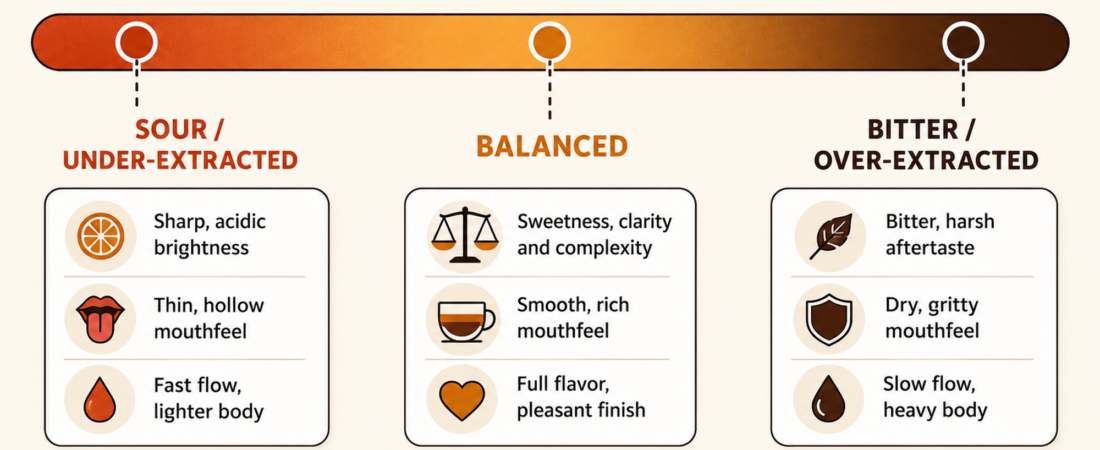
The espresso taste map is the fastest diagnostic tool you have, and every shot leaves a trail of evidence in the cup, and most people throw it away without reading it. The espresso taste map is a simple way to read that evidence: sour and bitter aren’t just flavors to avoid; they’re diagnostic signals pointing at exactly which variable to change next. Once you can place a shot on the sour-to-bitter spectrum and connect it to a cause, dialing in stops being trial and error and starts being a short, deliberate process.
This guide covers how to read sour, bitter, and balanced shots, why both ends of the spectrum can show up in the same cup at once, and how to use taste as the final word over grind size, ratio, and extraction time.
Sour: The Under-Extraction Signal
A sour shot tastes sharp, tangy, sometimes almost like unripe fruit or vinegar, and it’s usually thin-bodied with a short finish. Sourness means under-extraction: water moved through the puck too quickly or too easily, pulling out the acidic compounds that dissolve first while leaving behind the sugars and deeper flavors that need more contact time to extract. It’s the coffee equivalent of pulling a tea bag out five seconds after dropping it in.
The fix is almost always to grind finer, which increases resistance and slows the water down, giving it more time and surface contact to pull out the remaining flavor compounds. Check extraction time too. A sour shot finishing well under 20 to 25 seconds confirms the water moved through too fast.
Bitter: The Over-Extraction Signal
A bitter shot tastes harsh, dry, sometimes ashy or burnt, and it often lingers unpleasantly on the palate long after the sip. Bitterness means over-extraction: water spent too long in contact with the grounds, pulling out the harsher compounds that only release late in the extraction, after the sweetness and acidity have already come through. Those compounds exist in every coffee. The question is whether you extracted them along with everything else, or stopped before you got there.
The fix is to grind coarser, reducing resistance so water moves through faster and spends less time pulling out those late-stage bitter compounds. A bitter shot dragging past 35 to 40 seconds is a strong confirming signal alongside the taste.

Balanced: What You’re Actually Aiming For
A balanced shot has a rounded sweetness up front, a gentle acidity that reads as bright rather than sharp, and a clean finish without harsh or ashy notes lingering afterward. It’s not flavorless or neutral; good espresso still has plenty of character; it just doesn’t lean hard toward either sour or bitter. This is the target you’re adjusting grind size toward: not a specific time on the clock, not a specific ratio on paper, but this taste in the cup.
When Sour and Bitter Show Up Together
Confusingly, a shot can taste both sour and bitter at once. Sharp and harsh in the same sip, with little of the sweetness that should sit between them. This combination almost never means “extract more and less at the same time”; it’s the signature of channeling. Water found a low-resistance path through part of the puck (under-extracting that section, tasting sour) while barely touching a denser section (over-extracting the little it did reach, tasting bitter). The fix isn’t grind size. It’s distribution. Uneven grounds in the basket are the usual cause, and a WDT pass before tamping is the most reliable fix.
Using Taste as the Final Word
Grind size, dose, ratio, and extraction time are all useful levers, but taste is the only measurement that actually matters. The others are just ways to get there faster and more predictably. If a shot lands inside the “correct” ratio and time window but tastes sour or bitter, trust the cup over the numbers and adjust grind accordingly. If a shot tastes balanced but the time or ratio looks unusual, that’s fine too. Every bean, roast level, and machine combination lands in a slightly different place, and the taste map doesn’t care what the textbook says the numbers should be.
Common Mistakes
The most common mistake is treating sour and bitter as opposite problems that need opposite fixes in isolation, without checking whether channeling is the real cause of a shot that tastes like both at once. A close second is confusing a genuinely under-extracted sour shot with just a naturally bright, light-roast coffee. Not every acidic cup is a mistake, and tasting the same coffee side by side at two different grind settings is the fastest way to tell the difference. Chasing a specific time or ratio instead of tasting the shot is the last major trap; the numbers are diagnostic tools, not the goal.
The Espresso Taste Map: Putting It Together
Taste the shot first. Sharp and thin means under-extracted. Grind finer. Harsh and dry means over-extracted. Grind coarser. Both sour and bitter in the same sip usually means channeling. Fix distribution before touching grind. Balanced and clean means it’s dialed in, regardless of what the clock or the ratio says. Every other variable in this series exists to help you get to that cup faster and more consistently, but the cup is always the final answer.
What to Check Out Next
For how grind, dose, and yield work together as one system, start with How to Dial In Espresso. For the ratio side of the equation, see Espresso Brew Ratio Explained, and for reading shot time as a diagnostic, see Espresso Extraction Time. If channeling or streaky shots keep showing up, Tamping and Distribution covers the WDT fix in depth, and Espresso Troubleshooting walks through more shot defects beyond taste alone.
For the extraction science behind why the same shot can taste sour at one end and bitter at the other, Wikipedia’s overview of espresso covers how pressure, temperature, and contact time shape what ends up in the cup.